Landless squatters descend on Kathmandu to protest evictions
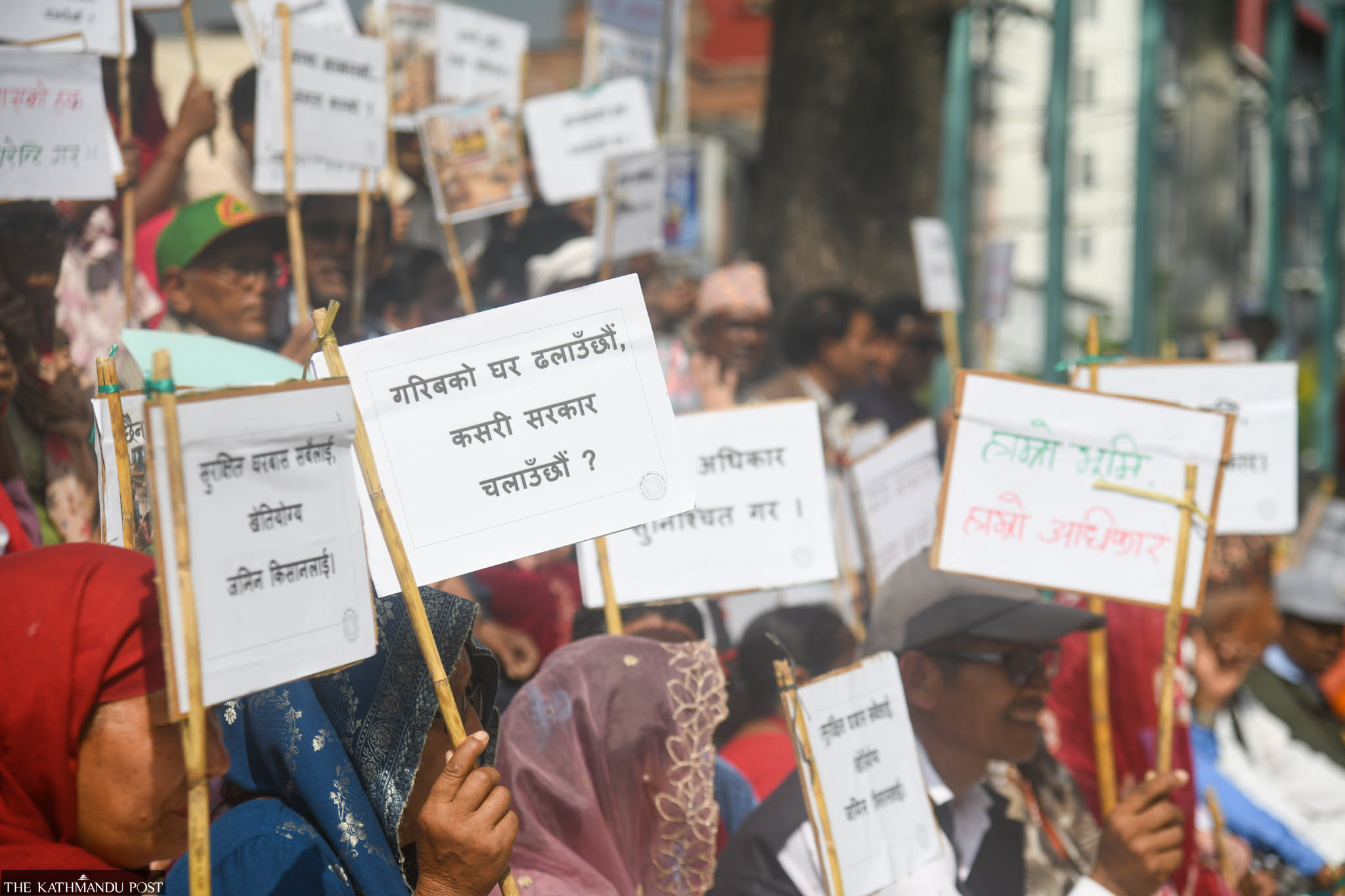
Protesters from all seven provinces accuse the government of displacing communities without resettlement plans. Representatives from landless communities across 20 districts protest at Maitighar, Kathmandu on Monday. Deepak KC/TKP
Landless squatters and informal settlers from different parts of the country have arrived in Kathmandu to protest nationwide eviction campaigns.
As part of their protest, launched amid fears that bulldozers could reach their own settlements and that they could be the next target, they say they will share stories of hardship and displacement with the government.
Gathering at Maitighar Mandala in the federal capital, they are asking the state why they are being removed from the land where they live without proper rehabilitation. They say they feel betrayed, claiming promises made by Prime Minister Balendra Shah before the election were reversed within a month.
Forced evictions carried out without clear justification or alternative arrangements have triggered protests among landless and informally settled communities across Nepal.
Since the government led by PM Shah began demolishing settlements of landless squatters and informal settlers in the Kathmandu Valley, many families have been rendered homeless, and the eviction drive has expanded across the country.
Under the leadership of the National Land Rights Forum (NLRF) Nepal, around 100 representatives from landless communities across 20 districts in all seven provinces gathered at Maitighar to warn the state and express solidarity with protests against eviction drives.
The protesters chanted slogans such as: “Manage the landless, don’t displace them”, “End injustice, do not demolish the homes of the poor”, “Stop forced evictions, stop bulldozer terror”, “If the land belongs to the government, who do the people belong to?”, and “Our land, our rights, the foundation of our lives and livelihoods.”
They say government policies and actions contradict each other. Clause 91 of the government’s 100-point reform agenda, issued on March 27, states that within 60 days, the government would complete an integrated digital record and verification of landless squatters and unmanaged settlers nationwide.
The agenda also pledges household surveys in coordination with local governments to resolve landlessness within 1,000 days, establish criteria to identify genuine beneficiaries, update records of public and Guthi land, create digital databases and maps, distribute land to verified squatters in phases, and provide integrated housing alternatives in densely populated urban areas.
It further promises a public dashboard to ensure transparency in land distribution and rehabilitation, with direct monitoring and implementation by relevant ministries.
In contrast, the government deployed thousands of security personnel and bulldozers in the Kathmandu Valley from April 25 onwards to demolish homes of squatters and informal settlers.
Protests are ongoing in districts including Kaski, Mahottari, Dhanusha, Sarlahi, Banke, Bardiya, Surkhet, Rautahat and Makawanpur.
“We have been raising the voice that landless squatters and unmanaged settlers should be properly managed, not displaced,” said Lyam Bahadur Darji, chairperson of the NLRF’s Parbat branch. “After the new government came to power, we believed there would be proper management for landless communities. But the result has been the opposite. The government’s first action has been against poor and vulnerable people. Protests are continuing across the country, and we have gathered at Maitighar to make the government hear our pain.”
Activists say forced evictions, by labelling long-settled landless families and unmanaged settlers as encroachers, have pushed genuine squatters into deeper hardship.
Parbati Thami, NLRF treasurer in Sindhupalchok, said the government has displaced people and placed them in holding centres instead of rehabilitating them properly.
“The government should manage evicted people properly, but instead it has displaced them and left them stranded,” she said.
Some protesters at Maitighar questioned whether the state intends to push all landless and unmanaged settlers onto the streets.
Landless squatters and informal settlers living in areas including Kalopul, Thapathali, Gairigaun, Balkhu, Manohara, Balaju, Banshighat, Gaushala, Shankhamul, Swayambhu, Kalimati, Dhobikhola, Kapan, Tenzing Chowk, Sattale and Krishna Mandir in the Kathmandu Valley have reportedly been forcibly displaced and moved to holding centres.
Activists claim more than 20,000 squatters from around 3,500 families have been displaced in the Valley alone. However, Kathmandu Metropolitan City has yet to complete an official record of those affected.
Outside Kathmandu, pressure has also increased following directives from the Ministry of Home Affairs instructing officials to clear encroached public and government land. On April 30, the Ministry of Federal Affairs and General Administration directed local governments to coordinate with district administrations to identify, verify and manage squatters living on public land.
Following these directives, some municipalities began using bulldozers to remove settlements, while others issued public notices, creating fear among residents.
Phaud Singh Syangba, general secretary of NLRF Mahottari, said the directives have increased anxiety among landless communities.
“The government should protect the housing security of people who have lived in places for years,” he said. “Instead, by evicting them, it has pushed them into greater fear and risk. Forced displacement does not solve the problem. If there is a valid reason to relocate people, the state must first provide acceptable alternatives and proper rehabilitation. Evictions without alternatives seriously violate the right of squatters to live with dignity.”
Several protesters shared personal stories of uncertainty and fear.
Deepak KC/TKP
Laxmi Bishwakarma, who travelled from Hetauda in Makawanpur, questioned where they will live after their homes are destroyed in eviction drives. “We settled wherever we found empty land because we had no land ownership documents. We built our homes through hardship and sacrifice. If our homes disappear, our lives fall apart. Since eviction notices were issued, we have lived in constant fear. We want security for our homes and the land we cultivate.”
Renu Tamang of Naya Basti in ward 2 of Chandrapur Municipality, Rautahat, said her earlier settlement near the Hardiya river was washed away by floods before 2003. Her current home stands on public land, and the municipality has issued a 21-day eviction notice.
“We are terrified,” she said. “We live on land classified as community forest land. We are a family of five. We constantly fear the day the government comes to remove us. Whenever unfamiliar people arrive, we panic, thinking they have come to evict us. We are suffering, but how do we make the government hear us?”
Sanjay Thapa Magar of Namuna Tole in Bharatpur Metropolitan City-20, Chitwan, who is physically disabled due to polio, said his family has lived there since 1988.
“We are completely landless,” he said. “Apparently, where we live is classified as a grazing area. We constantly fear eviction. If we are not allowed to stay here either, where will we go? We never imagined the state itself would create such anxiety for us.”
Dan Bahadur Gautam of the old airport area in ward 1 of Dhangadhi Sub-metropolitan City, Kailali, said his family has lived there since 2012 on land registered under the airport authority.
“We faced eviction on June 23, 2024,” he said. “We are landless squatters. Only my wife and I are in the family. I survive by driving an auto-rickshaw and doing wage labour. We believed the government existed for people who have nothing, but now even the place where we have lived is being taken away. We hope the state listens to our suffering and ensures safe housing.”
On May 3, the government amended several laws through an ordinance, including provisions of the Land Act 1964 relating to landless Dalits, squatters and unmanaged settlers.
One amendment removed a provision under Section 52(a)(3), which had authorised the government to form commissions, committees or task forces through a gazette notice to distribute land. With that clause removed, the Land Issue Resolution Commission was dissolved.
Following the dissolution, 1,152,870 applications collected from 750 local governments across the country have been left in limbo.
Since 2020, successive land commissions had been working with local governments to collect records of landless Dalits, squatters and unmanaged settlers. In some places, land surveys for distribution were already underway, while in others, ownership certificates had already been prepared.
Local governments had also been verifying records and updating digital data through the commission’s central database.
According to data updated on the commission’s digital portal, there are currently 88,895 landless Dalit families, 168,441 landless squatter families and 872,181 unmanaged settler families across Nepal.
The amended Land Act has now added Section 52(g)(1), allowing the government to form committees or task forces at the central and district levels to provide land to landless Dalits and squatters and manage informal settlers.
After bulldozers began clearing settlements in the Kathmandu Valley and elsewhere, a writ petition was filed at the Supreme Court. On May 8, the court issued an interim order directing authorities not to forcibly remove or displace squatters and unmanaged settlers without following due legal process. It also instructed authorities to ensure displaced families receive access to basic facilities such as housing, education, healthcare and food.
However, activists say local administrations in districts, including Banke, continue to demolish settlements despite the court order.
Under Sections 52(a), 52(b) and 52(g) of the Land Act, the government is authorised to provide land to landless Dalits and squatters who do not own land elsewhere in Nepal. The law also allows the state to formalise unmanaged settlers living on public or government land, including forest land, if they have continuously occupied and cultivated it for at least 10 years before February 11, 2010.
The protesters at Maitighar say they have one question for PM Shah and his government: when will the state stand for people, livelihoods and justice?
For many squatters, their journey has been marked by repeated hardship. Protesters gathered at Maitighar say their right to live with dignity is under threat.




 21.66°C Kathmandu