Farmers can’t beat monkeys. They change crops instead
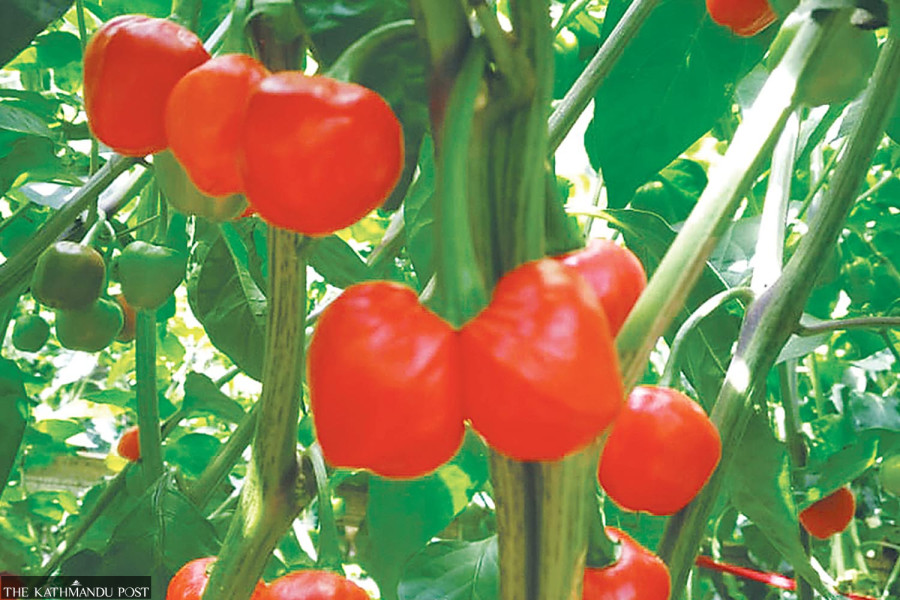
The monkey problem is particularly severe in Baglung Municipality, Jaimini Municipality and Kathekhola Rural Municipality.Akabare chilli is a crop not damaged by monkeys. Post File Photo
A persistent monkey menace has forced many local farmers to abandon crop cultivation altogether. Even those who continued farming were often unable to harvest what they planted.
Frustrated by repeated losses of traditional maize and wheat crops to monkeys, residents of Rayadanda in ward 11 of Baglung Municipality have spent the past three years searching for alternative farming options.
While some initially shifted to goat rearing, farmers who once depended largely on mustard greens and livestock have this year expanded into ginger and Akabare chilli cultivation, also known as fireball cherry pepper.
Ward Chairman Gyanendra Gautam said Akabare chilli and ginger farming were selected after extensive discussions on crops that could withstand damage from wild monkeys. In the current fiscal year, farmers in the area have planted 40,000 chilli saplings.
“This is a pilot project. If it proves successful, we will expand Akabare cultivation across the entire ward next year,” Gautam said. “The municipality and Heifer International will support farmers in marketing their produce.”
Heifer International has been working in the livestock and health sectors in the area for the past four years.
Shift to commercial agriculture
Located far from the district headquarters, Rayadanda has long faced challenges in transporting agricultural products to market. As a result, many farmers previously relied on goat farming, as transporting fresh milk was not practical. They are now moving towards commercial agriculture through ginger and Akabare chilli cultivation.
Farmers have also planted mustard greens, which so far appear to have escaped damage from monkeys.
“Monkeys have not eaten the mustard greens so far,” said local farmer Dal Bahadur Thapa. “We are hopeful that we can protect the chillies and ginger as well.”
Local farmers had earlier attempted vegetable farming using high-tech tunnels. However, protecting vegetables from monkeys proved difficult, prompting plans to cultivate Akabare chillies inside the structures instead.
In the first phase, 75 farmers have taken up Akabare chilli production. According to agricultural technician Raju Gautam, 40,000 saplings were successfully raised from seeds worth Rs40,000.
“This crop offers high returns with relatively low investment, and the local climate is highly suitable,” he said. “Most importantly, farmers no longer have to worry about monkeys destroying their crops.”
He added that if the initiative succeeds, Akabare chilli cultivation could be adopted in other villages facing similar problems with monkeys.
Dairy farming as a safer alternative
Rishiram Sapkota, chief of the Veterinary Hospital and Livestock Service Expert Centre in Baglung, said many farmers are also investing in dairy farming as a reliable source of income unaffected by wildlife damage.
Over the past five years, a large number of farmers in different wards of Jaimini Municipality have taken up commercial buffalo rearing. The milk they produce is transported directly to Baglung Bazaar and Pokhara.
According to Sapkota, milk production can be expanded significantly in areas located within an hour’s drive from urban markets, thanks to improved road access and reliable transport. To encourage dairy farming, the Expert Centre and Jaimini Municipality have been providing production-based subsidies of up to Rs5 per litre of milk.
The monkey problem is particularly severe in Baglung Municipality, Jaimini Municipality and Kathekhola Rural Municipality. Farmers in Kathekhola have also increasingly turned to dairy farming and ginger cultivation.
However, Balaram Kandel of ward 6 of Kathekhola Rural Municipality said that while Akabare chillies generally have a ready market, securing a stable market for ginger remains a challenge.




 22.41°C Kathmandu
.jpg)