Floods, landslides and lightning have killed 85 people since April, while fresh rain is causing deaths, displacement and road closures across several districts. Rescuers search for people buried by a landslide in Tamsu of Tribeni Municipality-9, Bajura, on Thursday night. Prem Raule/TKP
At least 85 people have died in monsoon-related disasters across Nepal in four months, according to Nepal Police. The toll includes 19 deaths from floods, 35 from landslides, 26 from lightning strikes, four from heavy rain and one from an avalanche between April 14 and August 14.
The monsoon is still active, and the risk of floods, landslides and other weather-related disasters remains high.
Nine people have gone missing, 196 have been injured, and 1,735 families have been affected by monsoon-related disasters during the period, police said.
The toll is slightly lower than last year. Between April and August 2025, monsoon disasters killed 90 people, including 39 in floods, 20 in landslides, 30 in lightning strikes and one in heavy rain.
But persistent rain over the past four days has caused fresh deaths and widespread damage in several districts.
In Rolpa, four people were killed when a landslide buried a house in Sun Chhahari Rural Municipality-2 on Thursday night.
The landslide struck the Phalbang settlement of Gam at around 10pm. A team of police and residents recovered the bodies of 77-year-old Biru Gharti Magar, his 68-year-old wife Shani Gharti Magar and their 70-year-old neighbour Lali Gharti Magar at around 11:30am on Friday.
Police said Lali had been visiting the couple when the landslide buried their house.
In the same ward, 64-year-old Lami Gharti Magar was buried inside her house in Mangraru. Her body was recovered on Friday, according to Rolpa police chief DSP Panchakumar Bakhu.
On Wednesday, a landslide swept through the Kotalbara settlement in Thabang Rural Municipality-5, burying 13 people. The bodies of only 10 have been recovered so far.
In Bajura, a 20-year-old woman was killed after a landslide buried a house in Tamsu of Tribeni Municipality-9 on Thursday night.
Pratikshya Thapa was killed when a landslide triggered by continuous rain swept down from above the house and buried the homes of residents Dharma Thapa and Karna Bahadur Thapa. Dharma Thapa, 40, and Dhauli Rawal, 40, were injured and are receiving treatment at Bajura District Hospital, Chief District Officer Dorendra Niraula said.
Pratikshya’s parents are in India. Her body has been kept at the district hospital.
Authorities held discussions with local officials and the district disaster management committee on Friday over relocation and other measures as the rain continued and the risk of further landslides increased, Niraula said.
In neighbouring Jajarkot, floods washed away five houses in Roli of Nalgad Municipality-10.
The homes of Prithivi Bahadur BK, Khaite BK, Nar Bahadur BK and Hasta BK were swept away. A tin shed and snack shop operated by Suntali BK on land belonging to Bir Bahadur BK were also destroyed.
Thirty-eight people living in the houses and sheds were moved to safer locations.
The local administration and security agencies were assessing damage in other areas, officials said.
Police and Armed Police Force personnel were deployed from Dalli to rescue residents at risk and move them to safety.
Flooding has also completely blocked the Jajarkot-Dolpa section of the Bheri Corridor. Vehicles travelling to Dolpa and those heading towards Jajarkot have been stranded along the route, leaving passengers and freight carriers stuck midway and disrupting road links with Dolpa.
With floods, landslides and road blockages disrupting daily life, authorities have urged residents to remain alert as further damage is possible.
In Baglung, eight families have been displaced by a landslide in Nisikhola Rural Municipality-2.
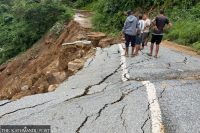
The landslide struck the Dharatole settlement on Friday afternoon after rocks and debris came down from the Brengri-Handichaur road, damaging houses and cattle sheds.
The homes and sheds belonging to Dhan Bahadur Chhetri, Rajan Pariyar, Narayan Kunwar, Tara Gharti, Dipak Pariyar, Harikala Gharti, Deviram Gharti and Kuber BK were damaged, according to Deputy Superintendent of Police Rameshwor Twati of the District Police Office.
The buildings were rendered uninhabitable, forcing the affected families to move into neighbours’ homes and a nearby school, he said.
In Kaski, flooding on Friday damaged roads at several locations, disrupting transport.
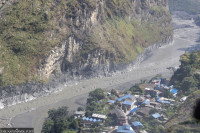
The Modi river flood cut through the Birethanti-Ghandruk road at two locations in Annapurna Rural Municipality-8, severing road access to Ghandruk.
The rural road leading through Tikhedhunga to Ulleri, Ghorepani and Poon Hill was also cut off.
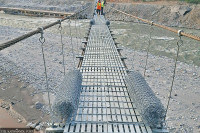
The flood also swept away two suspension bridges connecting Haijung in Annapurna Rural Municipality-6 with Deupur Mohoriya in Modi Rural Municipality-1 of neighbouring Parbat.
According to the Kaski District Police Office, the Modi river also eroded sections of the paved road along the riverbank at Birethanti. The river also damaged the road linking Chimrung and Syaulibazar to Sardikhola.
The erosion has put Birethanti, the gateway to popular tourist destinations including Ghandruk, Annapurna Base Camp and Ghorepani-Poon Hill, at risk.
The road from these areas to Pokhara runs through Birethanti and Nayapul before joining the Pokhara-Baglung section of the Mid-Hill Highway. With the road cut off at Birethanti, vehicles travelling towards the area have been stranded.
Assistant Chief District Officer Chitrangad Baral said the erosion had severed road access to all of wards 8, 9, 10 and 11 of Annapurna Rural Municipality. Electricity supplies were also disrupted after power poles were washed away at several locations.
Dozens of vehicles were stranded between Birethanti and Ghandruk, Baral said.
As of Friday, 45 four-wheelers, including passenger and private jeeps, buses, tractors, trucks and hydropower project tipper trucks, were stranded in the area. More than 25 motorcycles belonging to domestic tourists and residents were also unable to leave.
Eight foreign tourists and some domestic visitors were rescued and sent towards Pokhara, Baral said.
“There is no way to bring the tourists’ vehicles back to Birethanti, and there is no alternative route,” he said. “Once the water level in the Modi river drops, it could take up to one and a half months to repair the road and restore full access.”
The flood has also damaged the under-construction Upper Madi hydropower project in Hugu of Annapurna Rural Municipality-1.
Nepal Police spokesperson Abhi Narayan Kafle said police had identified vulnerable areas and safe locations in each district as part of the monsoon disaster preparedness and response plan.
“Rescue equipment has been serviced and kept ready according to the type of disaster it is meant to respond to,” he said. “Two platoons of specialised rescue personnel are on round-the-clock standby at the Nepal Police Disaster Response and Training Centre, while one platoon each is stationed at provincial police disaster management units for immediate mobilisation.”
A total of 10,085 police personnel have been deployed for disaster response, including at local police posts, Kafle said.
The Nepali Army has also stepped up preparations for the monsoon. It says it has trained 47,000 people at the central, provincial and district levels in disaster response.
Army spokesperson Rajaram Basnet said army units stationed in districts have kept designated personnel on standby with equipment needed for immediate rescue operations.
Search and rescue teams have been deployed at formations in all seven provinces, while a central-level team equipped with medical personnel is ready to conduct an air rescue within 15 minutes, he said.
“Specialised, trained personnel have also been kept on standby at the Nepali Army’s disaster management battalions in Sundarijal, Kathmandu, and Chitwan,” Basnet said. “A Nepali Army helicopter is also on round-the-clock standby in Surkhet.”
Boats and rafts have been prepared in areas prone to flooding, he added.
Thirteen buried as Thabang village struggles to recover
Sanju Pun Magar, 28, of Kotalbara in Thabang Rural Municipality-5, managed to save five members of her family when a landslide swept through the village on Wednesday evening.
When the ground suddenly began to shake, she grabbed her two-and-a-half-year-old son and rushed outside with her elderly grandmother, mother-in-law, sister-in-law and brother-in-law.
“It was raining heavily. There was thunder in the sky. Then we heard a sound like lightning striking and an earthquake hitting, and we panicked,” Sanju recalled. “When I stepped outside, the scene was terrifying. Then the electricity went out, and everything went dark. Even so, I got everyone out of the house, soaked from the rain.”
She was focused on getting her own family to safety. By then, however, the landslide had already buried a neighbour’s house and family.
She was focused on getting her own family to safety. By then, however, the landslide had already buried a neighbour’s house and family.
The roar of mud and floodwater was so loud that she could not hear people speaking or screaming, she said. Only after the rain eased did she realise that her neighbours’ house had been buried.
“There was no question of sleeping that night. We later learned that 13 people had been buried, apart from two who were injured. We only understood what had happened the next day,” she said. “The landslide has left the whole village looking like a pile of ruins.”
Sanju’s husband works for Nepal Police in Gulmi. Her sister-in-law lives in Sulichaur, where she runs a business, while her father-in-law has gone to Mustang in search of work.
“I came here from Upper Uwa after getting married eight years ago. I had never experienced anything as terrifying as Wednesday night,” Sanju said.
Her family stopped living in the house from Thursday because it is considered highly vulnerable to further landslides. She said finding a safe place for her 84-year-old grandmother, 65-year-old father-in-law and 50-year-old mother-in-law has become difficult because the family has nowhere else to live.
At around 7:30pm on Wednesday, a mudslide came down from the upper part of Sajang village in Uwa, above Kotalbara, burying 13 people and 12 houses, both large and small.
The bodies of only 10 of the victims have been recovered. Three people remain missing.
Resident Dhukaman Roka Magar said villagers are now struggling to find safe shelter for families whose homes remain standing but are still at risk.
“The whole village has been plunged into grief since Wednesday’s disaster. Three people are still missing, and we don’t know where to put the families who remain at risk,” he said.
Buddhi Gharti Magar, acting ward chairman of Thabang-5, where the landslide occurred, said officials were occupied with rescue efforts on Thursday and only began compiling details of affected families on Friday.
“Thirteen people from the village were buried at the same time. Only 26 people from the entire village are now left,” he said.
The Uwa river, where the landslide occurred, flows through Lungrī and joins the Madi river at Khungri before merging with the Airawati river in Pyuthan. By the time the Madi and Airawati rivers reach Bhalubang in Dang, they form the Rapti river.




 14.4°C Kathmandu


.jpg)