Child marriage, superstition drive stillbirth crisis in Achham
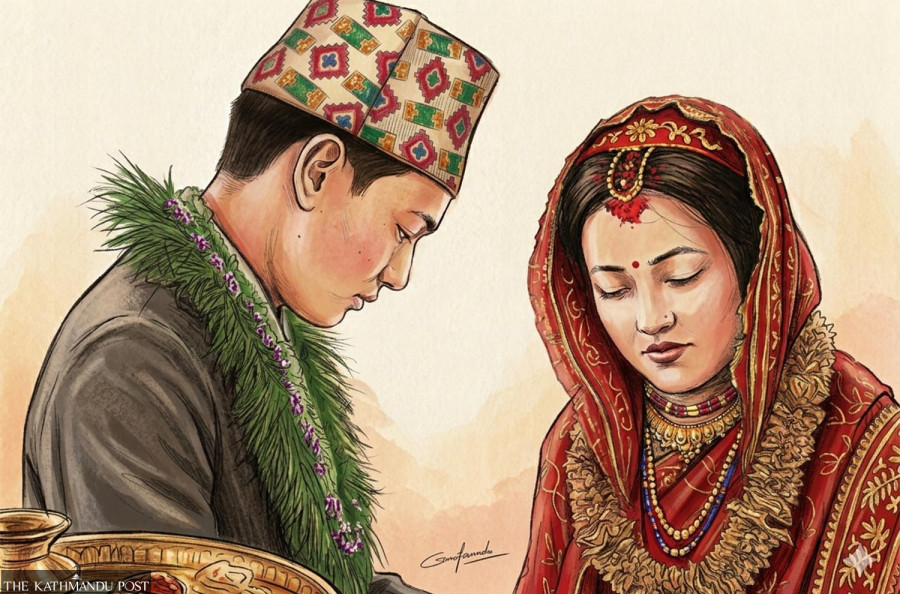
Health workers say teenage pregnancy, poor nutrition, and reliance on faith healers keep stillbirth figures stubbornly high. AI enhanced post illustration
A 14-year-old girl from ward 4 of the remote Turmakhand Rural Municipality in Achham district, then a grade 6 student, married a 16-year-old boy studying in grade 7. Two years later, she became pregnant. Having dropped out of school due to early marriage, the young couple lacked physical, mental, and social maturity required for parenthood. As her pregnancy progressed, she was further burdened with domestic chores and agricultural labour, despite her fragile health.
Marrying well below the legal age of 20 and navigating pregnancy while still physically underdeveloped, she suffered from chronic malnutrition and a lack of access to basic care, and this all severely affected her unborn child.
When her expected delivery date passed by a week without signs of labour, Turmakhand Health Post referred her to the District Hospital in Mangalsen, the district headquarters. Accompanied by her husband, the teenager arrived at the referral facility, where doctors found the foetus was dangerously overdue and advised an immediate Caesarean section.
According to Ganga Budha Magar, the information officer and senior nursing inspector at Achham District Hospital, the foetal heart rate and condition were stable upon arrival. However, following the medical recommendation, the young couple informed staff they needed to consult their family before consenting to surgery, and then quietly fled the hospital without formal discharge.
"My in-laws began shouting, saying surgery would ruin a woman's body permanently and make her unfit for physical work. They insisted on a natural delivery. We could not withstand that intense domestic pressure and ran away from the hospital," recalled the teenager. "Once we reached home, my family took me to dhami-jhankri (faith healers) to find out why labour had not started. We even made ritual offerings to local deities, believing it was caused by divine anger."
Hospital staff later launched a search to trace the high-risk expectant mother. When the couple finally returned to the hospital a week later, it was already too late. The delay resulted in an intra-uterine foetal death. The teenager was forced to deliver a stillborn baby.
The tragic case underscores a persistent crisis in Achham, a remote district of Sudurpaschim Province. Although the stillbirth numbers in the district have shown a marginal downward trend, health authorities say progress remains unsatisfactory.
Data from the District Health Office indicates that between the fiscal years 2020-21 and 2025-26, Achham recorded 362 stillbirths. Of these, 173 occurred during active labour or delivery, while 189 occurred in the womb prior to the onset of labour.
Annual figures show 109 stillbirths in 2020-21; 86 in 2021-22; 59 in 2022-23; 36 in 2023-24; 39 in 2024-25; and 33 so far in the current fiscal year.
Public health workers attribute this stagnation to child marriages, chronic maternal malnutrition, and deep-seated superstitious practices.
The vulnerabilities are further aggravated by repeated pregnancies and lack of reproductive autonomy. Last year, a 38-year-old woman from ward 5 of Dhakari Rural Municipality arrived at the District Hospital to deliver her sixth child. She had previously given birth to five daughters and was under intense social pressure to produce a male heir.
Medical practitioners say frequent pregnancies with short birth intervals severely weaken maternal health and increase risks to the foetus.
She endured obstructed labour at home for 12 consecutive hours. Because the local Dhakari health facility lacked the capacity, emergency obstetric care infrastructure, and surgical equipment to manage complicated deliveries, she was transferred to the District Hospital. Despite medical intervention, the baby was stillborn.
The psychological toll intensified when the woman discovered the stillborn infant was a boy. Her family and community had long subjected her to psychological abuse for failing to bear a son.
"I endured continuous humiliation for not giving birth to a son. Now, everyone blames me, calling me an ill-fated woman who could not save her male child," said the woman. "The moment my husband discovered the deceased baby was a boy, he abandoned me at the hospital. I had no one with me during the funeral rites."
Following her abandonment, she received no postpartum care or nutritional support. "My husband and in-laws still treat me with hostility, accusing me of failing to sustain the male lineage," she added.
Societal pressure also continues to disrupt family planning decisions.
A 21-year-old woman from ward 7 in Mangalsen Municipality had mutually agreed with her husband to delay their first pregnancy by two years to balance domestic work, agricultural labor, and her ongoing education. However, her in-laws pressured the couple to conceive immediately after the wedding.
"Because I did not conceive within two years of marriage, my in-laws began accusing me of infertility and took me to faith healers. Eventually, we gave in to the pressure,” she said.
During pregnancy, her workload increased. She was forced to carry heavy bundles of fodder and firewood alone from the forest."
With her husband away working in India, her in-laws increased her physical workload during the third trimester. Chronic physical exhaustion and emotional distress severely compromised the pregnancy.
By the eighth month, she noticed a reduced foetal movement, but was not allowed to seek medical care immediately. When she finally reached the hospital, the baby had already died in the womb. "After carrying a child for nine months through immense hardship, delivering a lifeless baby was unbearable," she told the Post.
Budha Magar said that while safe motherhood initiatives have contributed to a reduction in the maternal mortality rate in Achham, stillbirths remain a major challenge, particularly among teenage mothers.
"Adolescent mothers are physically underdeveloped and often unable to care for themselves or their foetus adequately during pregnancy. Many also fail to attend regular antenatal checkups,” she said.
She added that many women arrive at health facilities too late, after intra-uterine death has already occurred.
According to Budha Magar, Turmakhand, Dhakari, and Ramaroshan rural municipalities have the highest concentration of stillbirths. She observed that deep-seated resistance to surgical interventions often deters families from consenting to Caesarean sections even during critical emergencies.
Furthermore, women who deliver stillborn infants regularly face institutional and domestic abuse. "Postpartum care and nutrition are frequently withheld. Some family members openly abuse the mothers inside the hospital wards, and several husbands abandon their wives in the obstetric beds," said Budha Magar.




 17.6°C Kathmandu