Nepal’s peace score takes historic hit after Gen Z unrest
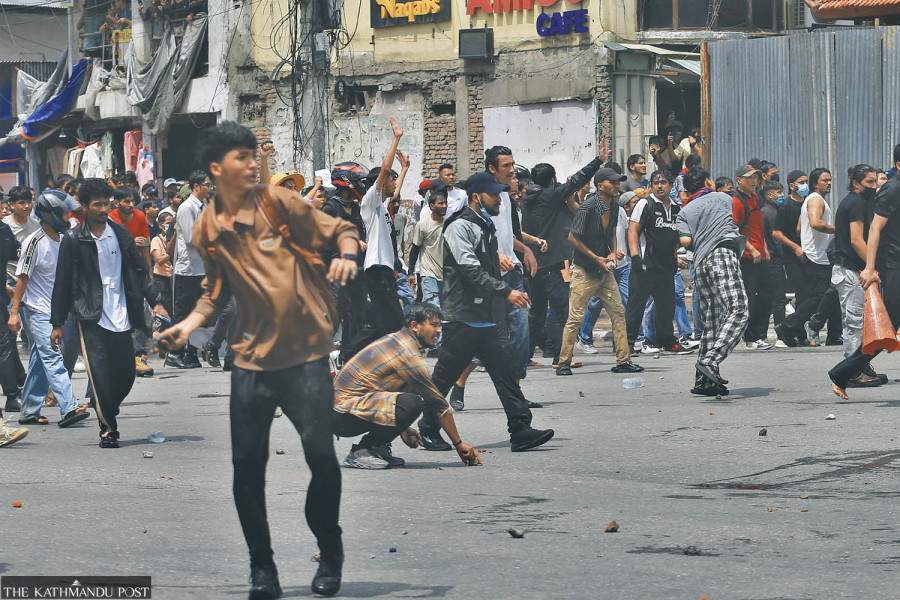
The country’s 26-place fall in the Global Peace Index follows the deadly unrest last September, but experts say deeper weaknesses in governance, public trust, and democratic institutions are at the root of the decline. Youths are seen pelting stones at police on the first day of the Gen Z protests on September 8 in Kathmandu. Political observers said themovement grew out of years of mounting public discontent over rampant corruption, poor governance and economic insecurity. Post File Photo
Nepal has suffered the largest deterioration in peacefulness of any country in the world over the past year, according to a new international index.
The 2026 Global Peace Index ranked Nepal 111th out of 163 countries, down 26 places from the previous year and marking its lowest position since 2008. Its overall peacefulness score fell by 9.1 percent–the largest decline recorded by any country in this year’s index, ahead of Oman and the Republic of the Congo.
Compiled annually by the Institute for Economics and Peace, the index measures peacefulness using 23 indicators across three broad areas: societal safety and security, ongoing domestic and international conflict, and militarisation.
The report attributes Nepal’s sharp decline primarily to the Gen Z protests last September and the state’s brutal response.
The demonstrations began after the government announced a ban on 26 social media platforms, including Facebook, YouTube, WhatsApp, and Instagram. Opposition to the ban quickly grew into a nationwide movement against corruption, inequality and the misuse of public funds. Security forces responded with live ammunition, rubber bullets, tear gas, and water cannons. By the end of the month, at least 76 people including police personnel had been killed and more than 2,000 injured.
Those events directly affected several measures used in the index.
Nepal’s score for ongoing conflict deteriorated by 23.4 percent, driven by a 100 percent deterioration in the indicator measuring the intensity of internal conflict. Violent demonstrations worsened by 45.5 percent, while political instability also increased. Although the country improved on measures including terrorism impact and violent crime, those gains were outweighed by the sharp deterioration in conflict-related indicators.
Mike Koslowski, senior communications advisor at the Institute for Economics and Peace, told the Post that such a decline was exceptionally rare.
“A 9.1 percent deterioration in a single year is relatively uncommon,” he said. “Most countries move only marginally from year to year.”
Looking across every country since the index was first published, deteriorations of nine percent or more have occurred only 55 times–fewer than two percent of all year-to-year movements.
“Almost every comparable case involved civil wars, interstate conflicts, coups, or insurgencies,” Koslowski said. Those events have generally produced even steeper falls than the one recorded by Nepal.
But researchers and peacebuilding experts say the September unrest alone does not explain the country’s dramatic decline. The protests, they argue, exposed political, economic and institutional weaknesses that had been accumulating for years.
Ajay Das, a peacebuilding practitioner, said the September violence reflected years of accumulated institutional weaknesses rather than a sudden breakdown.
“The scale of loss of life, injuries and destruction of property during the protests was among the worst in Nepal’s modern history,” Das said. “ The unrest did not emerge overnight.”
Although Nepal has made considerable progress since the end of the armed conflict in 2006 — including reducing poverty, expanding access to basic services and broadening political inclusion — persistent inequalities and governance weaknesses gradually surfaced through localised protests, periodic unrest and declining public confidence before erupting in September, he said.
Kuldeep Niraula, a senior researcher at King's College Nepal, and Sagar Khadka, programme officer at Global Peace Foundation Nepal, said the protests highlighted how years of weak governance and poor public accountability had undermined trust in state institutions.
Niraula argued that Nepal is experiencing what peace scholars describe as “negative peace”— the absence of open violence without the institutional reforms needed to sustain long-term stability.
“Peacefulness exists when people experience justice and upward mobility in a society," Niraula said. “I don’t see that to be the case for a large swath of the population in Nepal.”
Although a new majority government has restored political stability, he said, corruption, exclusionary governance and unequal access to public services continue to undermine citizens’ confidence in democratic institutions.
“The Gen Z protests called for an end to rampant corruption, nepotism, favouritism, impunity, and the systemic exclusion of minority groups, including youth, from governance,” he said.
For both researchers, institutional failure is at the centre of Nepal’s decline. Citizens routinely encounter bureaucratic delays, political favouritism, weak accountability and unequal access to public services, creating grievances that accumulated for years before the September protests.
“As long as elected representatives and government institutions act as gatekeepers rather than equitable and just service providers, peacefulness is hard to prevail among citizens in Nepal,” Niraula said.
Khadka said corruption, political instability, unemployment and declining public trust had created growing frustration, particularly among young people. The government’s social media ban and security response became the immediate trigger that transformed those established grievances into nationwide violence.
“When institutions fail to address grievances, unresolved tension becomes a source of social instability,” Khadka said.
Nepal’s unfinished transitional justice process is another example of those institutional weaknesses, the researchers said.
Nearly two decades after the end of the Maoist insurgency, many victims are still awaiting truth, justice, and reparations. Das said the slow pace of the process has reinforced a culture of impunity and weakened confidence in the rule of law.
Despite those shortcomings, he argued that Nepal’s democratic institutions have shown resilience.
The peaceful conduct of national elections six months after the September uprising demonstrated that the country retained a constitutional path out of political crisis, even after one of the deadliest periods of civil unrest since the end of the insurgency.
Das noted that the government should prioritise rebuilding trust between citizens and the state by strengthening institutions, improving transparency and accountability, and delivering public services more effectively.
Reversing Nepal's decline, he said, will require rebuilding trust between citizens and the state through stronger institutions, greater transparency and accountability, more effective public services, and broader economic opportunities, particularly for young people and historically marginalised communities.
Nepal’s decline also comes amid a wider deterioration in global peace. Worldwide, 99 countries became less peaceful over the past year, while only 62 improved, marking the 12th consecutive annual decline. South Asia recorded the largest average regional deterioration, driven largely by setbacks in Nepal, Pakistan and India.
Bhutan remained South Asia’s most peaceful country, ranking 16th globally. Sri Lanka ranked 67th, Nepal 111th, Bangladesh 117th, India 127th, Pakistan 152nd, and Afghanistan 157th.
Nepal fell to its lowest ranking since the Global Peace Index was first published in 2008.
Whether Nepal climbs back up the Global Peace Index, researchers said, will depend on rebuilding the institutions that failed long before demonstrators took to the streets and addressing the grievances that fueled the unrest.
“When institutions fail to address grievances, unresolved tension becomes a source of social instability,” Khadka said.




 16.49°C Kathmandu