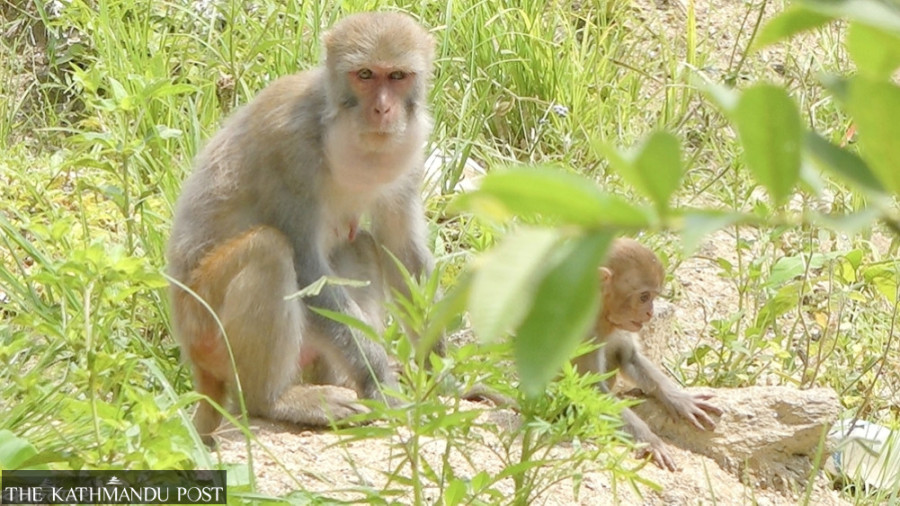
The growing monkey menace in Nepal’s hill districts has pushed one local government in Tehrathum to declare a public holiday so residents can collectively chase monkeys away from farms and settlements.
Laligurans Municipality has announced a public holiday across the municipality on May 15 to conduct a campaign against rhesus macaque monkeys, locally known as rato bandar, which have been destroying crops and vegetables.
The municipality said farmers have suffered heavy losses as monkeys continue to damage maize, potatoes, millet, fruits and vegetables. The problem has become so severe that farmers are spending nights guarding fields, while schoolchildren are skipping classes to protect crops.
In a notice undersigned by Mayor Arjun Mabuhang, the municipality said the monkey menace, though often viewed as a minor issue, has seriously affected the livelihoods of rural farmers.
“Farmers are forced to stay awake all night guarding their fields to save agricultural produce,” the notice said. “This has affected not only their economic condition but also children’s education and the daily lives of families.”
The municipality said a two-day campaign would be conducted on May 15 and 16 to drive monkeys beyond the municipal boundary. Farmers, elected representatives, employees and local residents have been asked to participate at locations and times designated by ward offices.
“The problem may appear normal, but it has severely affected the livelihoods of farmers,” Mabuhang said. “Monkeys are destroying maize, potatoes, millet, fruits and vegetables cultivated by villagers.”
The municipality has also deployed caretakers and built temporary watch posts in areas heavily affected by monkeys. According to municipal officials, monkey patrols have been arranged in Megha of ward 8, Nageshwori at the junction of wards 6 and 8, and Singhathap in ward 5. Four caretakers are currently mobilised to drive monkeys away from settlements and farmland.
Mabohang said many people initially mocked the municipality when it introduced caretakers to control monkeys at the beginning of his tenure.
“At that time, many considered it a normal issue, but now farmers are in despair,” he said.
He urged the federal government to recognise the monkey problem as a national issue and introduce long-term solutions.
“It is not possible for local governments alone to resolve this problem,” Mabuhang said. “The federal government needs concrete policies and programmes to protect agricultural production and provide relief to farmers.”
The municipality is also planning to plant fruit trees such as guava and pear in community forests affected by monkeys. Officials say the plan is aimed at providing food sources within forests so that monkeys are less likely to enter settlements and farmland.
Monkey attacks on crops have become a growing problem across Nepal’s hill districts in recent years. Farmers say repeated destruction of maize, potatoes, fruits and vegetables has forced many to abandon farming altogether.
Authorities and communities have attempted various measures, ranging from traditional scare tactics to technological interventions and sterilisation campaigns, but with limited success.
In 2024, Mayor Tirtha Raj Bhattarai of Diktel Rupakot Majhuwagadhi Municipality staged a hunger strike in Kathmandu, demanding a national policy to manage monkeys and other wildlife.
Despite the efforts, the government has yet to find the right measures to control the monkey menace.
A study conducted with support from the Gandaki provincial Ministry of Industry, Tourism, Forest and Environment refrained from recommending stringent measures, citing the religious significance of monkeys in Hinduism, where monkeys are worshipped as the deity Hanuman. The study also noted that sterilisation and capture methods were unlikely to effectively control monkey populations.
Nepal is home to three monkey species: the rhesus macaque (Macaca mulatta), the Assamese monkey (Macaca assamensis) and the Hanuman langur (Semnopithecus entellus).
Nepal is also a signatory to the Convention on International Trade in Endangered Species of Wild Fauna and Flora (CITES), which restricts international trade in threatened species. National laws prohibit the export of protected wildlife without government approval. One is jailed, according to the act, for five years to 15 years or fined Rs500,000 to Rs1 million or both if found guilty.
Similarly, the National Park and Wildlife Conservation Act has included the rhesus monkey on the list of protected animals, thereby prohibiting its export without government permission. However, the Act does not mention any measures for controlling protected animals that threaten people and agricultural production.
Authorities have suggested setting up dedicated “monkey parks”.




 14.2°C Kathmandu