Karnali Corridor set for crucial bridges and blacktopping
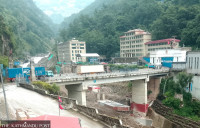
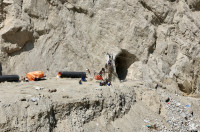
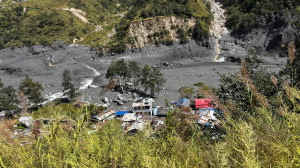
This road remains critical for ending the geopolitical isolation of Humla where residents still depend on expensive airlifted supplies. A section of the Karnali Highway (right) and the Karnali Corridor. The 508-kilometre trans-Himalayan highway connects Jamunaha on the Indian border to Hilsa on the Chinese border, with the Khulalu-Hilsa segment spanning 347 kilometres. Tularam Pandey/TKP
The government has secured Rs6.11 billion in budget funding for the long-awaited road upgrade and construction of bridges along the Karnali Corridor. The budget has been ensured for the construction of six bridges and the blacktopping of a 60-kilometre section of the strategic Karnali Corridor.
The Ministry of Finance recently granted formal approval to the Department of Roads to initiate the competitive multi-year bidding process for the Khulalu-Hilsa stretch of the national pride project.
According to Bisundas Lama, the chief of the Khulalu-Sallisalla road project, this fresh capital injection will finally facilitate the upgrade of the corridor into a two-lane asphalt highway. "The Finance Ministry has cleared the resource assurance for the Department of Roads. We will invite global tenders immediately after receiving formal authorisation from our departmental headquarters,” said Lama.
Out of the total package, Rs3.15 billion has been earmarked to upgrade a 41-kilometre segment covering Khulalu-Kot and Bhukka Khola-Piluchaur in Kalikot district alongside the Tumcha-Sallisalla section in Humla district. An additional Rs2.33 billion is allocated under the North-South Hilsa-Simkot Road Project to expand 19 kilometres between Kharpunath, Kharikhet, and Sallisalla. Furthermore, a sum of Rs624.3 million is designated for constructing six motorable bridges across hazardous rivers, including Rahagad, Sannigad, Phugad, Bhukka Khola, and Kwadi.
Currently, commuters and freight vehicles face life-threatening hazards daily while crossing these rivers due to the lack of permanent crossings. To address this, project officials plan to conclude the multi-year contract awards before mid-July 2026, aiming for full project completion within two years.
This financial breakthrough brings immense hope to isolated mountain communities who have long endured severe connectivity hardships. Jayapati Rokaya, a federal lawmaker representing Humla, hailed the funding assurance as a milestone for the Karnali region.
"The Karnali Corridor is the ultimate gateway to our economic prosperity. Once blacktopped, it will transform local trade and significantly boost religious tourism by providing Indian pilgrims with a shorter, safer overland route to Mount Kailash and Manasarovar lake,” said Rokaya.
However, complex engineering hurdles persist. A segment of the existing track is projected to be permanently submerged by the reservoir of the upcoming Phugad Hydropower Project. Consequently, the hydropower developer has already initiated fresh surveys to divert the alignment. Upgrading works will temporarily bypass this specific section to prevent a wastage of public funds, focusing exclusively on basic maintenance there until the alternative track is formalised.
The 508-kilometre trans-Himalayan highway connects Jamunaha on the Indian border to Hilsa on the Chinese border, with the Khulalu-Hilsa segment spanning 347 kilometres. This vital lifeline suffered from chronic underfunding and bureaucratic inertia and it took nearly fifteen years just to open a basic track.
The Nepali Army successfully blasted through 130 kilometres of exceptionally formidable cliffs between Khulalu and Sallisalla, while the Department of Roads completed the remaining 139 kilometres to Hilsa. This corridor remains critical for ending the geopolitical isolation of Humla, as locals still depend on expensive airlifted supplies.
Humla, arguably the country’s most remote district, was connected to the national road network only in July last year after a Bailey bridge was installed over the Karnali river at Chuwakhola in Kharpunath Rural Municipality. Although the road track had reached Simkot earlier, the lack of a bridge delayed full connectivity by nearly four months of the rainy season.
The road project has a long history. Plans to connect Humla to China by road date back to 1997, when a viral outbreak and food shortages exposed the district’s vulnerability. Construction began in 2000 using local resources, but progress was slow. The government established a dedicated project in 2013, and the Nepali Army took over construction in 2015, completing the track only in 2025 at a cost of nearly Rs7 billion.




 13.64°C Kathmandu