Problematic Daunne road section set for durable concrete upgrade
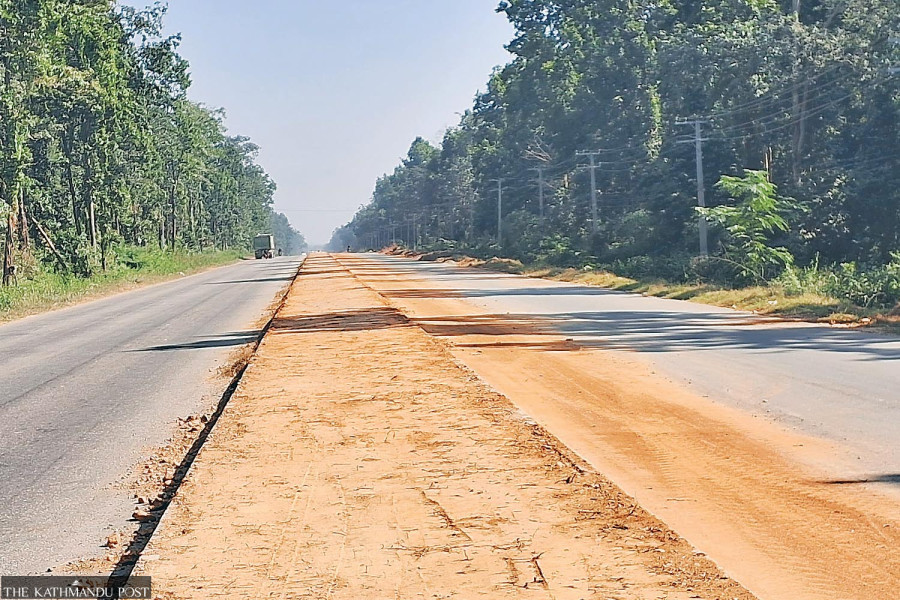
Officials say fragile land and risk of subsidence led them to choose concrete over asphalt. The fragile Daunne section of the Narayanghat-Butwal road is being paved with concrete. Nabin Paudel/TKP
It has been nearly seven years since the inception of the much awaited Narayanghat-Butwal road expansion project. Yet the project remains incomplete. Although construction has been finished in most sections, difficulties persist along the 14-kilometre long Daunne stretch, which has long been the most problematic segment.
With the monsoon repeatedly causing damage, authorities have decided to construct 11 kilometres of this section using cement concrete pavement. The project office said the original design had failed to fully assess the geological risks of the area. At the request of consultants and contractors, the design was revised to replace asphalt with concrete surfacing.
According to Chuda Raj Dhakal, project director at the Asian Development Bank (ADB) Project Directorate, the initial plan had proposed blacktopping the Daunne section as well. However, during construction it became evident that the soil conditions were unsuitable for asphalting. “We encountered far more complications than anticipated in the Daunne section,” said Dhakal. “The soil composition differed from earlier estimates. There is constant water seepage and marshy ground. With heavy freight vehicles frequently applying brakes on slopes, the risk of asphalt surface subsiding and deteriorating was high.”
Following consultations with experts and based on the consultant’s recommendation, the authorities concluded that concrete surfacing was the more durable option. Dhakal said only the Daunne section has been designed as a three-lane road due to its geographical constraints. In the remaining 99 kilometres, four lanes have been constructed in rural and forest areas, while market sections have been expanded up to eight lanes, including service lanes on both sides.
“The hills in Daunne are fragile, and the monsoon has caused repeated disruptions. Travellers suffered greatly during the festive season due to road damage. After the consultant indicated that asphalt would not be sustainable, we moved ahead with concrete construction,” said Dhakal.
Three kilometres of road in the Daunne section has been already blacktopped. So far, 6.5 kilometres of concrete road have been laid and work is under way on another 4.5 kilometres.
“We are progressing at a rate of around 50 metres of concrete paving per day. With the addition of concrete works, the estimated cost has increased by approximately Rs510 million,” said Dhakal. However, he argued that over a 30-year maintenance cycle, concrete would prove more economical. “An asphalt road would need to be reconstructed three times within that period and repaired every one or two years. When all those costs are added up, concrete surfacing turns out to be cheaper,” he added.
He also pointed out that bitumen and tar required for asphalt must be imported, whereas Nepal is self-sufficient in cement. “Cement is produced domestically, and stone, gravel and sand are locally available,” he said. “This supports domestic production and ensures the road’s durability.”
Although the overall project deadline runs until mid-July, he claimed that work on the Daunne section would be completed by mid-June. “Elsewhere, construction has been finished and painting is under way, and more than half of the service lane work has been completed,” he said. “Two culverts are currently being built in Daunne, but with the present pace of work, there should be no further delay.”
Delays have plagued the road widening project since its inception. The road, meant to be completed in 44 months, remains unfinished for seven years. Construction began in April 2019, with an initial completion deadline of August 2022. The deadline has since been extended four times, most recently to August 2026. Funded by a loan from the Asian Development Bank, the total cost of the projects stands at Rs16.99 billion.




 15.26°C Kathmandu