



 16.62°C Kathmandu
Sat, Oct 24, 2026
Money
Tightened Bhairahawa customs checks empty Sunauli market
Crackdown on informal cross-border trade reduces Nepali shoppers in Sunauli, while officials claim revenue gains and traders warn of shifting patterns.
bookmark
Madhav Aryal
Published at : April 24, 2026
Updated at : April 24, 2026 16:23
Bhairahawa
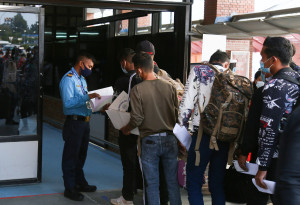
Sunauli market on the Indian side of the Bhairahawa border has turned unusually quiet after Nepal stepped up customs checks at the Bhairahawa entry point, sharply reducing the number of Nepali shoppers crossing over for daily essentials.
Consumers in Bhairahawa and surrounding areas have complained that prices of essential household goods have risen following the tightening of border controls. Retail activity in Sunauli, once bustling with Nepali buyers from nearby districts as well as distant areas, has slowed significantly in recent days.
Harihar Paudel, chief of the Bhairahawa Customs Office, said the tighter checks were aimed at discouraging the practice of bringing in large quantities of goods without paying duty under the pretext of household use.
“Smuggling through multiple daily trips carrying goods across the customs point has declined,” he said. “There is also a positive impact beginning to show in controlling revenue leakage.”
He added that small-scale personal shopping from nearby Indian markets is not being restricted. Customs staff and security personnel are focusing checks mainly on commercial quantities of goods brought in under the guise of household consumption.
A staff member at Hari Om General Stores in Sunauli said Nepali customer footfall has dropped by more than 75 percent compared to earlier periods. While Indian traders are reportedly unhappy with the decline in business, domestic business groups in Nepal say the tightening could help promote legal trade.
Prachin Kumar Thaiba, president of the Federation of Customs Agent Nepal, said stricter border enforcement benefits both Nepal and India by discouraging illegal trade. He added that increased checks across border points have also boosted retail-level customs trade and filled customs warehouses.
“There are also reports that while the main border points are under stricter control, smugglers are taking advantage of open side routes,” he said. “Those areas also need enforcement.”
He added that illegal goods entering Nepal without invoices or customs clearance are often purchased by traders within Nepal, which he said fuels smuggling networks. He called for stronger monitoring and inspection campaigns targeting such practices.
Local consumers have complained that prices of daily essentials in grocery and retail shops in Bhairahawa and nearby areas have risen sharply following the tightened border controls.
Netra Prasad Acharya, president of the Siddhartha Chamber of Commerce and Industry - Rupandehi, said the border crackdown is beginning to positively influence domestic trade. However, he warned against unjustified price hikes.
“If any business raises prices without reason, there should be regular market monitoring and action,” he said. “We are ready to support the government. But ordinary people should not be made to suffer at the border, and commercial trade without customs clearance is not allowed.”
At the Nuidihawa area of Siddharthanagar municipality, where a biweekly border market operates on the Indian side targeting Nepali consumers, attendance has also dropped significantly due to the tightened border checks.
Superintendent of Armed Police Navaraj Bohara, head of the 27th battalion of the Armed Police Force Nepal based in Rupandehi, said enforcement at the border is continuing, and there have been no major disputes or obstruction during inspections.
“In some situations, practical considerations are taken into account,” he said. “Earlier, people used to travel from far away for shopping at the border market. That number has declined now, and most shoppers are local and come mainly in the evening.”
Madhav Aryal
Madhav Aryal is the Palpa correspondent for Kantipur Publications.

Most Read from Money

Why does an hour long flight to Dhangadhi cost more than a flight to New Delhi?
Nepal travel agents threaten to stop selling Thailand trips over visa rules
Malaysia rejects Nepal’s demand to open recruitment to all manpower agencies

No school, but a graduation cap for women dairy farmers
Nepal arrests four medical service providers as Malaysia recruitment row deepens
Editor's Picks




E-PAPER | October 24, 2026

×