



 14.69°C Kathmandu
Sat, Oct 24, 2026
Money
Nepali media is fighting for survival. Its journalists are fighting for their paychecks
As the industry faces an existential threat, newsroom staff are going months without pay, with little recourse and nowhere else to go.
bookmark![]()
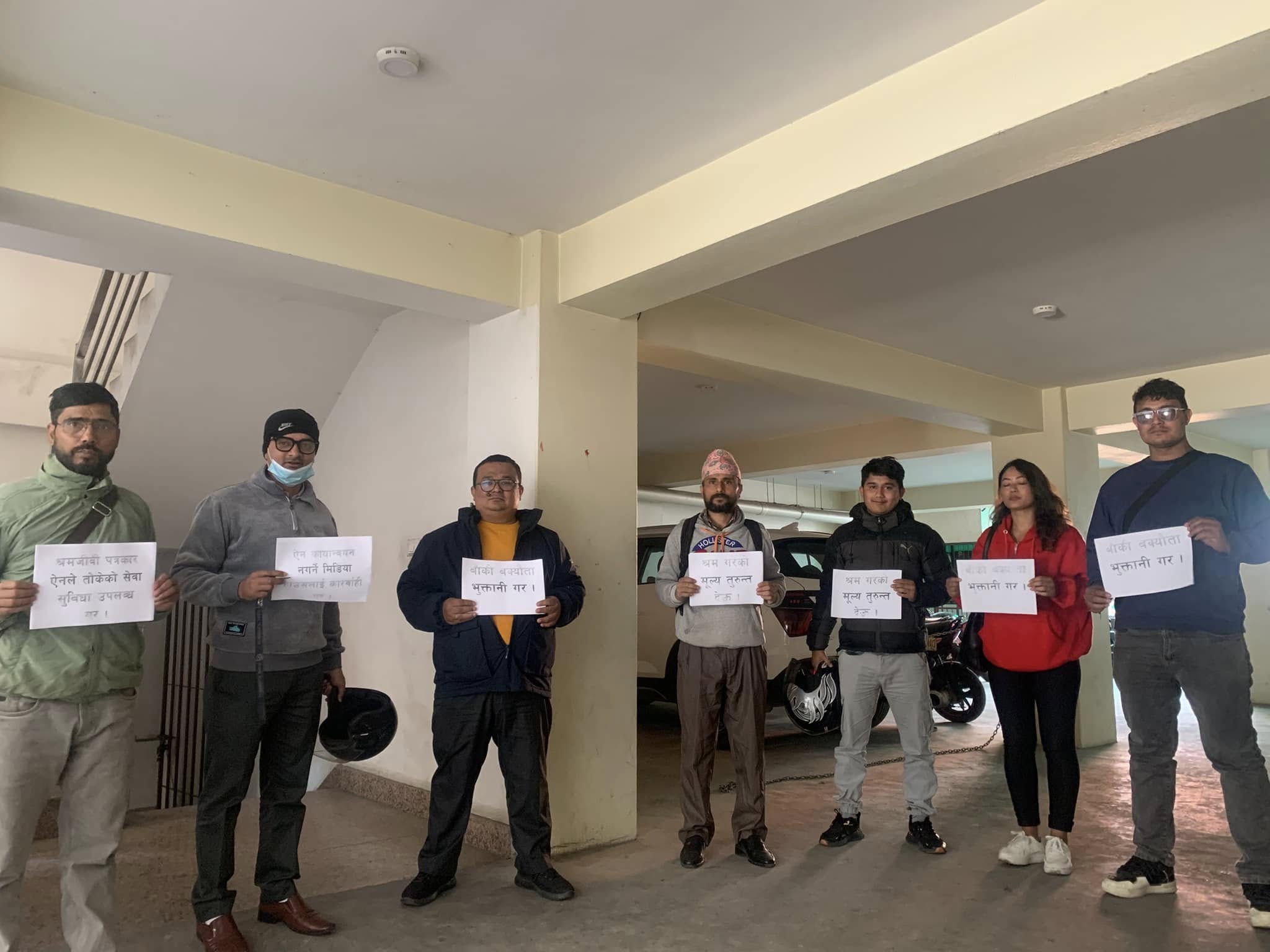
Journalists at Nepal Republic Media have been demanding that the management clear their back dues, some going back to six months. Photo: Courtesy of Janmadev Jaisi ![]()
Advertising in Nepali media has been steadily shrinking as advertisers increasingly shift to social media platforms. Shutterstock
Daya Dudraj
Published at : April 15, 2026
Updated at : April 15, 2026 17:49
Kathmandu
When journalist Suresh Rajak died on assignment in Tinkune on March 28 last year, he had not received a paycheck in ten months. His employer, Avenues Television, settled his outstanding salary only after his death triggered a wave of public outrage. The incident briefly forced into view what has been an open secret in Nepal’s media industry for the last few years: journalists across the country are routinely going months without pay, with little recourse and nowhere else to go.
“There’s nowhere to leave for,” one journalist at Mountain Television told Kantipur. “Every place is the same. Who do you even complain to?”
Nepal’s traditional journalism industry is in the middle of a slow-motion collapse that its own practitioners can no longer afford to ignore. Kantipur talked to 27 working journalists across print, television, and digital outlets, all of whom spoke on condition of anonymity, and said they were owed salary arrears stretching from two months to nearly a year. The problem spans the idealistic and the institutional, the niche startup and the publicly listed company — and it is pushing reporters out of the profession at a moment when the country, barely a year removed from a violent uprising, can least afford a weakened press.
What is happening in Nepal is an acute version of a global media crisis. Across the United States and Europe, the business model that sustained journalism for a century — built on advertising revenue and captive audiences — has been gutted by the shift to digital platforms. A few months ago, the Washington Post laid off more than 300 journalists in a single round. A Nieman Foundation report from April 2025 documented over 10,000 journalism job losses across just three years. Closer to home in India, the media and advertising industry lost more than 1,000 jobs last year, including at Zee Entertainment, a powerful conglomerate that runs close to three dozen channels worldwide.
But where Western outlets are grappling with revenue collapse and painful contraction, Nepal’s crisis has a different and in some ways harsher character: an industry that was never financially healthy, built on low wages and intermittent payment, now facing compounding stress — with no safety net, no severance culture, and no regulatory body willing to solve these issues.
According to the Federation of Nepali Journalists, at least 18 complaints related to professional insecurity were registered in 2025. The federation categorises issues such as non-payment of salaries on time and unlawful termination as cases of professional insecurity. Two years ago, only 11 complaints had been recorded at the federation, according to its annual report.
The scale of the growing problem is easiest to see at the extremes. Consider Ukaalo, which launched in November 2022 with an explicit commitment to running without advertising, funded entirely by reader donations. It represented something genuinely new in Nepali journalism. Its early work was celebrated: exposés on land grabs in Bansbari, irregularities at Balmandir, billion-rupee corruption in the President’s Educational Reform Programme, financial fraud by Devi Bhattachan and Ashok Sherchan at Prabhu Bank. Its reporters won major awards. Its investigations were taught in schools.
But since December of this year, Ukaalo’s journalists say they have not been paid. At least ten newsroom staff have resigned. One of the reporters, who was responsible for most of the major investigations, recently joined the new prime minister’s office as a press expert and researcher. Those who remain in the newsroom describe a crisis of faith — not just in their employer, but in journalism itself.
“At first I thought I’d found exactly the right place,” one Ukaalo journalist said. “The learning matched what I’d hoped for. Now I wonder if this profession is finished.”
The journalists say they have submitted formal grievance letters to management twice. Neither received a response. “We don’t even know where the management is,” one said. “When we ask the editor why salaries are delayed, there’s no answer.”
The publication’s editor-in-chief, Amod Pyakurel, acknowledges the recent challenges but says the problems are not a symptom of a failure of Ukaalo’s model, but rather the result of external factors like elections. “Our donors have temporarily held back from giving support, which has affected resource mobilisation,” he told Kantipur. “The model we adopted is what allowed us to strengthen independent journalism, so what’s happening now should not be viewed as a long-term crisis.”
Pyakurel said the organisation was committed to its journalists’ rights. “The current issues will be resolved soon, and we will continue to move forward as an independent non-profit outlet,” he said.
If Ukaalo’s crisis reads like a cautionary tale about an untested model, the situation at Nepal Republic Media Limited is harder to explain away. The parent company of Nagarik national daily, My Republica, and Nagariknetwork.com raised Rs 435.3 million from the public through an IPO in June 2023, marketing itself as Nepal’s first and only publicly listed media company. It currently holds the investment of 361,000 ordinary shareholders. It also received Rs200 million in concessional government loans during Covid-19, explicitly for staff salary payments and business continuity. Based on an audit report prepared by Pradhan & Shakya Associates, Nepal Republic Media Limited earned a net profit of Rs2.46 million last fiscal year.
And yet, some journalists at the publication say they have gone six months without regular pay. The federation has previously staged a lock-out at the company over the same issue.
“It’s not the same for everyone,” one Nagarik journalist said. “Some get paid faster, some slower. If you’re close to management, you get it quickly. Otherwise it gets held.”
Kantipur reached out to Nagarik for comment, but the publication’s editor-in-chief Guna Raj Luitel declined, saying he does not speak on administrative matters. Sambridhi Gyawali, whose family owns a majority stake in the publication, and was its CEO until last month, said she was not available to speak and asked to send a request to a generic administrative email. Kantipur did not receive any response to its email.
Journalists at Kantipur Media Group, which owns this publication, also say they have been facing salary delays. Half a dozen journalists across the two national dailies who agreed to speak for this reporting said they have not received their salaries for Falgun. Kantipur TV and Kantipur Radio journalists have received their pay for Falgun as of last week.
One Kantipur journalist noted that before Gen Z protests in September last year, arrears had stretched at one point to three months. Kantipur’s buildings and its owner’s home were both burned down during the protests. Although payments normalised after the protests, it has started to look inconsistent again for the past couple of months, the journalists say.
KMG, the largest media conglomerate in the country by reach and its size, employs more than 650 staff, of which 238 are newsroom staff. Once a thriving media business, KMG has seen its revenue drop by 70 percent over the last decade even as its core business model, newsroom practices and distribution systems remained largely unchanged. Sambhav Sirohiya, the group’s managing director, says he is clear-eyed about the problems facing the media industry, including Kantipur, but the solution cannot come from management alone.
“We not only need to rethink our business model and our content distribution strategy, we must also rethink what journalism means in this day and age,” Sirohiya told Kantipur.
Since Sirohiya took over the day-to-day operations three years ago, he has adopted cost-cutting measures, including a major restructuring across the organisation that saw dozens of staff laid off last year with financial packages. At the same time, he’s doubled down on investments in technology, making new hires to build automated systems for newsroom and operations. In an interview with Kantipur, he said he envisions a smaller newsroom in the future, but assured that journalists’ pay and their work’s impact will be higher. “We are investing in digitising our systems across the board,” he said. “Journalists who adapt by understanding different story formats, can distribute their content across platforms, and are attentive to how their stories are performing will ultimately thrive.”
The consequences of the industry’s challenges are not always abstract. Avenues Television’s Rajak case made that plain. Beyond his death, journalists at the outlet describe a workplace where salary delays are both severe and unevenly distributed. Of roughly 33 employees, some have gone 11 months without pay. Others say they haven't been paid for the last five months. Management, according to journalists, decides who gets paid and when based on no clear structure or philosophy. Avenues TV owner Bhaskararaj Karnikar, reached by Kantipur on April 10, put the arrears figure lower — three months — and said all dues would be cleared within days. When Kantipur asked one reporter five days later, he said he’d just received one month’s salary, while the previous six months’ dues were still unpaid.
Not every outlet’s crisis stems from dwindling advertising revenues. At Rajdhani — a publication with over two decades of history — the proximate cause is a family inheritance dispute. After the death of founding owner Mahendra Bahadur Sherchan, a property conflict among his survivors has paralysed the publication. Journalists there have not been paid for five months.
“We’re being crushed under the weight of their family fight,” one of the 13 journalists still employed there said. “They’re fighting over property and we're the ones suffering.”
Kantipur contacted Ashish Sherchan, managing director Director of Rajdhani Daily, to inquire about the labour issues at the publication and whether he had plans to resolve them. He declined to comment. “First, you should resolve your own issues at Kantipur, then I’ll speak,” he said.
Annapurna Media Network, one of the country’s larger media groups with a daily newspaper, radio station, and online platform under its umbrella, presents a murkier but no less troubled picture. Journalists at Annapurna Post say salary payments remain irregular, a problem they trace back to the Covid-19 period that has never been fully resolved. Some journalists at the Post and its sister publication Annapurna Express have not received their pay going back to 12 months.
“I have never received my salary on time in the last three and half years I’ve worked here,” one journalist said. “Sometimes they deposit some money once every two months, sometimes once every three months. I have repeatedly raised the issue with the management but they lie and insist they’re paying on time. I want to resign but fear that if I do so my arrears will not be cleared.”
The network’s general manager, Manoj Basnet, disputes that characterisation. “Since I took over sixteen months ago, salaries have gone out every month,” he told Kantipur. The gap between what management says and what journalists experience has become its own defining feature of Nepal’s media industry.
Prime TV journalists say they have not been paid for three months, a situation they describe as having worsened since the departure of Rishi Dhamala, the swashbuckling presenter who ran for a parliament seat last month and lost.
“When Dhamala dai was here, the salaries were late but at least it came,” one journalist said. “Since he left, it’s gotten worse.”
Mountain Television journalists report similar arrears of around three months each.
A journalist at Image Television said their salary was irregular. However, another journalist at the same organisation claimed that while there were delays in the past, salaries have been paid on time in recent months.
Image chairperson Direk Lal Shrestha denied any delay in payments. “It is completely wrong to say that salaries at Image are irregular. Since I assumed management leadership in July, 2025, payments have been regular. Salaries up to Falgun (mid-March) were cleared by the end of March,” he said.
Janmadev Jaisi, president of the Working Journalists’ Union, who has spent years on labour issues in the industry, says the picture he hears from contacts across newsrooms is consistent with what Kantipur found. “Most journalists I’m in touch with have not been paid,” he said. “If we enforce the Working Journalists Act, many of these problems would be resolved.”
What makes the crisis feel intractable is that enforcing the law, even when journalists know their rights, offers little relief. And the law itself does nothing to address the economics that have quietly hollowed out Nepali media for years — economics that a government decision last week may now accelerate into outright collapse.
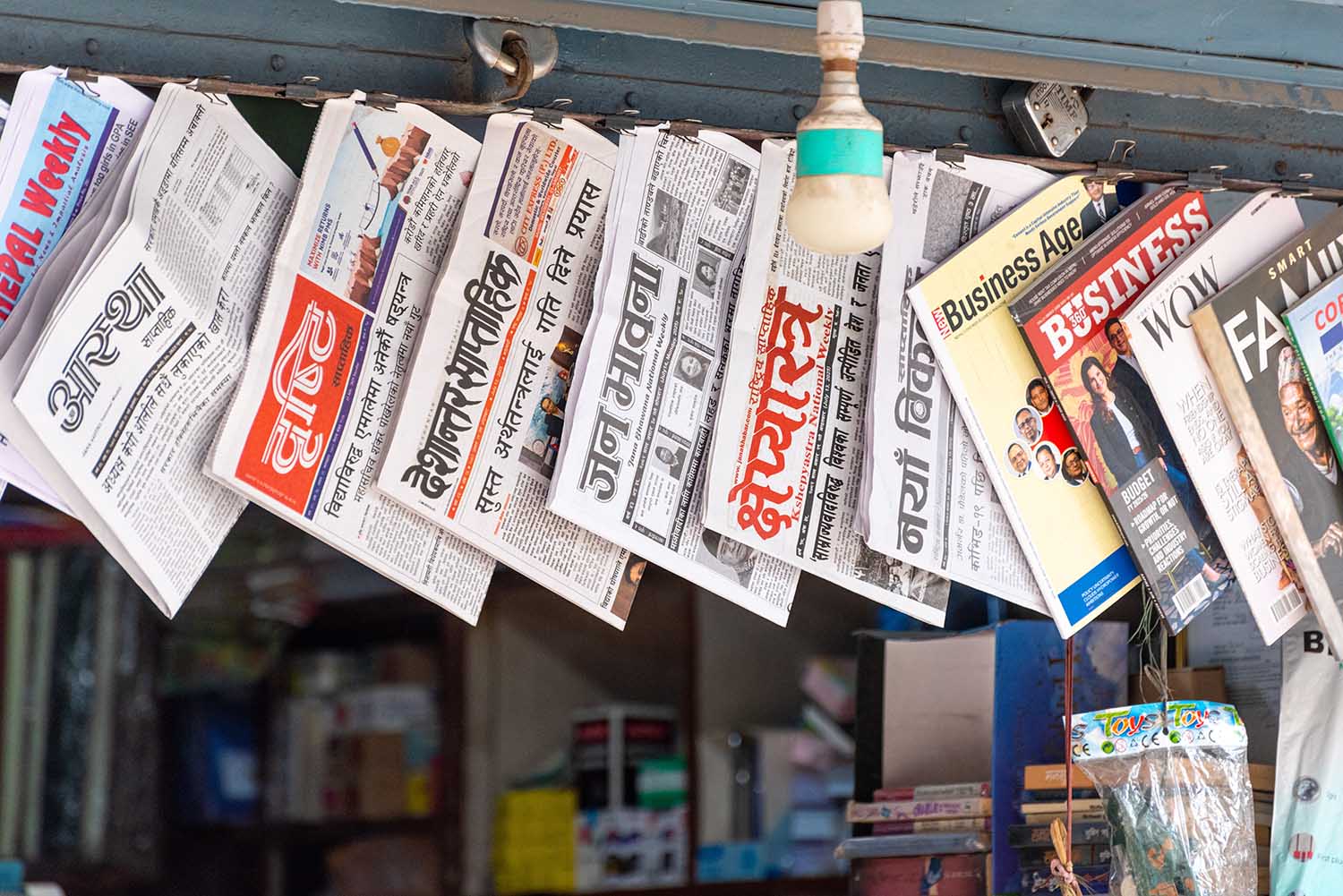
Nepal’s private media has long survived on a fragile dual dependency: government advertising and private sector advertising, neither of which was ever reliable or sufficient. Private advertising has been pulling back from print for years as audiences migrated online, and its commitment to digital has remained thin and inconsistent, concentrated in a handful of large Kathmandu outlets.
According to the Department of Information and Broadcasting, there are 14,842 media outlets registered across the country — 8,058 newspapers and magazines, 5,307 online platforms, 1,207 FM radio stations and 252 TV channels. This sprawling market competes for a shrinking pool of revenue, often from a handful of major business groups.
The advertising culture compounded the problem: outlets competing for the same clients, demanding equal treatment, accepting whatever rates were offered simply to stay alive. Smaller papers, local radios, and regional television stations survived on a mix of small private advertisements and steady government notices. Government advertising, in other words, was not supplementary income for most outlets. It was operating income.
On April 2, the Office of the Prime Minister issued a directive to place all official advertisements and public notices exclusively through state-owned media — Gorkhapatra, Radio Nepal, and Nepal Television, cutting off private media entirely. Officials say the move aims to address long-standing irregularities in the advertising market, where intermediaries and agencies have been accused of taking large commissions without benefiting either the state or media houses.
The industry’s reaction has been swift. The Advertising Association of Nepal said the ban would hit independent journalism and that the government could address market distortions through better monitoring — mandatory third-party billing, oversight by the Advertising Board or the CIAA — without cutting off private media entirely.
What is striking about the outcry is how little anyone in it addressed the salary crisis. The Federation of Nepali Journalists has been vocal about the ad ban as a press freedom issue. It has been considerably quieter about the fact that journalists at outlet after outlet have gone months without pay.
According to Jaisi, although the law allows journalists who haven’t received their pay to file complaints with the Press Registrar under the Department of Information, cases are often redirected to the Labour Office and then to the Labour Court, making the process lengthy and ineffective.
“In such a long process, it is difficult for journalists to get justice,” he said.
Though stories about unpaid wages and sliding revenue are common, not every outlet is struggling. Karobar national daily pays on the 15th of every month, journalists there say, with emergency funds available when needed. Arthik Abhiyan follows the same discipline. “Every month, on the 15th, the mobile notification arrives,” one journalist said. The Himalayan Times has made regular payments since 2025, though some older arrears are still being paid out incrementally.
Online outlets tend to perform better still. Setopati.com and Baahrakhari.com are cited consistently as reliable when it comes to paying their staff. Onlinekhabar had a roughly 50-day gap at one point but has since cleared all arrears.
“Our editor has been clear: if we can’t pay salaries, we shut down,” one Setopati journalist told Kantipur. “So ours is regular. Same day every month, the money arrives.”
For others, the issue is grim.
“My friends have left,” one Naya Patrika journalist said. “The ones who remain — I don’t know how much longer they’ll stay.”
Another Ukaalo journalist was more blunt: “I chose the wrong profession.”
The story has been updated to include additional comments from Image Television’s management.
Daya Dudraj
Dudraj covers media, ICT and youth issues for Kantipur Daily.




Most Read from Money

Why does an hour long flight to Dhangadhi cost more than a flight to New Delhi?
Nepal travel agents threaten to stop selling Thailand trips over visa rules
Malaysia rejects Nepal’s demand to open recruitment to all manpower agencies

No school, but a graduation cap for women dairy farmers
Nepal arrests four medical service providers as Malaysia recruitment row deepens
Editor's Picks




E-PAPER | October 24, 2026

×