



 22.06°C Kathmandu
Tue, Oct 20, 2026
Money
Indian duties batter Nepal’s steel exports, wipe out billions in earnings
Shipments plunge over 77 percent as safeguard tariff and policy hurdles hit high-value goods.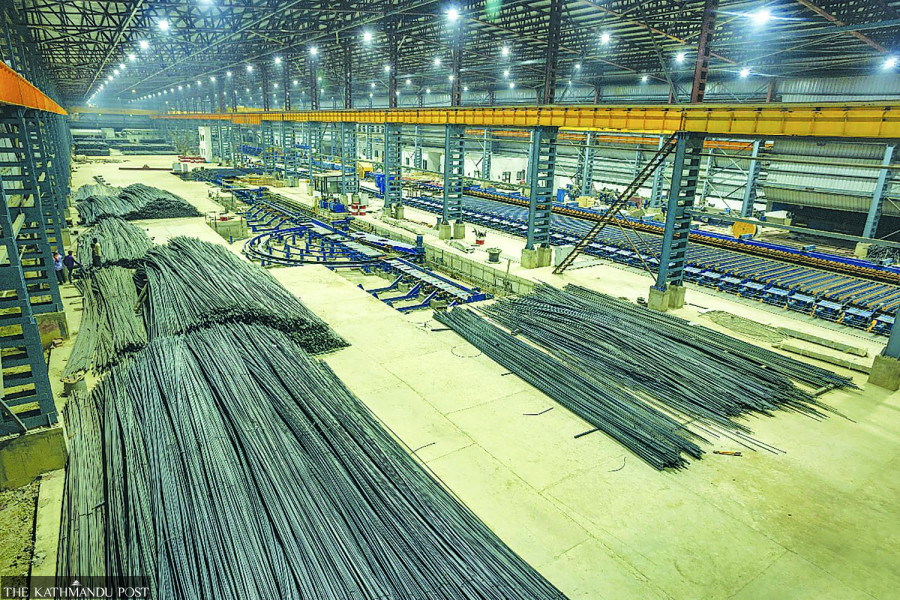
bookmark
Krishana Prasain
Published at : April 7, 2026
Updated at : April 7, 2026 06:03
Kathmandu
The imposition of hefty import duties by India on iron and steel products has sharply dented Nepal’s export potential, causing losses of billions of rupees and pushing domestic manufacturers into crisis.
Nepal’s iron and steel exports plunged by 77.28 percent to Rs2.34 billion in the first eight months of the current fiscal year, down from Rs16.35 billion in the same period last year.
Industry insiders say the slump has translated into a loss of around Rs14 billion for manufacturers who had invested heavily targeting the Indian market.
The downturn follows India’s move to impose a three-year safeguard duty ranging from 11 percent to 12 percent on select steel products, alongside earlier requirements related to Bureau of Indian Standards (BIS) certification.
The tariff, introduced in December last year, is aimed at curbing cheaper imports, particularly from China, but also applies to “developing countries” including Nepal and Vietnam, according to Reuters.
Under the provision, the duty stands at 12 percent in the first year, tapering to 11.5 percent in the second and 11 percent in the third. Specialty steel products such as stainless steel are exempt.
“We are not a developing country, yet the tariff has been imposed on us,” said Sunil Manot, chief finance officer of Hulas Steel Industries. “The BIS certification issue has largely been resolved, but this duty has brought Nepali steel producers to their knees.”
Nepal’s steel exports have traditionally been dominated by zinc sheets, with India serving as the primary market. Industry officials say diplomatic engagement could help ease the restrictions.
The collapse in iron and steel shipments has dragged down Nepal’s high-value exports, even as overall export earnings rose by 20.83 percent to Rs191.11 billion in the review period ending mid-March. The growth was largely driven by re-exports of edible oils—soybean, palm and sunflower oil—worth a total of Rs86.87 billion.
By contrast, exports of goods identified under the Nepal Trade Integrated Strategy (NTIS) 2023 slipped by 0.38 percent to Rs65.68 billion, reflecting weak performance in value-added sectors.
Former commerce secretary Chandra Ghimire warned that the trend is particularly concerning as Nepal prepares to exit the least developed country (LDC) club by November this year, a transition that will end preferential zero-tariff market access.
“If we fail to make our domestic products competitive in cost, quality and quantity, sustaining exports after LDC graduation will be far more challenging,” he said, urging stronger coordination among government agencies.
He added that the Rastriya Swatantra Party (RSP) government’s target to build a $100 billion economy with 7 percent growth and create 1.2 million jobs all hinge on strengthening productive sectors, particularly exports.
Trade experts also caution that ongoing tensions in West Asia could further disrupt Nepal’s export performance by driving up production costs. Nepal’s manufacturing costs are already estimated to be over 20 percent higher than those of regional competitors, making its products less competitive in international markets.
Analysts argue that Nepal should discourage low value-added re-exports such as edible oils through industrial policy while incentivising higher value-added goods. “This will automatically shift the export structure towards more sustainable products,” Ghimire said.
Although NTIS 2023 replaced the earlier 2016 strategy, its implementation has been hampered by weak coordination among agencies, officials admit. As a result, several key export items have recorded declines.
Yarn exports fell by 1.95 percent to Rs9 billion, while woollen carpet shipments dropped 9.33 percent to Rs6.53 billion. Tea exports plunged 22.63 percent to Rs2.67 billion, and handmade paper exports declined 3.8 percent to Rs806.88 million. Likewise, spice exports also dropped sharply by 23.87 percent to Rs205.72 million.
However, some sectors posted gains. Large cardamom exports surged 62.41 percent to Rs9.46 billion, while footwear exports jumped 78.39 percent to Rs2 billion. Pashmina shipments rose 21.44 percent to Rs2.56 billion, and jute products increased by 33.23 percent to Rs6.87 billion.
Other exports showing growth included felt, fabrics, medicinal herbs, rosin, ginger, essential oils, jewellery, lentils, vegetables, fruits, coffee, honey and pasta.
Despite these gains, economists warn that the decline in high-value industrial exports such as steel underscores structural weaknesses in Nepal’s export sector, which could become more pronounced after the country’s LDC graduation.
Krishana Prasain
Krishana Prasain is a business reporter for The Kathmandu Post covering markets. Before joining The Kathmandu Post in 2018, she spent 3 years in New Business Age magazine covering business.



Most Read from Money

Nepal travel agents threaten to stop selling Thailand trips over visa rules

Why does an hour long flight to Dhangadhi cost more than a flight to New Delhi?

Malaysia rejects Nepal’s demand to open recruitment to all manpower agencies

No school, but a graduation cap for women dairy farmers

Nepal arrests four medical service providers as Malaysia recruitment row deepens
Editor's Picks




E-PAPER | October 20, 2026

×