Air pollution clouds health, tourism, and economy in Nepal
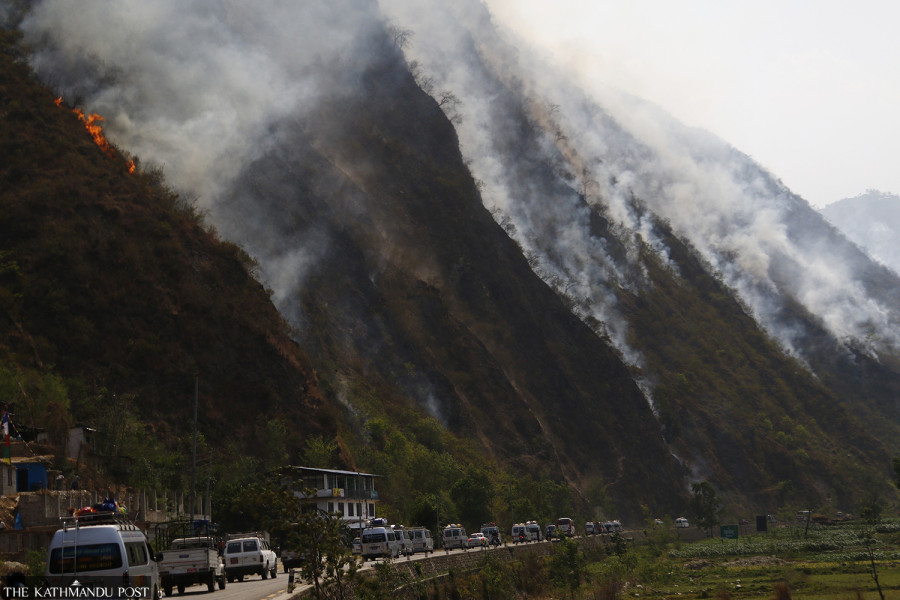
From flight disruptions to growing health costs, unchecked air pollution hitting lives, livelihoods and tourism. Forest fires rage in Sunkoshi Rural Municipality in Sindhuli district in April 2021. Post file photo
Pokhara, Nepal’s tourism capital, was shrouded in a thick haze during the peak tourist season in 2024, dimming its iconic mountain vistas and disrupting air travel. Scores of flights were cancelled or delayed due to poor visibility, leaving many tourists—particularly those visiting for mountain sightseeing—deeply disappointed.
Until a few years ago, Pokhara was regarded as an exceptional city, largely free from air pollution. That reputation is now fading.
Janakpur and Chitwan face similar plights.
Airline officials say flights to and from Janakpur, Pokhara and other tourist destinations are frequently cancelled or delayed because of haze, mainly during spring, one of Nepal’s busiest tourism seasons.
In Pokhara, locals say even the mountains—the city’s primary draw—are often invisible.
The growing crisis has now drawn global attention.
In its latest report, the World Bank says air pollution has emerged as the number one risk factor for death and disability in Nepal, surpassing malnutrition and tobacco use. Without urgent additional measures, the bank warns, air pollution could cause irreversible damage to both public health and the economy.
According to the report, fine particulate matter—PM2.5—is the single biggest contributor to Nepal’s economic burden from pollution.
In 2015, PM2.5 exposure alone caused a loss of $130 million in economic output and a total welfare loss of $1.36 billion. These estimates, presented in the World Bank’s Country Environmental Assessment, represented about 0.6 percent and 6.4 percent of Nepal’s annual economic activity, respectively.
More recent estimates, using updated methodologies and values, paint an even bleaker picture. Welfare losses from ambient air pollution reached $1.4 billion in 2019. When household air pollution is added, the combined cost rises to more than $3.1 billion—equivalent to over 10 percent of Nepal’s gross domestic product.
PM2.5 particles, with a diameter of 2.5 micrometres or less, are approximately 30 times smaller than a human hair. Their microscopic size makes them nearly invisible, but also allows them to penetrate deep into the lungs and vital organs, posing a severe threat to human health.
“If no additional measures are taken, the impact of air pollution is projected to intensify significantly by 2035,” the report, titled Towards Clean Air in Nepal: Benefits, Pollution Sources, and Solutions, states.
Under a baseline scenario, average PM2.5 concentrations are projected to reach 52 micrograms per cubic metre in the Kathmandu Valley and 42 micrograms per cubic metre in the Tarai. Both figures are far above the World Health Organization’s interim target of 35 micrograms per cubic metre.
“These levels would result in tens of thousands of additional premature deaths, particularly affecting children and the elderly, place further strain on the healthcare system, and increasingly drag down productivity and competitiveness,” the report says.
“Without intervention, the economic burden is expected to grow proportionally, underscoring the cost of inaction that leads to irreversible damage to health and the economy.”
The tourism industry is already feeling the effects.
Ang Tshiring Sherpa, a veteran mountaineering expert, says pollution is no longer confined to cities. “There are reports that even in the mountains, black particles caused by pollution are visible,” he said. “This demands urgent measures for the country’s tourism economy, of which the mountains are a centrepiece.”
The World Bank has identified the Kathmandu Valley and the Tarai as Nepal’s air pollution hotspots, noting that pollution levels in both regions have failed to show significant improvement over the past decade.
Air pollution concentrations are highest in Kathmandu and the southern plains of the Tarai near the Indian border. Trend analysis in the report shows that pollution levels have remained largely unchanged over the last ten years, despite growing awareness and policy commitments.
The World Health Organization has set clear benchmarks to guide countries in reducing air pollution. Its ultimate guideline for annual mean PM2.5 concentration is 5 micrograms per cubic metre, with an interim target of 35 micrograms to encourage incremental progress.
Current pollution levels in Nepal far exceed both thresholds, highlighting the scale of effort required.
Air pollution reduces life expectancy in Nepal by an average of 3.4 years and causes approximately 26,000 premature deaths annually, the World Bank estimates.
It contributes to 75 percent of chronic obstructive pulmonary disease cases, 46 percent of strokes, 44 percent of ischemic heart disease, 41 percent of lower respiratory infections, 38 percent of lung cancer cases, 30 percent of neonatal complications such as low birth weight and preterm birth, and 20 percent of diabetes cases.
In the Kathmandu Valley, the main sources of air pollution are industrial production, cooking and mobility. These sectors will continue to pollute over the next decade unless stronger interventions are introduced.
Industrial fuel combustion—particularly from boiler use—is projected to rise significantly.
Forest fires, which peak during the dry months from February to May, constitute the fourth-largest local source of annual average pollution exposure, a metric closely linked to adverse public health impacts.
Transboundary air pollution further compounds the problem.
Around a quarter of the pollution in the Kathmandu Valley originates outside the valley, with more than half of that coming from outside Nepal. Despite being surrounded by hills, the valley is vulnerable to regional pollution transported by wind patterns and atmospheric conditions.
In the Tarai, transboundary pollution is even more dominant. Around two-thirds of PM2.5 exposure there comes from across international borders, largely driven by agricultural and industrial emissions in the Indo-Gangetic Plains and Himalayan foothills, the report states.
Stubble burning has now emerged as a growing concern in eastern Nepal too.
Tika Dutta Ban, founder chairman of Sagun Cooperatives in Sunsari, told the Post in a recent interview the practice—long common in India—has started to spread in Nepal due to labour shortages.
Straw that was once reused for livestock feed or roofing is now often burned.
His cooperative has begun using super seeders, a technology that shreds paddy straw and allows it to decompose naturally in the field. “These machines eliminate the need to burn fields, but not everyone is practising this,” Ban said.
The aviation sector is increasingly affected.
Dipendra Karna, media manager at Buddha Air, said forest fires and stubble burning have disrupted more and more flights in recent years. “Last year, forest fires significantly affected flights, particularly in Chitwan, Simara and Pokhara. This trend has been increasing slowly but steadily,” he said.
Former environment minister Ganesh Shah told the Post recently that policy contradictions undermine progress.
“The government talks about clean energy, yet it imposes VAT and excise duty on goods like biomass pellets,” he said, calling for such tax exemptions if Nepal is serious about transitioning industries away from fossil fuels.
He pointed to India’s mandate requiring coal-based industries to blend 5 to 10 percent biomass pellets with conventional fuels as a model Nepal could adopt.
The World Bank has proposed a suite of measures to curb air pollution.
In the Kathmandu Valley, it says the WHO interim target can be achieved through three priority actions: cleaner industrial production, cleaner cooking solutions and cleaner heavy-duty vehicles. These measures are among the most cost-effective, with costs ranging from $1 million to $5 million for each microgram per cubic metre reduction in PM2.5.
In the Tarai, however, these measures alone are insufficient. As most pollution originates across borders, the report stresses the need for regional coordination across the Indo-Gangetic Plains and Himalayan foothills. While the Tarai could theoretically meet targets independently, doing so would be expensive.
Nepal has introduced pollution taxes since 2008 and a green tax in 2024. To enhance their impact, the World Bank recommends redirecting revenues to clean transitions, including cleaner industrial technologies, subsidised electric cooking and investments in electric vehicle (EV) infrastructure.
Aligning fiscal and environmental policies and consolidating overlapping levies would improve transparency and public trust.
Addressing air pollution would bring significant co-benefits, including improved energy security, reduced reliance on imported fossil fuels, industrial cost savings and better urban livability. These gains align closely with Nepal’s Sustainable Development Goals and climate commitments.
However, the report cautions that transitions must be carefully managed.
Shifts away from polluting industries could cause localised job losses unless paired with green job creation. Managing these trade-offs will be critical to ensuring a just and sustainable clean-air transition.
Addressing air pollution is also central to the World Bank Group’s Country Partnership Framework for Nepal for 2024-25 to 2030-31, underscoring the urgency of action as pollution increasingly threatens lives, livelihoods and Nepal’s global image as a pristine destination.
Reduced duty on EVs has emerged as Nepal’s most significant subsidy policy for cleaner transport. The government has slashed import duties and excise taxes on EVs to encourage the substitution of fossil fuels with domestically generated hydroelectricity, while also cutting local air pollutants and carbon dioxide emissions from the transport sector.
Under the current tax regime, EVs enjoy substantially lower import duties and excise taxes compared to their Internal Combustion Engine (ICE) counterparts, creating a clear price advantage aimed at accelerating adoption.
For instance, a 1,000 cc ICE light-duty vehicle costs, on average, Rs3.06 million in Nepal. Of this total, costs, import duties and taxes—including 13 percent value-added tax—account for Rs2.18 million, or about 71.2 percent of the final price.
By contrast, an equivalent-sized EV with a motor capacity of less than 50 kilowatts costs around Rs2.41 million. Duties and taxes account for only 23 percent of this price. As a result, EVs in this category are about 21 percent cheaper than comparable ICE vehicles, primarily due to significantly lower tax and duty rates.
Nepal’s tax structure thus provides a strong fiscal incentive in favour of electric mobility.
Duties and taxes, including VAT, imposed on ICE vehicles as a percentage of their border price—calculated on a cost, insurance and freight (CIF) basis—are far higher than those levied on EVs.
On average, taxes on ICE light-duty vehicles amount to 247 percent of their CIF price, while the equivalent figure for EVs is only around 30 percent.
The scale of this incentive becomes clearer when hypothetical comparisons are made.
If EVs were taxed at the same rates as ICE light-duty vehicles, their price would jump to around Rs6.43 million—almost three times their current cost. This means that, on average, an electric light-duty vehicle in Nepal receives an implicit subsidy of roughly Rs4 million through reduced duties and taxes.
These fiscal incentives have made EVs far more affordable and have played a central role in promoting their adoption, particularly in urban areas such as Kathmandu Valley.
The World Bank notes that such price advantages are crucial for reducing emissions from the transport sector, one of the major contributors to PM2.5 pollution in Nepal, while simultaneously strengthening energy security by reducing dependence on imported fossil fuels.
However, the report also stresses that sustaining and expanding the shift to cleaner transport will require complementary investments, including charging infrastructure, grid upgrades and consistent policy signals, to ensure that gains from EV adoption translate into lasting improvements in air quality and public health.
Sangam Prasain is Business Editor at The Kathmandu Post, covering tourism, agriculture, mountaineering, aviation, infrastructure and other economic affairs. He joined The Kathmandu Post in October 2009.




 25.92°C Kathmandu