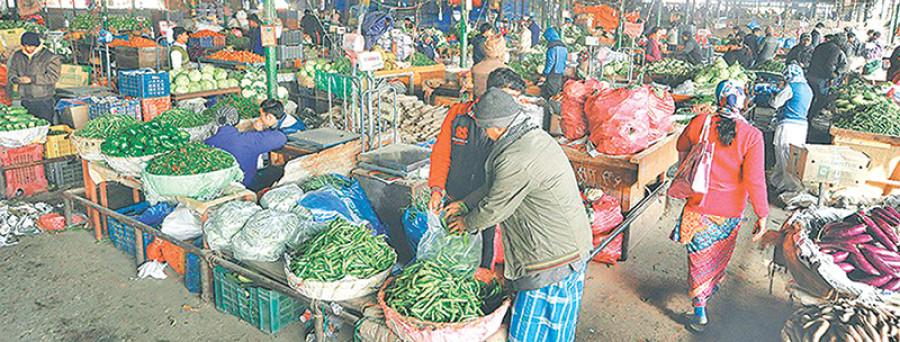
Vegetable prices vary greatly in different parts of the Kathmandu Valley, prompting consumers to accuse sellers of engaging in fraudulent practices.
A snap survey conducted by the Post at five key vegetable markets, namely Kalimati, Balaju, Chabahil, Bagbazaar and Jawalakhel, revealed widely differing prices for the same produce.
Most retailers in the Valley purchase vegetables from the Kalimati Fruits and Vegetable Wholesale Market, the largest vegetable market in the country. Yet there is no consistency in prices when the farm products are sold to consumers residing in different parts in the Valley.
For instance, the retail price of cauliflower is Rs70 per kg in Kalimati. The same product costs Rs100 to Rs120 per kg in Balaju, and Rs80 to Rs90 per kg in Chabahil. In Jawalakhel, it costs Rs100 per kg.
It’s the same with potatoes, which is available for Rs25 per kg in Kalimati, but costs Rs35 to Rs40 per kg in Balaju, Rs30 per kg in Chabahil and Rs40 per kg in Jawalakhel. Prices of other vegetables like cabbage and capsicum also vary greatly.
“The markup added by retailers vary, so prices differ from place to place. If consumers can afford to pay, they will buy the vegetables. Otherwise, they will bargain and bring down the price to a level they can afford,” said Sharmila Karki, a vegetable retailer at Bagbazaar. “It is not fair to compare our prices with those at the Kalimati market.”
No one can control prices in a free market economy. And retailers have the right to fix prices. But most retailers do not use scientific methods to fix the price by taking transport costs and other factors into account. As a result, end consumers are the ones who suffer. Take for instance the price of cabbage. It costs Rs20 per kg in Kalimati. You go to a shop in Balaju or Jawalakhel, and they will charge you double. In Chabahil, one may even have to fork out as much as Rs50 per kg.
“This is profiteering,” said Prem Lal Maharjan, president of the National Consumers Forum. “And this is the result of lack of effective market monitoring by the government.”
Although there is a broad understanding that markets should be allowed to function on their own based on the principles of demand and supply, Maharjan said factors such as wholesale price and transportation cost should be taken into account while fixing prices.
Ram Thapa, a vegetable seller in Jawalakhel, said most retailers do not have any option other than to add a hefty profit margin because vegetables are a perishable commodity.
“The risk factor in the vegetable business is high because there is no guarantee that the shipment will be sold within a day,” said Thapa. “If we can’t sell a shipment that arrives in the morning by the same evening, the vegetables will start to rot and we will lose a lot of money. So we factor in this risk as well while fixing the retail price.”




 20.12°C Kathmandu