Kantipur Economic Summit highlights push for reforms, policy stability and private-sector-led growth
Finance minister says upcoming budget will prioritise digital economy, while business leaders warn policy uncertainty is discouraging investment. Angad Dhakal/TKP
Finance Minister Swarnim Wagle on Wednesday said the government’s policies and programmes were aligned with its agenda and commitments, and that the upcoming budget would take the same direction.
Addressing the Kantipur Economic Summit 2026 virtually, Wagle said the government would prioritise e-governance, digital service delivery and the digital economy in the upcoming fiscal year, stressing the need to make public services more efficient through digital systems.
“We have paid the price of poor governance, and now it is time to reap the dividends of good governance,” the minister said.
Speakers at the summit called for governance reform, policy stability, stronger public-private cooperation and accelerated digital transformation, saying Nepal’s economic ambitions cannot be achieved without restoring investor confidence and improving the business environment.
Wagle said the government would move to restructure the import-based economy and work to reduce the tax burden on the middle class.
At the summit’s opening fireside conversation, David Sislen, division director for the Maldives, Nepal and Sri Lanka at the World Bank, said Nepal must place the private sector at the centre of its development strategy, particularly in infrastructure development and job creation.
Minister Wagle said several international studies had shown Nepal’s environmental conditions were highly suitable for developing data centres. He also said all work related to the information technology sector would now be handled through the Office of the Prime Minister and the Council of Ministers.
Speaking at the summit in Kathmandu, Sislen said relying solely on government investment would not be enough to meet Nepal’s infrastructure and economic ambitions.
He said Nepal needed to change the way it viewed private enterprise and treat it as an engine of economic growth, citing India’s economic transformation after opening greater space for the private sector.
“Even today, profit-making is often portrayed negatively on social media,” Sislen said. “The private sector should be regulated and managed properly, but the government must work in partnership with businesses.”
Sislen said Nepal was at a critical stage of economic transition and that the next 12 to 18 months would be decisive in shaping the country’s future direction.
Highlighting the country’s employment crisis, he said nearly 2,000 Nepalis leave the country every day in search of jobs abroad. According to him, around 1.2 million Nepalis had left the country during the 21 months he had been in Nepal.
“If this trend continues, the number of people leaving over the next four years will equal Kathmandu’s current population,” he said.
Sislen also raised concerns over the future of foreign employment as artificial intelligence disrupts labour markets globally. He said the World Bank had placed employment generation at the centre of its agenda for Nepal.
According to Sislen, Nepal required reforms in three key areas, infrastructure, policy and finance, to address the employment crisis and support private-sector growth.
He said Nepal managed to spend only 59 percent of its capital budget last year, highlighting weak infrastructure execution capacity, while uncertainty in the tax system remained a major obstacle for businesses and investment.
Sislen said the government appeared clearer about potential areas for employment generation and noted that Nepal could emerge as a powerhouse in agriculture while also expanding its service economy through tourism and information technology.
“Kathmandu has possibilities that few cities in other continents have,” he said, expressing optimism about the city’s potential in the IT sector.
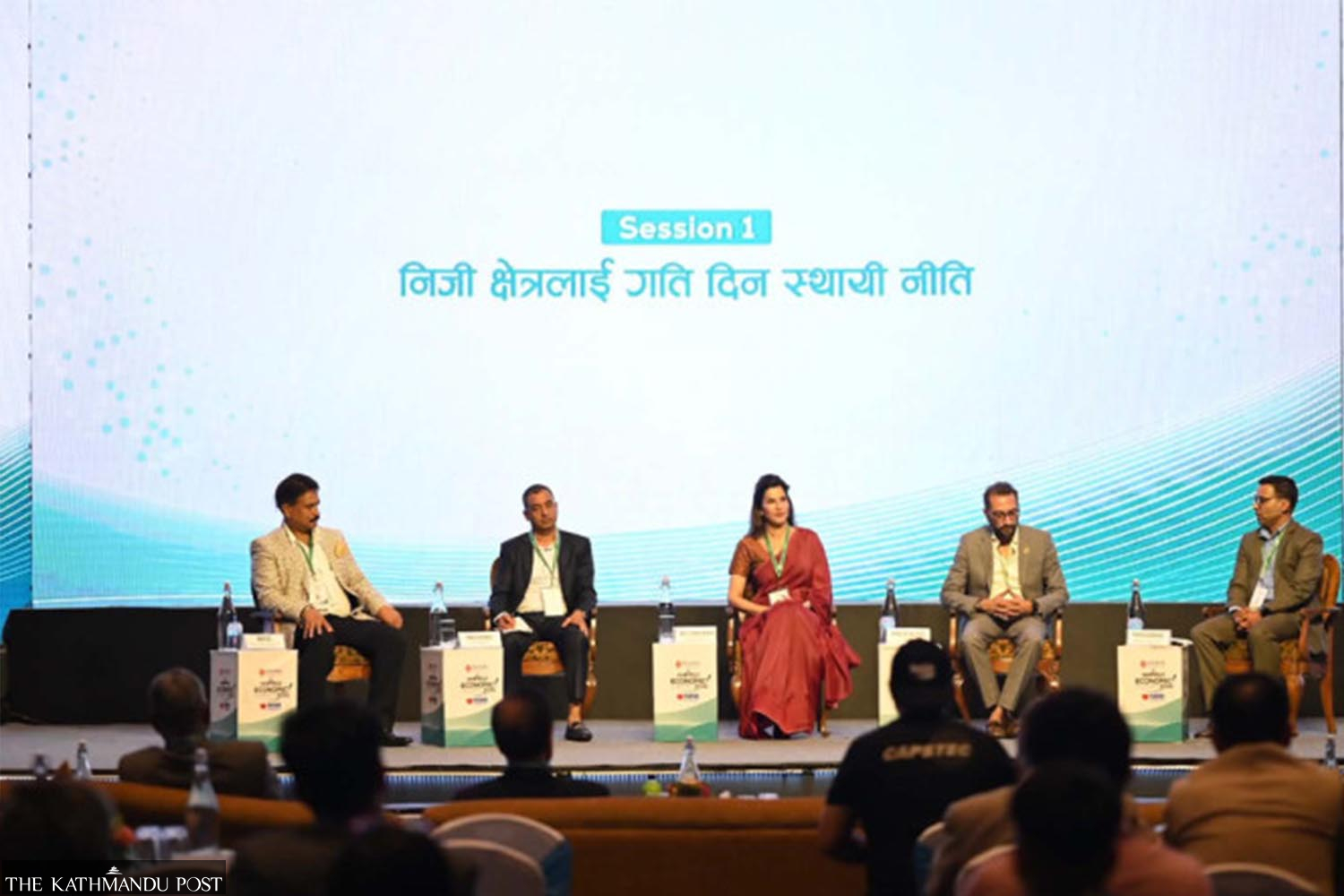
Business leaders speaking at the first session of the summit, titled “Driving private sector growth: Policy, partnership and progress”, said frequent policy changes and regulatory uncertainty were discouraging investment and industrial expansion.
Ravi KC, vice-president for corporate affairs at Surya Nepal, criticised the jailing of businesspeople over tax-related issues, saying entrepreneurs should not be treated as criminals simply because businesses seek profits.
He said detaining industrialists who had spent decades building businesses and creating employment generated fear across the business community and discouraged entrepreneurship.
“No nation can achieve economic growth unless the government and the private sector work in partnership,” KC said. “The government is merely a facilitator. All actual development work must be carried out by the private sector.”
He said recent ordinances introduced by the government had raised hopes that some private-sector concerns would be addressed, but stressed that long-term policy stability remained essential.
Hitesh Golchha, director of Diwakar Golchha Organisation, said domestic industries had helped keep the country stable during crises such as the border blockade and the Covid pandemic, but policy instability continued to undermine industrial growth.
“Business demands policy stability,” Golchha said. “When you invest billions in large-scale industries, it takes four to five years just to get off the ground, stabilise operations and establish a brand in the market. If the rules of the game change five times in those same five years, success becomes impossible.”
He said governments often rewrote laws to target individuals rather than reforming policies systematically, adding that such practices weakened good governance.
Hem Raj Dhakal, co-founder and managing director of IME Group, said Nepal had strong potential to compete globally through an IT and knowledge-based economy.
Dhakal welcomed the government’s current focus on the IT sector, citing Nepal’s young workforce and English-speaking population as major advantages.
“Data from the last few years shows that Nepal is already exporting IT services worth approximately Rs20 billion annually,” he said.
Panellists pictured at the Kantipur Economic Summit in Kathmandu on Wednesday. Angad Dhakal/TKP
However, Dhakal said policy inconsistency continued to affect the sector. “Taxes on IT exports have fluctuated from one percent to 10 percent and then five percent,” he said. “A stable policy will boost the confidence of the sector.”
Dhakal said Nepal’s IT sector could contribute more than two percent to GDP, but this would require stronger digital infrastructure, including connectivity and payment systems.
“While the private sector should lead, the government must provide the foundational infrastructure,” he said.
He also warned that rapid digitalisation had increased cybersecurity risks and made retaining skilled manpower more difficult and expensive.
Ritu Singh Vaidya, president of the Nepal Automobile Importers and Manufacturers Association and managing director of VOITH Group, said businesses were suffering because economic policies changed with every change in government.
“There should be a national consensus on economic policy regardless of which political party comes to power,” she said. “Stable policies are necessary for economic progress.”
Vaidya also criticised the requirement to place maximum retail price labels on imported goods at customs points, saying the process was impractical and increased costs and delays for importers.
Speaking at the summit’s second session titled “Budget: Beyond figures, towards purpose,” Finance Secretary Ghanshyam Upadhyaya said the government’s priorities for the upcoming fiscal year had already been outlined in the policy and programme document, with good governance remaining the top focus.
He said economic reform and infrastructure development would follow as key priorities, with investment and facilitation forming the foundation of those efforts.
Upadhyaya said supportive government policies over the past decade had helped Nepal become self-sufficient in cement production and transformed the country from enduring up to 18 hours of daily outages to exporting electricity.
“The government has worked to reduce import dependency and facilitate growth in productive sectors through policy measures,” he said.
He added that restoring private-sector confidence had become essential, saying businesses sought guarantees of property rights and personal security.
Upadhyaya also said the government planned to involve the private sector more actively in public infrastructure development and profit-oriented projects, while the upcoming budget would place special emphasis on completing unfinished projects.
Other speakers at the session said Nepal could not achieve long-term economic growth targets without innovation, industrial productivity and stable policies.
Anjan Shrestha, president of the Federation of Nepalese Chambers of Commerce and Industry, said the private sector had suffered for years because of unpredictable government decisions.
“We keep jailing businesspeople and then expect them to think freely and innovate,” Shrestha said. “If businesses do not have the freedom to operate with an open mind, how can innovation and research flourish?”
He said policy reversals by successive ministers had created uncertainty among investors.
Biswash Gauchan, executive chair and director at the Centre for Economic Policy under the Institute for Integrated Development Studies, said Nepal was unlikely to achieve a 100-billion-dollar economy within the next five to seven years under the current pace of growth.
He said the government’s target of maintaining average annual economic growth of 7 percent over the next decade would require far stronger and sustained reforms.
“While we continue discussing second-generation reforms, we should be building an economy capable of competing globally,” Gauchan said.
He argued that both the government and private sector had failed to prioritise innovation and said Nepal had yet to produce a fully successful public-private partnership project.
Economist Anjana Lamichhane said Nepal’s production and industrial sectors remained weak, while private investment continued to lag despite excess liquidity in banks.
“Even though banks have liquidity, investors lack confidence, which has prevented investment from increasing,” she said.
Lamichhane also said the government should avoid scattering budget allocations across numerous small projects and instead focus spending on programmes that deliver measurable results.




 21.05°C Kathmandu