Is AI killing our creativity? Experts warn convenience may come at a cost
As generative AI becomes the first stop for ideas and answers, experts question whether people are losing the habit of thinking and creating for themselves. Shutterstock
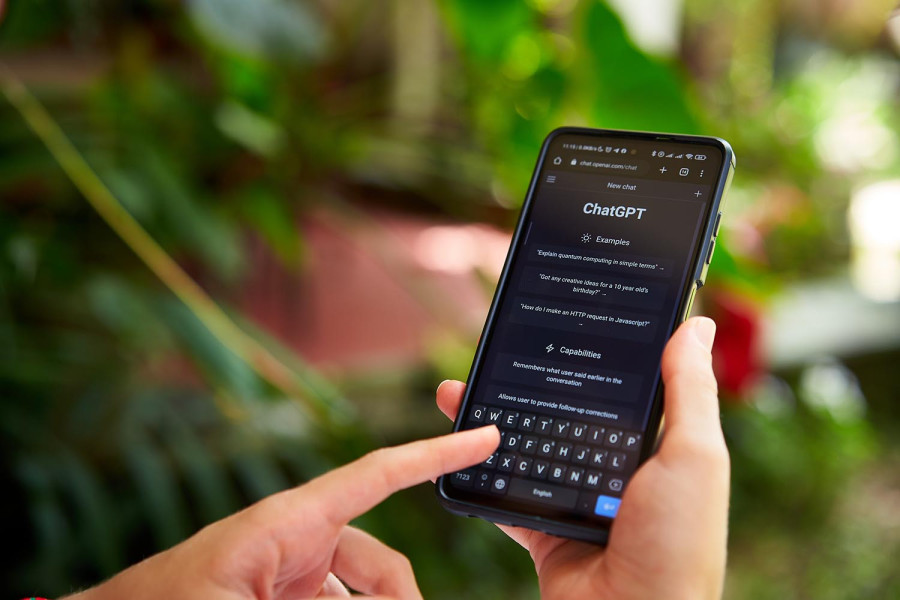
When college student Sapana (name changed) sits down to write an essay, she pulls up the ChatGPT page in her browser. She asks the chatbot to generate ideas for her piece. Then, she begins writing. She does not proofread the paper. Why would she? Instead, she opens ChatGPT again, copies and pastes what she has written, and asks the AI platform to check her article for errors.
ChatGPT will rephrase Sapana’s sentences or, in her words, “fix them.” Sapana may review the article or tweak the phrasing in a few places. Then, she submits it.
Her approach is not uncommon. Most of Sapana’s college friends use AI regularly in their studies. It is accessible and easy. “My first thought is always, ‘I need to ask ChatGPT,’” Sapana says. “Why not use it?”
According to Aarati Gurung, psychologist at CMC-Nepal (Center for Counselling and Mental Health), this instinct is natural. “The human brain is always ready to grab the easiest things,” Gurung explains. “AI makes the process easy.”
But AI experts say that convenience may come at a cost. As tools like ChatGPT become the first stop for brainstorming and problem-solving, some worry that overreliance on AI is hindering creativity.
“Creativity is a very complex process,” says Dovan Rai, a computer scientist and information technology expert. According to Rai, creativity often requires friction, uncertainty and silence—moments where people sit with problems long enough to explore different pathways. “You get creative ideas when you are walking or showering,” she says. “Because it is about making the connections in your brain that are not obvious.”
Before Sapana knew of ChatGPT, she would reread her own writing. When she was confused about a concept in class, she asked her friends for help. Now, that process has completely changed. Recently, she was learning about yellow journalism and struggling to understand the topic. “I didn’t ask my friends or go to the library or talk to my professors,” Sapana says. “I just went straight to ChatGPT.”
And this is where Gurung warns people. If someone turns to ChatGPT for every task, she says, they may begin to question whether they can complete work successfully on their own. “Sometimes, you might doubt your response and your ideas,” Gurung says. “‘Is this actually my response?’”
“If you take an elevator all the time, you’ll lose your muscles,” Rai says. “In the same way, you’ll lose your creative muscles over time if you stop using them and rely only on instant answers.”
Rai says AI has also changed people’s expectations around perfection. “Before, even if my email was not perfect, it was okay,” she says. “Now the bar has risen. People are uncomfortable being imperfect. That is the trap.”
As a result, Rai often finds herself negotiating where to use AI and where to resist it. When she decided to create a blog and include artwork, she asked herself whether she should generate the artwork with AI or by hand. “Just because a tool is there doesn’t mean you need to use it,” she says.
“ChatGPT is simply reusing old data,” says Gaurav Pandey, president of the Nepal Association for Software and IT Services Companies (NAS-IT), a non-profit organisation which advocates for the growth of Nepal’s tech sector.
Rajat Sainju, a Nepali scientist and Postdoctoral Appointee at Argonne National Laboratory, agrees that AI is largely combinatorial, comparing the process to a blender mixing vast amounts of online information. While AI can generate new combinations at a speed humans cannot, Sainju says the systems are still built from pre-existing material rather than original thought.
He also notes that AI models are trained to produce agreeable, standardised responses via reinforcement learning from human feedback (RLHF), often resulting in “average” outputs rather than unexpected ideas. A 2024 study published by Anil Doshi found that AI-assisted short stories were 10 percent more similar to one another than stories written without AI assistance.
Gurung encourages individuals to first brainstorm their own ideas. “We need to think before reaching out to ChatGPT,” Gurung says. AI, she argues, should function as an assistive tool rather than a replacement for human thinking. She compared its use to collaborating on a group project: while people may seek help from their partners, they still contribute their own ideas and effort. Finding the line between collaboration and reliance, Gurung says, is critical.
She believes creativity is deeply tied to human emotion and lived experience, qualities she claims AI cannot fully replicate. Rai echoes that concern, arguing that large language models (LLMs) like ChatGPT can produce novelty without true originality. If a user asks ChatGPT to generate a new recipe, the AI tool may technically produce something that does not yet exist.
But according to Rai, the process remains mechanistic and statistical. “AI is not going to the market and smelling the ingredients,” she says. Without lived experience or sensory understanding, Rai wonders whether such outputs can truly be considered original.
These questions are becoming increasingly important as generative AI expands into creative industries. To examine AI’s impact on creativity, Sainju says it is important to look at how AI is affecting people in creative fields, including musicians, writers and visual artists. An economic impact study by CISAC and PMP Strategy found that music and audiovisual creators could face a cumulative revenue loss of 22 billion euros by 2028 due to generative AI.
According to music streaming platform Deezer, 44 percent of daily uploads are AI-generated, with 95 percent of listeners unable to distinguish them from human-made tracks. For Sainju, those findings reflect the fundamentally combinatorial nature of AI systems, with many AI-generated songs built from existing music. “It is creating something out of what people already have as opposed to creating something new,” Sainju says.
Students also turn to AI outside academic settings. Sapana’s classmate, Bidushi Thapa, uses AI to answer messages from friends. Sapana asks silly queries on ChatGPT. “A few days ago, I typed, ‘What does it mean if you cry from your left eye instead of your right eye?’” Sapana remembers with a laugh. Instead of the question sparking a fun conversation with those around her, ChatGPT’s straightforward response quickly brought her curiosity to an end.
Pandey, however, argues that AI can expand creativity in countries like Nepal, where access to certain resources remains limited. In his workplace at NAS-IT, AI handles much of the repetitive work, allowing employees to focus on tasks that require more judgment and imagination.
He says that AI’s impact on problem-solving ultimately depends on the individual using it. “If an individual has the critical thinking capability, they can use the tool efficiently,” he explains.
Rai also sees AI as a tool that can support creativity if utilised intentionally. She suggests people use AI to brainstorm ideas or test different concepts through back-and-forth conversations. “You can use it as a creativity partner,” Rai says. “If you have multiple ideas, you can ask ChatGPT to evaluate them or build on them.”
AI tools are also making certain forms of creation more accessible, Rai adds. People can experiment with image, sound and multimedia generation, or even build applications without extensive coding knowledge.
Both Pandey and Rai agree that the impact of AI ultimately depends on how individuals use the technology and whether they remain aware of the skills they may be outsourcing. “Watch yourself when you are using AI,” Rai says. “Are you losing confidence and skills, or are you building on them?”
For Rai, the concern is not AI itself, but what people may lose in the process of creating something. “Creativity is a process, not just the answers,” Rai says. “It is your own resourcefulness, and it can be learned.”




 14.1°C Kathmandu