‘Shape of Momo’ offers a thoughtful portrait of a woman navigating the tensions between individuality and social conformity. Courtesy of The Kala Salon
Perhaps a distinct shape—the familiar semi-circular structure, almost crescent-like, edged with delicate pleats, or the perfectly circular variety, gathered at the top like a flower, or even the compartmentalised ‘open’ momo with its wrapper folded into symmetrical pockets cradling acharand fillings.
Or, we might think of a particular place, a restaurant, a street, or someone’s home.
Women in our society are expected to be the same, with a distinct understanding and specific expectations.
Tribeny Rai’s debut film ‘Shape of Momo’ takes us somewhere far from these conventions, into the hills of Sikkim, and into the shapes of Bishnu’s (Gaumaya Gurung) momo.
Bishnu’s former workspace in Delhi moulded her perceptions of life in ways that made her return to Sikkim uneasy. In her village, she comes off as someone ‘complex’, someone quick to argue, and someone who takes dependence as the least of her priorities.
Negotiations frustrate her, and the inherited patriarchal ambitions collide with her sturdiness.
The film begins with Bishnu narrating her pitch for a phone advertisement that was published in a national newspaper. A conversation that started as a triumph for her entire village immediately turned into questions and suggestions about her marriage. Consequently, we are shown from the very start that this return is not a typical coming-of-age story.
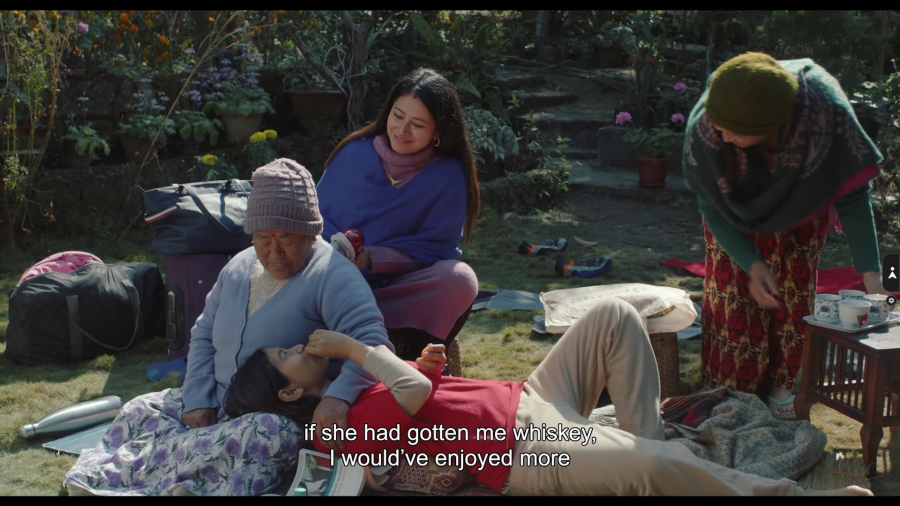
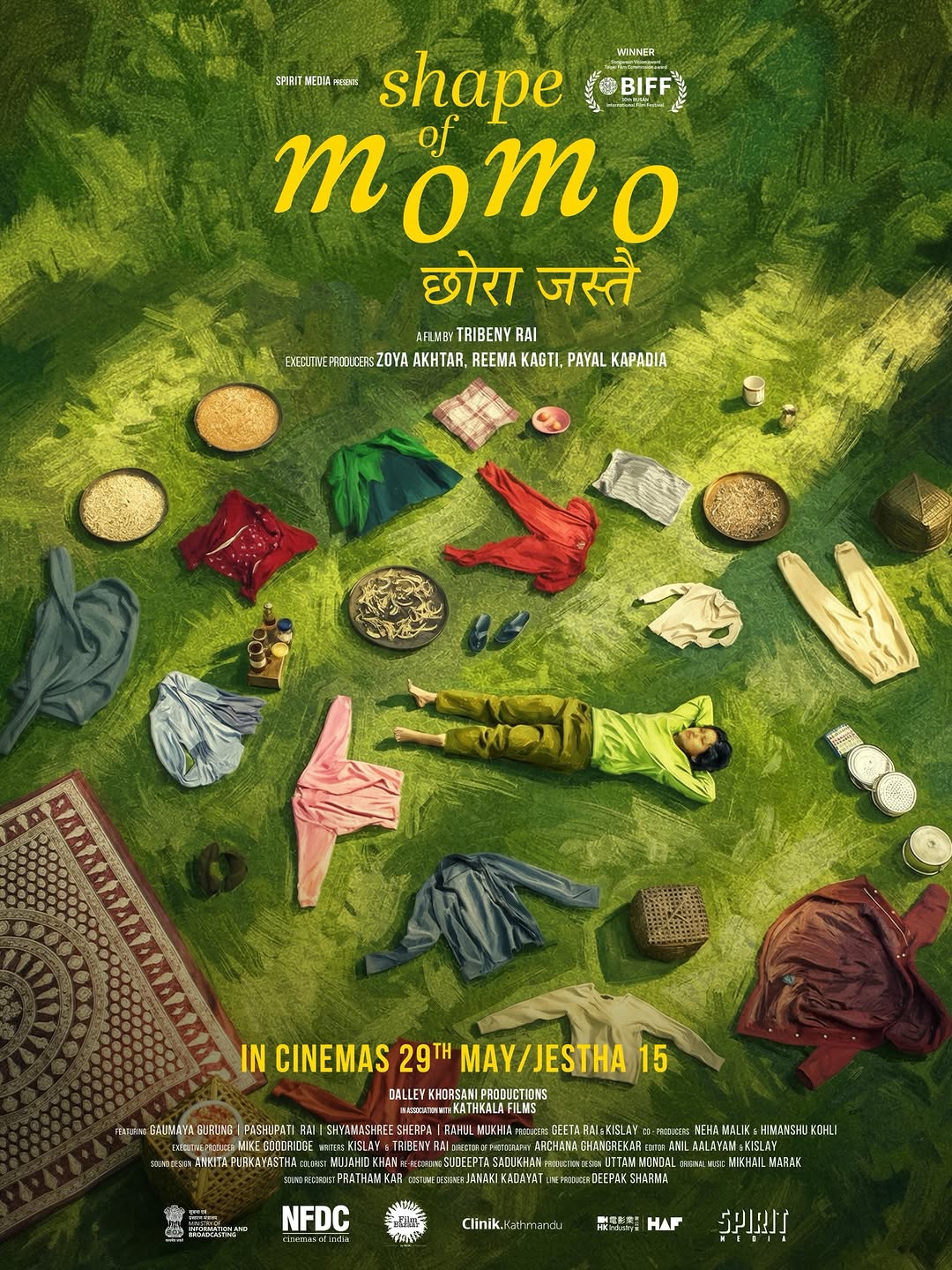
The absence of male members in Bisnu’s family has made the women thoroughly sceptical and vigilant. When a stranger comes to her house late at night, asking for clean water, she is told to say her (late) father would be angry. Later, her mother scatters her late husband’s clothes on the ground, just to show that there is still a man in the house, someone strong enough to protect them.
Bishnu struggles to understand this perception. Neither can she bring herself to be just as forgiving as her mother, as patient as her grandmother and as compromising as her sister. Therefore, she remains in a void, intricate, unchanged, and adrift.
While initially, we are encouraged to sympathise with Bishnu’s frustrations, the film gradually complicates that perspective, particularly through her interactions with the workers at her mother's orange farm. Viewers are given the agency and moral position to interpret her actions.
In a scene where the vendor's son throws the fruits given by Bishnu onto the ground, she stands in, we are made to confront the striking moment of resentment and misunderstanding without many dialogues.
The performances throughout the film are sharply nuanced. Each character, including the grandmother, is rendered with depth and conviction. The cast's emotional authenticity represents, resonates and lingers.
Sikkim, despite shaping every edge of Bishnu’s life and the film as a whole, is, however, dominated by a focus on the characters’ introspection. Perhaps this was a conscious choice by Rai—rather than showcasing Sikkim for what it's famously known for, she dedicates her frames to the characters and their emotional landscapes.
However, one of the few moments when Sikkim’s natural landscape and Bishnu’s introspection blend is when she is seated on a large rock in a river. This shot recurs throughout the film, gradually acquiring deeper emotional weight. The rock exists within the river's ebbs and flows; it is a part of the river's ecosystem but never truly belongs to it. Yet, it is this very rock that offers Bishnu shelter.
Curled up upon it, folding her knees into her chest, she appears small against the vastness of the landscape. In this scene, solitude becomes a form of protection. It reflects her displacements and emotional states.
We also find binoculars frequently in the frames. While they may serve as ordinary objects within the narrative, they invite a symbolic reading of how women are bound to look far beyond their immediate circumstances. They are placed in a stagnant position, looking at the patriarchal boundaries they wish to transcend.
Another unforgettable scene is when Bishnu rests amid the everyday objects of her home, placed on the ground to dry. There are clothes, utensils, rugs, and Bishnu. Being there, it seems, she understood what it meant to belong, also the cost of it.
Colours in ‘Shape of Momo’ narrate a story of their own. With lighting, saturation, contrast, colour emphasis, and shadows, the palette feels particularly composed, projecting the film's emotional ambience.
Bishnu is consistently seen wearing red-coloured clothes in her home, perhaps symbolising vitality and a transformation of the inherited notions of womanhood within her family. Amid moments of subtle emotional epiphanies, her wardrobe shifts toward brighter, lighter colours.
Bishnu’s emphasis on the taste of momo rather than its shape becomes one of the film’s most potent ideas. In a society that prioritises appearances, expectations and prescribed forms, she values what truly matters. She is more inclined towards substance than conformity.
Therefore, ‘Shape of Momo’, despite its meditative appeal on life, identity and belonging, is strikingly political. Patriarchy is not unfamiliar in Nepali cinema. However, only a few films examine it with the painful intimacy that Rai achieves. Her critique, rather than evolving through grand confrontation or overt declaration, emerges subtly within what people expect from others in society, what they talk about in gatherings, and even how they shape their momo.
Rai exposes how patriarchy sustains itself through habits, traditions and mundane cultural occurrences.
With this poignant reflection, Bishnu realises that this identity, for the generations before her, is almost entirely inevitable. Thus, at last, she writes to her mother, “Isn’t it strange? It is the things that tangle and exhaust us that make us who we are.”
____________________
In conversation with actress Gaumaya Gurung
Finding a complex and representative female character is almost unconventional in cinema. Tribeny Rai states in an interview that the film’s motif is this very representation. As an actress, how important are such screenplays to you?
Very important. Growing up, most female characters I saw on screen were obedient daughters, devoted wives, self-sacrificing mothers, or objectified love interests who existed mainly to support larger-than-life male protagonists.
Yet the women I grew up around were far more complex. Fupus and Aamas in my life ran households independently, navigated challenges with resilience, humour, and diplomacy, and carried their own aspirations and conflicts. Those rich, lived realities rarely made it to the screen. Instead, indigenous women were often reduced to stereotypes, while dubbed and copied narratives distanced us from our own identities and stories.
That is why scripts like this matter deeply to me. Acting is more than performance; it is a powerful platform for challenging outdated tropes and expanding representation. I want young girls who look like me to feel seen. Women are flawed, vulnerable, ambitious, contradictory, and multidimensional. That complexity is what makes us profoundly human.
This shared vision of our director, Tribeny, is what brought our team together. To have premiered at international festivals, connected with audiences worldwide, and now to secure distribution through Rana Daggubati’s Spirit Media with Zoya Akhtar, Reema Kagti, and Payal Kapadia as executive producers , feels like a powerful validation. It shows that stories rooted in our realities can resonate far beyond where they begin.
In Nepal, I am grateful to organisations like Women in Film Nepal, Katha Ghera, KathaSatha, Katha Haru, Gauthali Entertainment, Gograha, Women of the World Festival Nepal, and Duluwa Outdoors, who are actively creating pathways for women in film, theatre, music, and travel, reshaping who gets to tell stories and how those stories are told.
While bringing Bishnu to life, did you feel as though she was a part of you already, or did you find a new version of womanhood in her?
Bishnu was already living in me, but she also pushed me further.
When I first read the script and encountered her mother scolding her, “Pagal bhais?”, I burst out laughing. My own nickname growing up was “Bauli”, the crazy one. I was a rebel at school, protested with our principal for a girls’ basketball team, and pointed out that we didn't have one because our school is called HIMS.
At home, I deliberately sat with the men in the living room, voiced my opinions loudly, and avoided the kitchen at all costs. I chose basketball courts and running fields over domestic chores. I got away with a lot because I was academically bright, but I was constantly told to walk softly and not laugh too loudly, lest I expose my imperfect teeth. I did the opposite.
Whether it was volunteering at the London Paralympics 2012, trekking in South America, Everest Base Camp, or leading outreach programmes in Ethiopia, Zambia, and Ghana, I pursued everything my father said wasn’t safe or possible for a girl. The younger me was determined to prove him wrong. But deeper than defiance, I simply wanted to understand the world through my own experiences, not through the patriarchal lens forced upon me.
My mother, like Bishnu’s, was focused on finding me a “suitable” husband. Right after my bachelor’s, I reluctantly spoke to a prospective groom. When I asked about his values and non-negotiables, he replied, “Whatever makes Mom happy.” I politely wished him well and never entertained another proposal. That moment crystallised something vital: financial independence was not just a goal, it was freedom. I despised the idea that daughters are eventually “given away”, to leave their family home to join their husband’s.
So I left before anyone else could decide it was time. I worked across the UK from Cornwall to Norwich, sometimes pulling 20-day stretches. I saved aggressively, bought my own place, took my parents on travels, funded my mother’s treatment, and helped extended family with debts. I was determined to prove I was no less than a son.
Through Bishnu, however, I discovered something new: her unapologetic directness. I’ve always tried to push boundaries, but usually diplomatically, trying to keep the peace. Bishnu doesn’t negotiate. She taught me the power of taking up space without apology, the strength in saying “no”, and the freedom of refusing to shrink for anyone’s comfort.
Photo: Courtesy of Hamburg FilmFest
Would you agree that art and cinema are political? If so, how does ‘Shape of Momo’ present this idea? How important is it for cinema to ask uncomfortable questions to its viewers?
Absolutely. Art and cinema are inherently political because they reflect and actively shape the power structures, values, and realities of the societies we live in.
‘Shape of Momo’ embraces this with fearless honesty. Through Bishnu’s journey, the film interrogates patriarchy, migration, class, and gender inequality. It exposes how society treats rebellious men and women so differently, the impossible expectations placed on daughters, and how power quietly shifts depending on gender, class, and circumstance.
The story opens in a funeral hall filled with men. Bishnu’s ad from a Delhi newspaper is read aloud, followed by approving claps that soon give way to a search for a suitable match. Time and again, her mother urges her to stay silent, to endure, or to leave. Yet the tenant’s wife makes constant excuses for her rebellious son “He’s just a boy,” or “He’s tired.”
Power dynamics shift dramatically in the presence of Gyan, Bishnu’s love interest. Suddenly, the mother feels safer and more superior, even encouraging Bishnu to open the homestay, an idea she had earlier rejected.
Every detail carries meaning: the woman running across the rooftop, Padam Daju’s struggle for an Aadhaar card, the class tensions with tenants and migrants, the pity Junu faces at the hospital without her husband, the uncertain fate of her baby depending on gender, the mother removing her hat after the loss of the family head, and even the cat named Azadi (Freedom). Nothing is accidental. All of it reflects our director Tribeny’s sharp, observant worldview.
What I love most is that the film refuses easy answers. Bishnu is flawed, stubborn, and sometimes unlikable, which makes her profoundly human. Through her, the film invites audiences to question assumptions they may have never even noticed before.
Cinema should make us uncomfortable at times. If it only comforts and confirms what we already believe, it fails in its highest purpose. The most powerful films linger long after the credits roll, quietly urging us to look at ourselves and the world with new eyes.




 22.92°C Kathmandu