



 17.92°C Kathmandu

Tue, Oct 6, 2026
Culture & Lifestyle
In ‘One foot in front of the other’, four runners build their utopia on the road
Biradar’s documentary follows four runners on a 340-kilometre journey, where endurance gives way to an unexpected sense of community.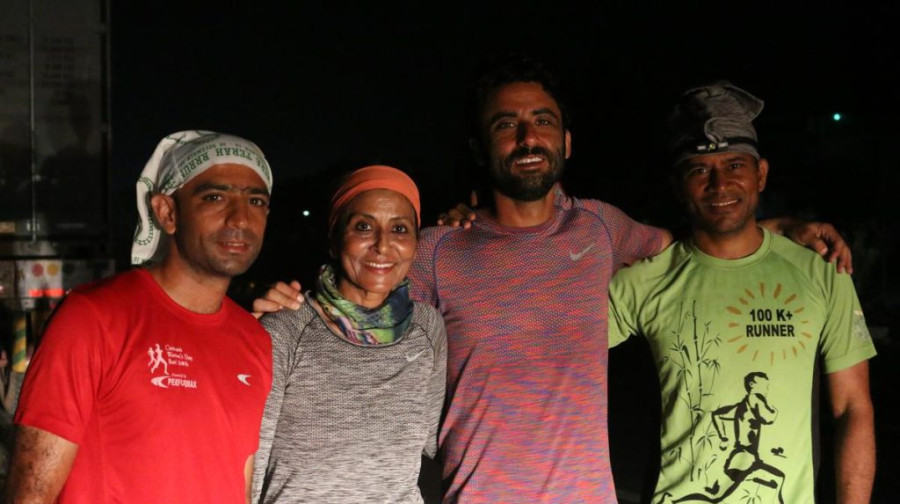
bookmark
Tatsam Mukherjee
Published at : August 12, 2026
Updated at : August 12, 2026 09:36
Few things help people bond more than being in the trenches through an extreme experience: travelling/living with someone over a long period, being on an outdoor schedule, working in the same department overseen by a tyrant, or taking part in high-endurance sports like trekking or long-distance running.
It is during adverse conditions that all politeness flies out of the window, and people show you who they really are. It’s intimacy unlike anything else. It’s what probably explains the thick camaraderie at the heart of Basav Biradar’s 62-minute documentary, One Foot in Front of The Other.
Here, Biradar chronicles a 2018 run between Bengaluru to Chennai, along with backstories of the four runners: Santosh, Chandra, Mani and Krishan. As the group undertakes the journey of 340-odd kms, the film gradually bleeds the noise around long-distance running as an endurance sport.
Santosh, a US-returned software techie (one might consider him a Bengaluru cliche), took up social work on the side in the mid 2000s. Dissatisfied with how it wasn’t leading to any ‘positive’ change, he started a running group in the late 2000s, inviting friends, acquaintances and strangers to join him.
With Runner’s High, Santosh found an outlet for his compassion to do good for society, while also seeing tangible results for his effort. Santosh leads the group over four and a half days, meticulously planning each stop, the food to be had, the overall pace of the group, ensuring everyone’s safety (especially Chandra, the only female runner here).
Biradar’s film is a pared-down project, with the rawness of a V-log. If the role of a documentarian is to become invisible around their subjects, Biradar is successful. None of the runners seem conscious of the camera, and keep their banter going. It seems like the filmmaker has spent enough time with the ‘characters’ here, so as to never treat presence as an invasion of their privacy. More than once, during the film, the runners warmly greet the camera.
All four runners hail from different backgrounds – Krishan recounts growing up during the 1980s insurgency in Punjab. Having moved to Bengaluru in 1998, he began training under Santosh from the late 2000s. Chandra, originally hailing from Kerala, discovered her passion for long-distance running at the Mumbai marathon at the age of 45, when she accidentally won in her category.
At the age of 60, she’s the eldest and among the most resilient in the group. Mani, a native of Trichy (Tamil Nadu), seems to look at running as a way to test himself, but confesses that it’s the feeling of community that has brought him back to Runner’s High again and again.
As much as high-endurance sports are about the myth of discipline, focus and isolation – a thing I appreciated about Santosh in the film is his intent to bust all of it. He calls his group of long-distance runners, JLBR: Jobless Lazy Boring Runners.
“Anyone can do it, as long as they have the time,” Santosh tells the camera, which is, of course, not entirely true.
During the run, everyone’s mindful about doing their best, and inspiring each other to keep moving when things become unpleasant beyond a certain degree. None of the runners want to be the one to slow down the entire group. And yet, at no point, are any of the runners being forced to finish the run at the expense of their mental or physical health. An unspoken trust binds the group.
The group’s culture, primarily under Santosh’s leadership, is a Utopian bubble unto itself. Everyone tries their best, they wait for the one struggling on a particular day, and manage to inspire each other to get over the finish line.
As a result, long-distance running becomes a metaphor for life, and the generosity on the road begins to feel like a larger philosophy for one’s way of living. I think running for such hours over long distances gives one time to think: about their value system, beliefs. I’d like to believe after all the pain a body is subjected to, it turns one into a humble, empathetic version of themselves.
One thing I particularly enjoyed about Biradar’s documentary was the idealism he brought out, especially in this world of late-stage capitalism. I associated its sincerity and charm with the Doordarshan films I grew up watching. I was reminded of a film that I’d caught by chance, Parvati Menon’s Triyatri (1990).
Menon’s film follows three teenage boys, who have just got their results for 10th boards. They’re encouraged to learn from living, by riding their bicycles from Bombay to Kanyakumari (by none other than Utpal Dutt, who plays a character’s grandfather here). Menon’s film has a sense of wading into the unknown, and the optimistic outlook to treat any adverse experience as an opportunity to build character. Similarly, as much as there’s toil, sweat and pain in the mission at the heart of Biradar’s film, there’s also a sense of exploration.
While Santosh, Chandra, Mani and Krishan put their bodies on the line, by running on an average for 11 hours on consecutive days (about 70 kms per day), they also never seem to be trying to make it look aspirational. Biradar’s film, while recording this extraordinary feat, never frames the runners as anything beyond ordinary people.
It might make viewers think of taking up long-distance running as a hobby (it’s obviously harder than the film makes it look). However, as the film’s name also accurately explains, it’s only about putting one foot in front of the other.
This story was originally published in The Wire and is republished here with permission, under a special arrangement with The Wire.





Most Read from Culture & Lifestyle
‘Tenzing’ puts the Sherpa at the centre of the Everest story

It’s a bird … it’s a plane … it’s the Indian ambassador’s farewell tweets

Nepal wants high-paying careers. Its humanities classrooms are paying the price

Indian comic Sharon Verma to make her Nepal debut

What’s on in Kathmandu Valley today
Editor's Picks

What triggered the Rasuwa flood? Scientists piece together a complex chain of events

The floods keep coming. Nepal keeps starting over

In a settlement destroyed by the Bhotekoshi flood, a disabled couple offer strangers the little they have

Nepal working on detailed assessment as Bhotekoshi flood reconstruction could cost up to $5 billion

Rabindra Dhant gave Nepal a reason to smile. Now his camp wants real action behind the praise
E-PAPER | October 06, 2026

×