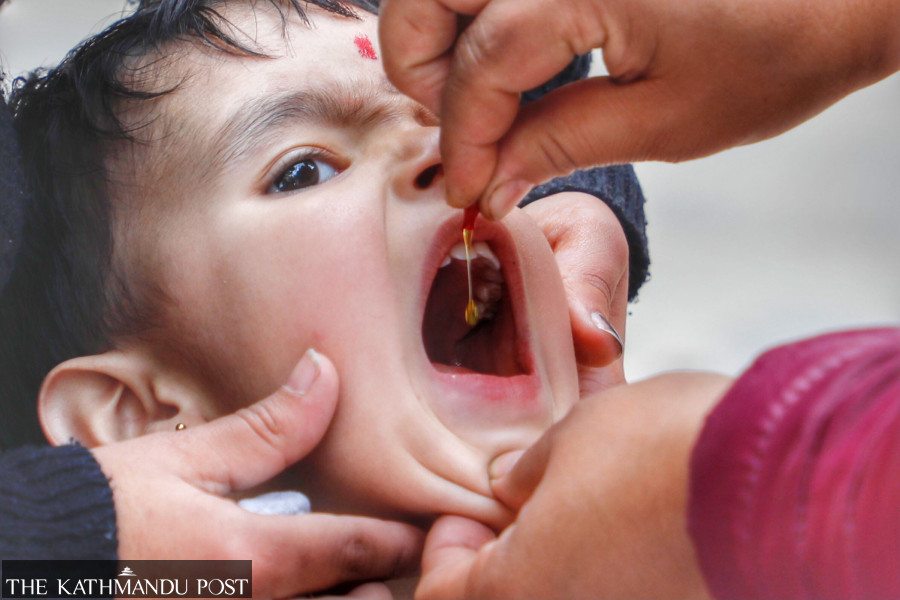
The Ministry of Health and Population again turned to UNICEF for help after failing to procure vitamin A supplements in time for a nationwide drive slated for April 19 and 20. UNICEF has already supplied the doses for the campaign.
This is not the first time, health authorities failed to procure the supplements, which are part of a national priority programme under which millions of children under five years of age are covered. Authorities have missed procurement deadlines several times in the past and have requested the UN agency for help.
“Due to issues with the procurement process and pricing, we could not purchase vitamin A supplements on time,” said Lila Bikram Thapa, chief of nutrition Section at the Family Welfare Division under the Department of Health Services. “UNICEF has provided us with 2.5 million doses of vitamin A at our request.”
The Health Ministry administers vitamin A supplements and deworming tablets twice a year—in April and October—to children aged six months to five years.
But despite the set schedule, authorities often fail to initiate the procurement process on time. As a result, they have had to knock on the doors of the UN body.
The ministry buys vitamin A supplements through international bidding. The process takes at least six months. Thapa said the Management Division under the department has already initiated the process to procure the supplement following the tender initiated earlier cancelled due to pricing issues.
During the campaign this month, vitamin A supplement will be administered to around 2.3 million children between six months and 59 months and deworming tablets to around two million children between 12 months to 59 months old, according to officials. Over 52,000 female community health volunteers and 15,000 health workers will be deployed for the campaign.
The World Health Organization says a lack of vitamin A causes visual impairment (night blindness) and increases vulnerability to illnesses like measles and diarrhoea among children. Vitamin A supplements mitigate the risk of exposure to such diseases.
Vitamin A deficiency was one of the major public health problems in the past. But with the implementation of the campaign to administer vitamin A supplements, vitamin A deficiency is no longer a public health concern.
It is because of campaigns like these that night blindness among children—which used to be very high until two decades ago—has been almost eliminated, according to Thapa.
Regular supplementation campaigns are estimated to have reduced deaths among children under five by 23 percent. Vitamin A deficiency is estimated to be responsible for nearly one-fourth of global child mortality from measles, diarrhoea and malaria.
The pilot project was launched in 1993 from eight districts expanded throughout the country in 2003. The programme has over 90 percent coverage rate, the highest among health campaigns, according to the Health Ministry.
Deworming tablet administration was started in 1999.
Meanwhile, officials at the Nutrition Section complain the budget ceiling for the next fiscal year to purchase critical health supplies—including vitamin A supplements, Balvita (micronutrient powder), and iron folic acid—is less than half of what is required. They said that over Rs300 million is needed, but the allocated ceiling is only Rs130 million.
Arjun Poudel is a health reporter for The Kathmandu Post. Before joining the Post, he worked for Sagarmatha Television, Naya Patrika, Republica and The Himalayan Times.




 19.51°C Kathmandu