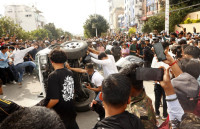
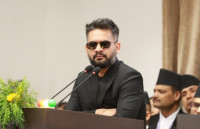
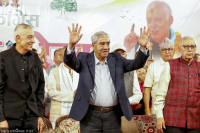
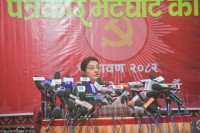
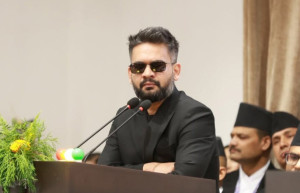
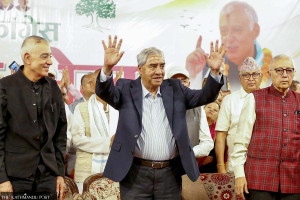
On Monday, the ‘Gari Khana Deu’ movement led by Gen Z representative Miraj Dhungana staged a protest at Maitighar despite the district administration denying them permission to do so, citing procedural requirements. As a result, security forces immediately dispersed protesters who had started gathering at the Maitighar area. A clash ensued between the protesters and the police, followed by one between the protesters and journalists.
Even after the success of the Gen Z revolt, the calls for renewed protests have been vociferous over the past three months, with multiple groups—including Sudan Gurung-led Hami Nepal and Gen Z for Monarchy—having staged protests and calling for more. The agendas of each of these protests differ. Gurung is apparently disgruntled with the appointment of Om Prakash Aryal as the home minister. Dhungana has called for the formation of an all-party government, which includes representatives of Gen Z too. The royalist Gen Z group has called for the restoration of monarchy, while multiple groups are still stuck on the agenda of a directly elected executive.
None of these agendas is conducive to the March 5 elections—and timely elections are the only way out of the ongoing political crisis. Gurung’s demand for the resignation of the home minister seems to be driven by personal vendetta. He apparently still fails to differentiate between his personal interests and national interests. Dhungana’s call for the formation of an all-party government would delay the polls, as a new transitional government would have to work from scratch. The calls for the restoration of the monarchy or the provision for a directly elected executive would be against people’s mandate if those agendas are forced by circumventing the ballot.
The Gen Z representatives have strayed off their original course of good governance and anti-corruption and entered the realm of power. Each group is on a quest for greater presence in national politics. They have started to expand their organisations, forming structures at the provincial and district levels. And it makes sense for them to delay the elections to strengthen their organisation and create a strong competition for the mainstream political parties with established organisations. However, such delay in holding the polls will push the country into further chaos. The CPN-UML and even a bulk of the Nepali Congress now want reinstatement of the House of Representatives if the March 5 elections are not realised. And if the House is indeed reinstated, it would have been a big setback to the Gen Z revolt that played a vital role in its dissolution by invalidating its mandate. It would also open a new Pandora’s box.
Again, there is no credible option for timely polls. The call for action against the individuals involved in killing unarmed youths on September 8 is a genuine concern that needs to be addressed. But the Gen Z-ers who are calling for the conclusion of the investigation into the incident before the elections seem to forget that justice cannot be delivered in haste. Their cry of botched probe would be more credible if the Karki government had ditched the investigation agenda—yet the probe panel it formed continues to summon witnesses and record their statements, nearly on a daily basis.
The Gen Z representatives, from all the different groups, must realise that the more roadblocks they create to timely polls, the further they push the country into uncertainty. While the right to protest is not something that should be denied to anyone, the Gen Z groups must get their priorities right and help the interim government create the right environment for timely polls—which in fact would be the first meaningful step towards building the kind of corruption-free and accountable country they envision.




 15.26°C Kathmandu