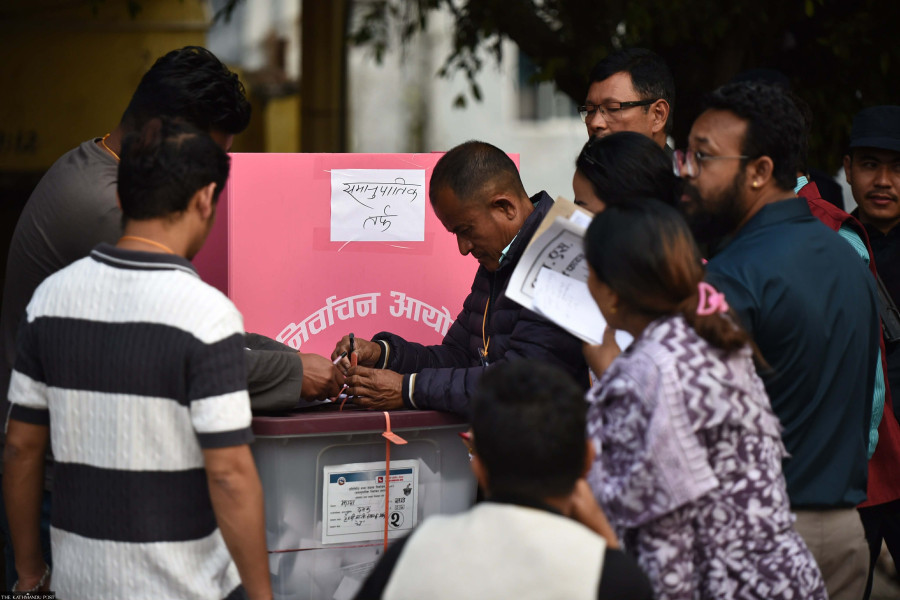
Nepal voted yesterday—exactly six months after the Gen Z uprising. In a display of civic vibrancy, around 60 percent of voters cast their ballots. The polling stations were graced by a cross-generational tapestry of citizens—from enthusiastic first-time voters to centenarians, all arriving with the hope of altering the trajectory of Nepali politics. The interim government deserves credit for conducting snap polls amid daunting uncertainties, ranging from a fragile security environment marked by low police morale and looted weapons to the absence of a broad political consensus in favour of timely elections. The voter response was a resounding affirmation of democratic resilience.
This successful electoral exercise marks a triumph for the interim government led by Prime Minister Sushila Karki. When Karki took her oath on September 12, following the tumult of the uprising, her administration was greeted not with a honeymoon period, but with dark clouds of doubt. The task of organising an election in just six months was Herculean. The state was reeling from a deteriorating security situation where police offices were vandalised, and the force’s morale was low. Yet the prime minister maintained a single-minded focus of holding timely polls. By skillfully reaching out to established parties to gain their confidence and ensuring the state remained on a political track, the Karki government has effectively bridged the gap between a period of upheaval and a future of stable governance. To have moved from the chaos of the streets to the order of the ballot box in such a short window is an achievement that warrants the highest praise.
Equally deserving of a standing ovation are the voters of Nepal, who have again shown their abiding faith in the democratic process. In a country where the median age is just 26, the influx of nearly a million first-time voters inspired by the September movement provided a necessary infusion of energy in Nepal’s ageing political landscape. The millions of citizens who cast their ballots on Thursday deserve the nation’s gratitude. The turnout of around 60 percent is a healthy indicator for any democratic election. The Election Commission also merits recognition for its logistical and administrative agility. Managing the franchise for 18.9 million eligible voters across 23,112 polling centres is a feat of engineering that requires precision and dedication. Under the guidance of the Commission, voting was conducted in a peaceful, free and enthusiastic environment. By facilitating a contest among 65 political parties and 3,406 direct candidates, the Commission ensured that every shade of the political spectrum had a voice. Their extensive preparations provided the structure necessary for the democratic conscience of the people to be heard without interference.
The security apparatus deserves a salute for its professional resurrection. Only months ago, the Nepal Police were struggling with looted weaponry and the escape of prisoners after the uprising. To see the same force successfully deploy 75,797 personnel and 149,000 temporary police to guard the sanctity of the vote is nothing short of remarkable. The security forces employed modern surveillance techniques, including drone monitoring in the Valley and helicopter patrols, to ensure a stable environment. While the day was not entirely without incident—sporadic disputes occurred in Dolakha, Syangja, Sarlahi and Rautahat, and a clash in Rolpa left two cadres injured—the overall climate remained calm and free of fear.
The successful conduct of these polls is a victory for every stakeholder: Kudos, everyone. You have again proven that Nepal’s future will not be shaped by fear, but by the collective will of a people who believe in the enduring power of democracy. The transition is almost complete; the work of building a new, accountable Nepal now begins in earnest.




 14.81°C Kathmandu