The roar of the crowd at the Dasharath Rangasala has long been the heartbeat of Nepali sports that transcends political turmoil and economic hardship. Yet today, that heartbeat is faint, thready and failing. The beautiful game is being systematically dismantled in Nepal by a combination of bureaucratic ossification, administrative ineptitude, and a succession of governments that treat its athletes as disposable ornaments of state pride.
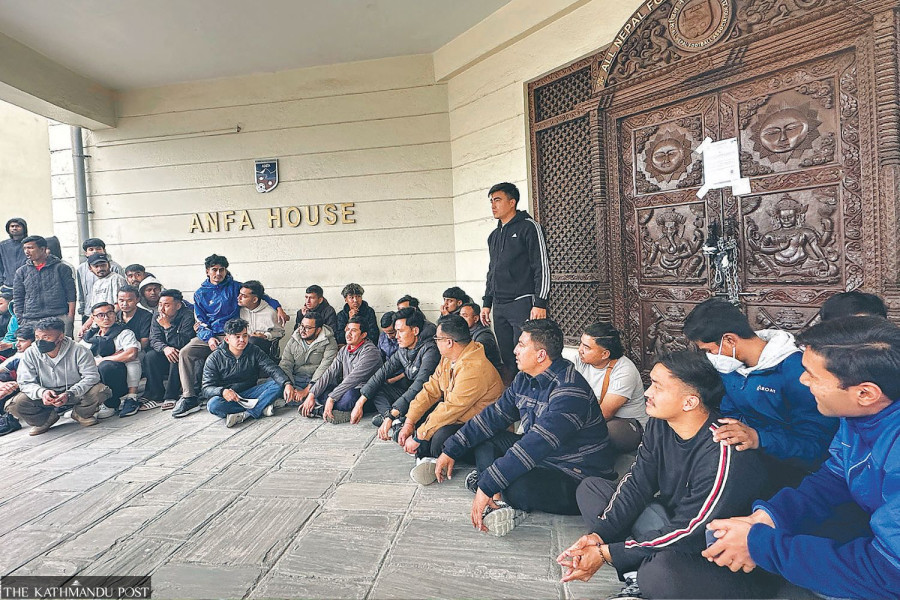
The recent sight of the Nepal Football Player Association (NFPA) padlocking the All Nepal Football Association (ANFA) Complex in Satdobato is a desperate cry for help from a sport on its deathbed. For the second time in four months, Nepal’s finest footballers have been forced to trade their boots for placards, demanding the bare minimum: A schedule to play and the wages they have earned. It is hard to believe that Nepal’s A Division League has been absent from our calendars for over 1,000 days. This professional negligence has robbed a generation of players of their peak years and left the domestic football ecosystem in a state of catastrophic collapse.
The failure of the state to nourish football is not new, but it has reached a shameful zenith. We need only look two weeks back at the trauma of Sabitra Bhandari ‘Samba’ to see the true face of this institutional apathy. Nepal witnessed the national travesty of its most accomplished footballer being forced to crowdfund on social media for a critical knee surgery. While Samba’s spirit remained unbroken, the state’s shoulders proved remarkably narrow when she needed them most. ANFA’s response was nothing short of pathetic, offering a measly pittance while a foreign club showed more care for our icon than our own governing body.
This culture of neglect extends to the pitch itself. Reports of players being denied sufficient ice for recovery, drinking water, and adequate nutrition during international tournaments are signs of moral bankruptcy. It is no wonder that high-calibre coaches resigned prematurely, citing dissatisfaction with the hostel-like conditions and lack of basic services. When the experts flee and the players protest, the problem is not the talent—it is the leadership.
The authorities often hide behind a veil of financial opacity. The NFPA’s demand for transparency regarding the Players’ Perpetual Fund (PPF) and the missing millions from previous tournaments is a demand for basic accountability. Where is the money? Why has prize money promised as far back as 2017 remained unpaid? ANFA’s defence—that they will reimburse previous debts slowly—is a slap in the face of players who have bills to pay and families to feed. The state cannot expect gold-medal performances on a copper-coin budget managed with leaden hands.
Nepali football fans are tired of excuses. They remember the golden days when domestic clubs were household names, and the domestic league was the pride of the region. They now look to the upcoming government with desperate hope. But hope is not a strategy. What is required is a radical, structural overhaul that prioritises the athlete over the official. If the beautiful game is to survive in Nepal, the authorities must move beyond reactionary press releases and hollow promises. Footballing revolution must be transparent, professional and player-centric. First, the government must enforce a non-negotiable domestic football calendar. Second, it should subject governing bodies to independent financial audits to resolve years of unpaid prize money and ensure transparency for funds like the PPF. Central to this reform is the creation of a welfare fund that provides guaranteed medical insurance so that elite athletes no longer face the indignity of having to make digital pleas for surgery. Finally, the state needs to mandate professional standards for player nutrition and recovery facilities and pivot investment toward grassroots youth development.




 28.31°C Kathmandu