A 28-year-old woman from Tanahun left for Israel on January 1 to work as a caregiver. But after working for two months, she found something shocking: the country where she had been working was not Israel but Palestine.
She is currently in Ramallah in the West Bank, Palestine. The West Bank is divided into two parts—one under Israeli control and the other the Palestinian part.
Until now, the Government of Nepal had no information that Nepali citizens were working in either of these areas. However, it has emerged that a human trafficking network has already placed Nepali women as domestic workers in homes across the Palestinian territory.
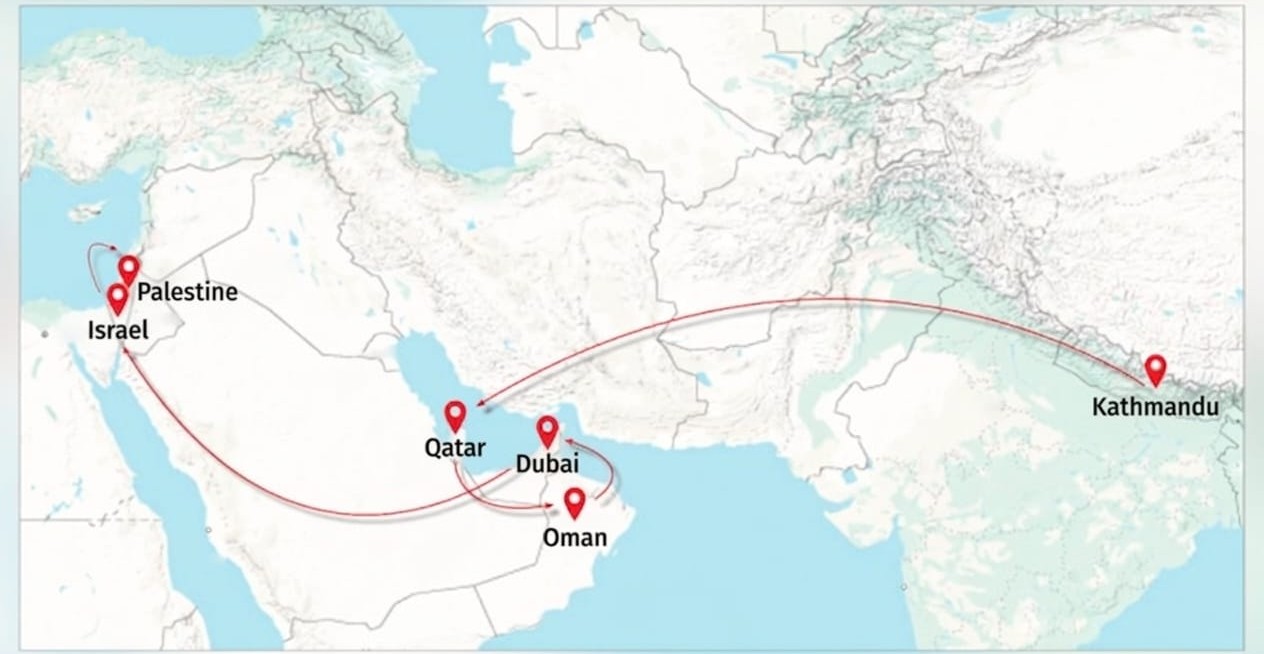
“We were a group of 32 until we reached Oman. From Kathmandu, we travelled through Qatar, Oman and Dubai before reaching Israel,” the woman said over the phone. “But from Oman they sent us to Palestine one by one.”
Travelling abroad on a visit visa is relatively easy. After earlier attempts to tighten regulations were undermined by middlemen's influence, the Department of Immigration adopted a more flexible policy following a ministerial decision on October 30. Under this policy, travellers must have a passport valid for at least six months, a visa for the destination country (or eligibility for a visa on arrival), an air ticket to the final destination, and a self-declaration that the traveller is responsible for the purpose and consequences of the visit.
“I stayed in Oman for two days. There is a place for people like us. There are many Nepalis in Oman,” she said. “The visa for Oman was valid for 10 days. From Oman, I came here via Dubai.”
A connection with a friend already in Palestine
The woman lived in Dumre, Tanahun. The arrangements for her journey were made by a friend from the same district who was already working in Palestine.
“It was my own friend from Tanahun who trapped me,” she said. “She also works as a domestic help here and gets $400 in commission for each individual she brings. She has brought many girls.”
Within three days of sending her passport, she received her visa and ticket. The visa was for Oman, not Israel. “I only had a ticket to Israel,” she said. She travelled alone from Oman to an Israeli airport.
How she was allowed to board the flight without a visa remains unclear. “Even the embassy [officials working in the Nepal embassy at Tel Aviv] asks me that question,” she said. “I don’t know. I had no documents except for the ticket. The visa was only for Oman.”
She did not know the person who issued her ticket in Nepal. “I saved his number as ‘Ticket Dai’ [ticketing brother] on my phone. Someone in Dubai controls him, and another person in Jordan controls both of them,” she said. “I have no idea how I ended up here.”
From the Israeli airport, she was taken directly by road to the West Bank. Someone picked her up at midnight.
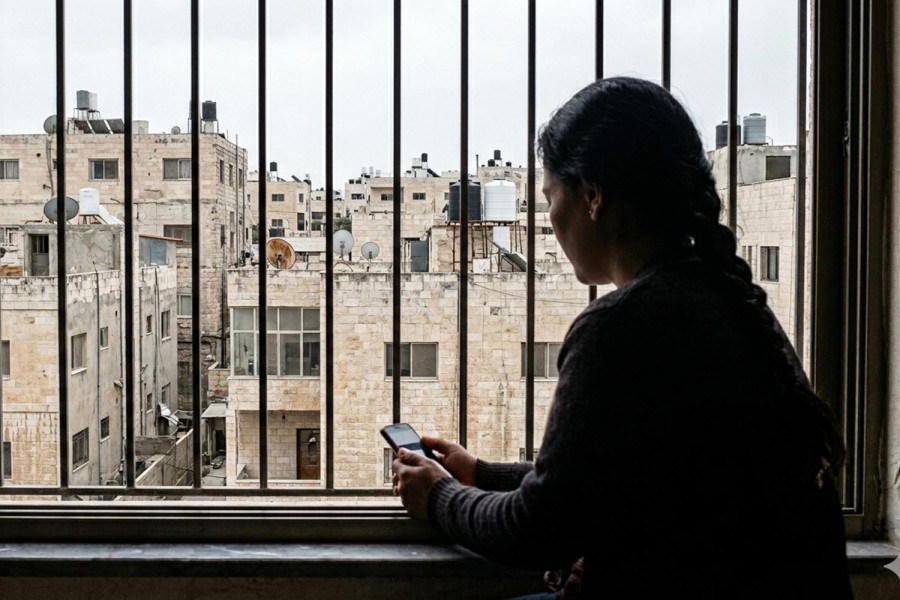
“In the morning, I looked around and thought I was still in Israel. Later, I found out I was actually in Palestine,” she said. “After learning that, I started trembling and felt like collapsing. There is a nurse here who helps me recover when that happens.”
She had known that caregivers in Israel receive attractive salaries and benefits. Nepalis can go to Israel only through a government-to-government mechanism. Of the 2,000 caregivers selected in the second round, about 1,700 have already left. She had also completed a three-month training course from the Council for Technical Education and Vocational Training and practised caregiving at a hospital.
But now that she has discovered she is in a different country altogether, panic has set in. She does not have her passport. When she asked the agent to send her back, he told her it was impossible.
“My friend can’t help either. The main agent is apparently in Jordan,” she said. “I told him I would even pay my own expenses to return to Nepal. He just says it’s difficult to send me back. Now he doesn’t even read my messages.”
Employer demands $15,000 to let her leave
The family she works for is wealthy. There are four children—two young and two older. The household employs four drivers and six security guards. She works more than 12 hours a day, caring for children, mopping floors, washing dishes and cleaning cars. She does not cook.
“I don’t know how to cook Arabic food. The madam cooks by herself,” she said. “They trust me and sometimes leave the house under my care.”
She says language is not a major problem. “They speak broken English, and mine isn’t good either—I only passed the SLC [grade 10],” she said.
However, she still does not have her passport. “Sometimes I faint. I had this problem once before in Nepal, but it had gone away after treatment. Since coming here, it has happened again,” she said. “Even if I’m sick, my madam says I have to work, unless I am completely unable to get up.”
Her employer is unwilling to send her back immediately, claiming that she was hired under a four-year contract with an agent. She, however, has not signed a bond.
Another Nepali domestic worker who had been in contact with her regularly has already escaped and returned to Nepal.
“We were connected through a group of friends. Everyone said that if we land here, it wouldn’t just be four years, but could be our whole life,” she said. “If someone can’t work here, the agent says they will be taken to Jordan or Oman. One girl was supposed to be sent to Oman, but during transit, she managed to escape and return to Nepal.”
Three main land crossings connect northern Jordan with Israel and Palestine: the King Hussein (Allenby) Bridge, the Sheikh Hussein Bridge and the Wadi Araba crossing. Palestinians mainly use the King Hussein Bridge, which connects the West Bank cities of Hebron, Ramallah, Jerusalem and Bethlehem. The crossing is open Sunday to Thursday from 8:30 am to 6 pm, Friday from 8:30 am to 4 pm, and closed on Saturdays.
Authorities suspect Nepali domestic workers are being trafficked along this route.
The woman, who has languished in Ramallah, receives a monthly salary of $400. She has a separate room but must work from 7:30 am until midnight.
“I could run away from the house,” she said. “But where would I go? I don’t have my passport. This is a village. The market is nearby, but I have only been there twice.”
She says escaping to Jordan or Israel would be extremely difficult.
“Even the drivers are too afraid to help. They barely understand English,” she said. “They only ask why I came here.”
She had asked her employer to send her home.
“They say I have to do what they assign me to. If I want to leave, I must return the $15,000 they reportedly paid the agent to get me here,” she said.
“How could I ever pay that much money? So I stayed silent.”
She said she has been sending the $400 she earns home through money transfer services.
She said she talks to her family regularly, and her parents are very worried about her. They ask her to escape anyway. She doesn’t know how.
“Earlier, I lost Rs170,000 trying to go to Kuwait for work. I came to another country to recover that loss, and now I’m trapped here.”
She also said she cannot send her live location.
“I once sent my location to a friend. Within a minute, my employer came and told me not to send the location like that,” she said. “I don’t know how they found out, but they did.”
The Nepali Embassy in Tel Aviv says it has been in regular contact with the woman.
“We are aware that Nepali citizens in Palestine have sought rescue. We are in regular communication with her,” said Om Bhandari, the acting Nepali ambassador to Israel. “This is a new case for us. We are discussing how rescue might be possible from there and are preparing to consult with Israeli authorities.”
Hom Karki is a reporter with two decades experience covering migrant workers issues and the Nepali diaspora. He was previously based in the Gulf for Kantipur Daily.




 19.14°C Kathmandu