Even moderate rain washes away diversions on BP Highway
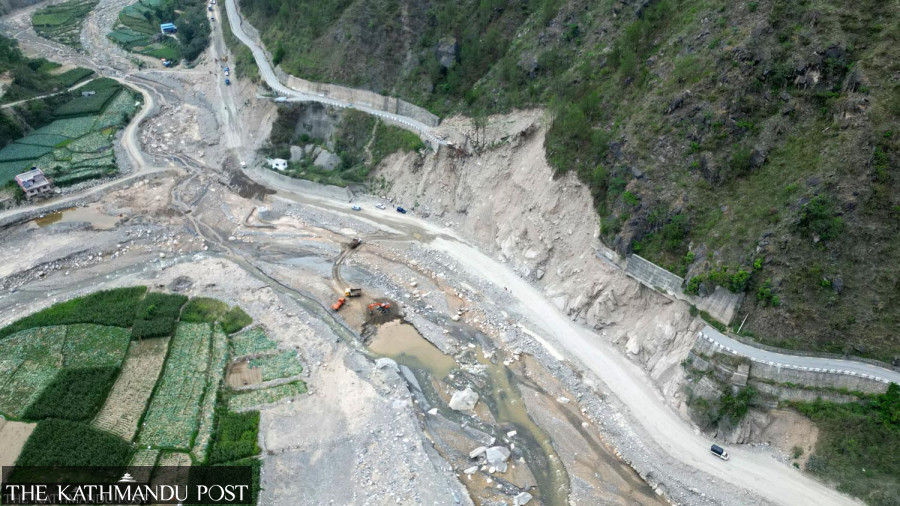
Drivers and passengers say journeys that once took three hours now often take twice as long due to recurring disruptions. Vehicles run on a temporary track prepared by filling boulders and aggregate on the foot of a cliff in Kavre in this photo taken in the first week of June last year. Hemanta Shrestha/TKP
Major highways in Nepal are usually blocked during floods and landslides triggered by heavy monsoon rain. But even moderate rainfall has become enough to halt traffic in the Kavre section along the BP Highway. Rains in upper areas around Phulchoki, Panauti, Banepa and Dhulikhel often swells the Roshi river within hours, sweeping away temporary diversions built on the riverbed and cutting off one of the country’s most important road links.
The repeated disruption has deepened public frustration and raised questions about whether reconstruction work on the damaged sections can be completed on time. Contractors, commuters, locals and transportation workers complain millions of rupees have already been washed away rebuilding temporary crossings that last only until the next flood.
The BP Highway, which connects Kathmandu with eastern Nepal, suffered severe damage during the floods of October 2024. A 12-kilometre section from Chaukidanda in Namobuddha Municipality to Kaldhunga in Roshi Rural Municipality was badly hit, with eight kilometres completely destroyed by the swollen Roshi river.
The Bhaktapur Road Division Office reopened the road around 10 days after the disaster by carrying out emergency repairs costing nearly Rs100 million. But the temporary restoration has remained fragile. Since then, travellers have repeatedly been stranded after floods swept away diversions or damaged repaired sections of the road several times.
According to Suman Yogesh, chief at the Bhaktapur Road Division Office, the office spent Rs39 million on road maintenance and diversion construction between October 2024 and mid-July 2025 alone. “We have had to rebuild diversions again and again whenever floods damaged them,” he said.
Three separate reconstruction contracts have been awarded for the reconstruction of the damaged highway sections. In July 2025, Lama/Navakantipur JV signed a Rs1.14 billion contract to rebuild an 11-kilometre stretch from Charsayabesi to Bhakundebesi. In the same month, Khani/Kamaljit/A-one JV secured a Rs1.22 billion contract to reconstruct 8.5 kilometres from Dalabesi to Charsayabesi. Another 2.2-kilometre section from Dalabesi to Sukhkhapahiro was awarded to Uma/Bhandari/Amarjyoti JV for Rs685.8 million in November 2025.
According to the contractors, the weather has become the biggest obstacle to the project.
Bhakta Bahadur Lama, a representative of Khani/Kamaljit/A-one JV said effective work could not begin after the contract was signed because of persistent rainfall and repeated flooding. “Within a month of starting work, we again faced disaster,” he said. Floods in October 2025 caused fresh damage to the highway, he added.
Since the contract agreement, according to Lama, his company alone has rebuilt diversions seven times. Each reconstruction costs between Rs6 million and Rs7 million, he said. “Some support comes from the Department of Roads, but most of the cost is borne by the contractor. The money we spend building diversions is literally being swept away by the river,” he added.
Lama said floods have also destroyed construction materials and delayed permanent work. During floods in February and April this year, equipment prepared for concrete work, including rods, pipes, generators and formwork materials, were washed away. He estimated losses at around Rs20 million. “The weather is unpredictable. It may be sunny below, but heavy rain upstream suddenly sends a flood downstream. Sometimes workers have to run for their lives,” he said.
Janak Bhatta of Lama/Navakantipur JV said his company had built diversions around 10 times since signing the contract, causing losses of nearly Rs20 million. He said the company has also suffered human tragedy.
“One worker was swept away and died in March while working near the river,” said Bhatta. “Whenever the road closes, we have to send excavators and machines into the river to reopen it. Workers operate in dangerous conditions when the water level rises suddenly.”
Bhatta also complained that the compensation provided by the Department of Roads covered only around 10 percent of diversion-related costs. Rising prices of diesel, cement, steel and transportation have added further pressure on contractors struggling to continue work.
Rameshwar Thapa of Uma/Bhandari/Amarjyoti JV echoed similar concerns. Although rainfall may not occur directly at the construction site, he said water flowing from Panauti, Banepa and Dhulikhel frequently causes flooding downstream. “Floods have blocked the road more than six or seven times,” Thapa said. “Every time we repair a damaged diversion, it costs between Rs1.3 million and Rs1.5 million.”
Yogesh said that the cost of constructing and maintaining diversions is included within the contract agreement with the construction company. According to him, since the contract amount is determined by the contractor's bid at the outset of the procurement process, there is no provision for additional departmental funding to repair diversions when they are washed away or damaged.
“Everything is included within the contract amount,” he said. “If a diversion is washed away, the Department of Roads does not provide separate assistance for its repair or reconstruction.”
While construction entrepreneurs have argued that this has created an additional financial burden, the Road Division Office has clarified that such costs fall within the scope of the existing contract.
Labourers working on the project also face constant risk. Twenty-year-old Bhesh Bahadur Ale Magar from Nawalpur has been working on road widening and foundation construction along the highway for the past six months. He said working conditions become extremely difficult during the rainy season. “As soon as it rains, structures under construction suffer damage. Diversions have already been swept away three or four times while we were working nearby,” he added.
Drivers and passengers travelling along the route say journeys that once took three hours now often take twice as long. Gokarna KC, who has been driving vehicles on the route for 12 years, said travel has become exhausting and unpredictable. “Earlier we could reach our destination in three hours if we left at seven in the morning. Now it often takes five or six hours,” he said.
KC said the cycle of floods, repairs and further damage has continued for months. “The Roshi river has not only washed away roads, it has also washed away government money,” he added.
According to Yogesh, reconstruction work is under way simultaneously in all three sections. Around 30 percent progress has been achieved in the Dalabesi-Charsayabesi section, 25 percent in the Charsayabesi-Bhakundebesi stretch and 27 percent in the Dalabesi-Sukhkha Pahiro segment.
Permanent structures, including retaining walls and reinforced concrete protection works, are being built in the most vulnerable locations. Road widening is also continuing in several sections.
Still, officials admit that meeting deadlines may be difficult if weather conditions continue to worsen. “We are trying to accelerate work before the monsoon intensifies, but rainfall has prevented effective construction,” said Yogesh.
Local representatives call for prioritising sustainable solutions rather than temporary diversions. Dinesh Lama, chairman of Roshi Rural Municipality, said the government should focus on speeding up permanent structures rather than relying on repeated emergency repairs.
“Construction of permanent road structures has already begun along the original track. Although the contractor has started building the structures, the work has not progressed as expected,” said the rural municipality chief. “If the permanent structures can be completed quickly, there will no longer be a need to rely on diversions.”
He claimed the main reason behind the slow pace of construction is the contractor’s failure to mobilise sufficient manpower and equipment. “The work appears to be moving slowly, but the solution is not to divert the road to another route. Instead, the focus should be on accelerating construction of the permanent structures already under way,” he said.
According to him, the temporary diversions currently operating through the river are repeatedly being swept away by floods. While such diversions are necessary to keep traffic moving in the short term, he said they are not an effective long-term solution. He added that once the permanent structures are completed, the repeated expenditure on rebuilding diversions after every flood will come to an end. He urged the construction companies to deploy additional manpower, equipment and resources to speed up the permanent reconstruction work.
The BP Highway was originally built with Japanese assistance and formally opened in 2015 after years of construction. The 160-kilometre route reduced travel time between Kathmandu and eastern districts and quickly became a preferred corridor for passenger buses and emergency transport.
Although the Highway was set to be constructed in 1958 during the tenure of the then Prime Minister BP Koirala, the project had sinked into oblivion following the political change in 1960.
The project that had remained in limbo for 37 years after that had been rejuvenated with financial assistance from the Japanese government in 1996.




 14.79°C Kathmandu