Karnali apple farmers’ market worry sets in months before harvest season
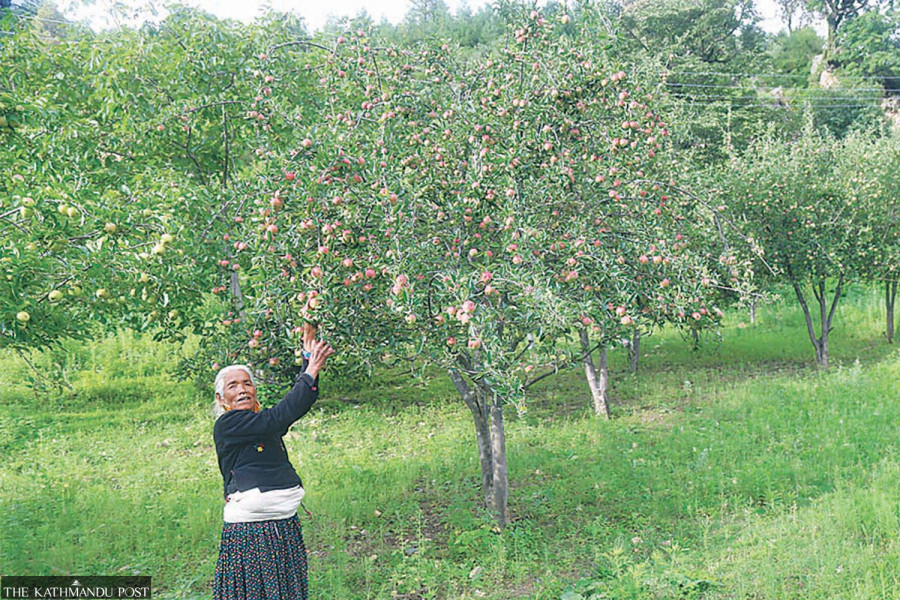
Record harvests are expected across Karnali this year, but growers worry that poor roads, lack of cold storage and weak market systems will once again force them to sell apples at throwaway prices while consumers pay several times more. Almost every household in Talcha, Maitulek, Ghattalekh, Bam, Phoipata, Dakhryalbada, Jhapagard, Mathitum, Pina, Jhyari and Kotila of Chhayanath Rara Municipality owns an apple orchard. Post Photo
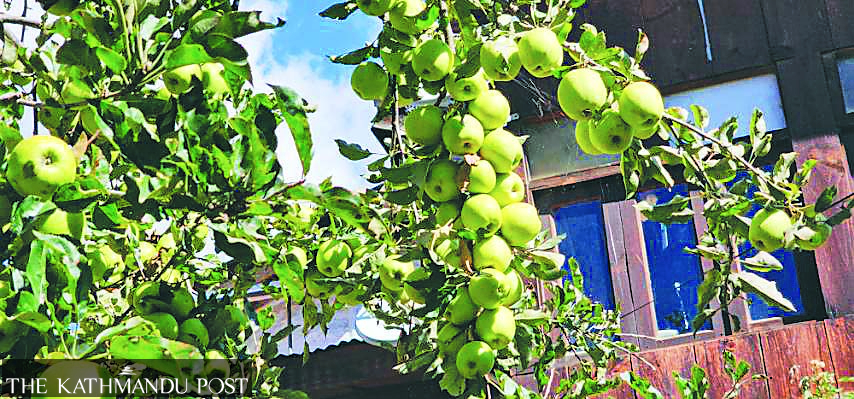
The apple orchard of Banche Mahatara in Chhayanath Rara Municipality of Mugu is heavily laden with fruit this year. He has planted around 1,000 apple trees on nearly 10 ropanis of land; 600 of them bear fruit.
“The harvest looks good this year. The branches are bending under the weight of apples,” he said. “The fruit will start ripening from mid-September, but concerns about prices and markets have already begun.”
Last year, Mahatara produced nearly eight tonnes of apples and supplied five tonnes to Nepalgunj. But then landslides blocked the Karnali Highway during the peak harvest season.
“The highway remained closed for five days due to landslides, leading apples to rot on the way,” he said. “When the highway shuts down in the harvest season, farmers suffer huge losses.”
He sold his apples to local traders for Rs45 per kilogram last year, while the same fruit fetched Rs150 to Rs200 per kg in Nepalgunj and Surkhet.
Almost every household in Talcha, Maitulek, Ghattalekh, Bam, Phoipata, Dakhryalbada, Jhapagard, Mathitum, Pina, Jhyari and Kotila of Chhayanath Rara Municipality owns an apple orchard.
According to local farmer Ankalal Mahatara, nearly 300 farmers in Talcha cultivate apples on plots of up to 10 ropanis.
“During harvest season, we first face a shortage of cartons. Then comes the problem of prices and markets,” he said. “The traders who come here never pay more than Rs40-45 per kilogram. If we could send the apples directly to cities, we would get better prices. If there were cold storage facilities, we could store apples until Dashain and sell them at much better rates.”
He said the lack of an assured market often forces farmers to harvest and sell apples before they are fully ripe.
According to the District Agriculture Development Office, Mugu produced 3,800 tonnes of apples in the fiscal year 2023-24, up from 3,640 tonnes in the previous year.
Ganesh Bahadur Adhikari, chief of the office, said inadequate storage, the absence of grading facilities, poor road connectivity and packaging problems continue to prevent farmers from securing fair prices.
Last year, farmers started sending unripe apples to markets as early as mid-August. Although juicier and sweeter apples became available after mid-September, many growers rushed their produce to market fearing a price crash once apples from across Karnali arrived simultaneously.
“We have not been able to earn the profits we expected from apple farming,” said Karna Bahadur Mahatara from Talcha. “If wholesale traders purchased directly from farmers, it would provide some relief.”
He said unsold and rotting apples often end up as livestock feed.
Data from the Karnali provincial Ministry of Land Management, Agriculture and Cooperatives shows that apple production continues to rise. Apples are cultivated in 9,377 hectares across all Karnali districts except Surkhet, with 3,419 hectares classified as productive orchards.
Average productivity stands at 9.1 tonnes per hectare. The province produced 31,102 tonnes of apples last year. Jumla led production with 12,500 tonnes, followed by Humla with 4,224 tonnes, Mugu with 3,891 tonnes and Dolpa with 3,600 tonnes.
Other districts recorded smaller outputs: Kalikot 5,800 tonnes, Jajarkot 330 tonnes, Dailekh 260 tonnes, Salyan 172 tonnes and Rukum West 75 tonnes.
Tek Bahadur Shahi, a farmer from Raskot-2 in Kalikot, said storage and transportation remain the biggest challenges facing apple growers in Karnali.
“If we had cold storage facilities, we could preserve apples without spoilage and earn better prices,” he said. “Market demand could also be met for seven to eight months. But every year, landslides close the Karnali Highway during the apple season, and a large portion of the harvest rots on the way.”
The Karnali Highway remained blocked for 18 days in mid-August alone last year due to 43 separate landslides.
Shahi said apples from his village must be carried by porters for nearly three hours before reaching the highway.
“Transportation by porter costs Rs20-30 per kilogram, and there is always the risk of damage,” he said. “Only after reaching the highway do traders buy the apples, and even then at very low prices.”
He has planted around 900 apple trees on 10 ropanis of land, with nearly 700 now bearing fruit. Last year, he sold about seven metric tons of apples at Rs40 per kilogram.
Agriculture expert Nabin Sharma said annual apple production in Karnali has increased steadily due to improved saplings, better organic manure management and wider use of biological pesticides.
However, farmers have not benefited proportionately.
“Traders from Nepalgunj and Surkhet travel directly to road-accessible orchards, but they dictate the prices,” Sharma said. “Without proper storage and transport infrastructure, farmers have no option but to sell cheaply.”
Average productivity stands at 9.1 tonnes per hectare. The province produced 31,102 tonnes of apples last year. Post photo
Marketing remains particularly difficult in Humla. Apple cultivation covers around 518 hectares across all seven local governments, including Simkot, which was connected to the national road network only last year.
According to the District Agriculture Development Office, Humla produced about 4,200 tonnes of apples last year.
“On newly opened roads, nearly a third of the apples are damaged in transport,” said Bhim Bahadur Rokaya of Simkot Rural Municipality-7. “Because there is no cold storage, we must sell all our apples within a month. Unsold fruit is fed to the livestock.”
Five years ago, farmers often had to distribute apples to relatives or feed them to cattle because there was no market access.
Rokaya has planted around 800 apple saplings on nine ropanis of land, with roughly 500 trees now bearing fruit. Last year, he sold about three metric tons of apples to Nepalgunj at Rs50 per kilogram.
Large-scale growers face fewer marketing challenges. Min Bahadur Bhandari of Guthichaur Rural Municipality-5 in Jumla has invested nearly Rs220 million in an apple orchard over the past four years.
His orchard contains around 48,000 trees and produced 80 tonnes of apples last year. Traders purchase apples directly from the farm, which aims to produce 200 tonnes this year.
“When production is on a large scale, marketing is not a problem,” he said. “Wholesale buyers bring trucks directly to the orchard. However, without storage facilities, it is difficult to keep apples even for 10 to 15 days.”
Jumla was declared an organic district in 2000 by the then District Development Committee, which also launched the “One Household, One Apple Orchard” campaign. According to the District Agriculture Development Office, around 16,000 of Jumla’s 19,000 households now cultivate apples.
Trader Manoj Bohora said farmers would be protected from losses if the government introduced a minimum support price.
“Apples that sell for Rs40-50 per kilogram in Jumla are sold in Kathmandu for up to Rs250,” he said. “The price gap between farmers and consumers is about Rs200 per kilogram, while transportation, packaging and grading cost only around Rs50-70 in total. Most of the profit goes to traders and middlemen.”
He added that inadequate cold storage, packaging and grading facilities force farmers to harvest apples before they are fully ripe.
Sanjiv Kumar Karn, secretary at the Ministry of Land Management, Agriculture and Cooperatives, said Karnali is expected to produce between 31,000 and 33,000 tonnes of apples this year, similar to last year's output.
He acknowledged that shortages of cartons, storage facilities, grading centres, roads and proper packaging continue to undermine apple marketing.
“Because marketing remains poorly organised, farmers receive low prices while consumers pay high prices,” Karn said. “To address this, we have proposed forming an Apple Board. Once established, it will support both production and marketing.”
According to him, apples from Karnali meet around 47 percent of Nepal’s market demand between September and November. Since chemical fertilisers and pesticides are not used, Karnali apples are effectively organic. Improved grading, labelling and packaging could also open up international markets, he said.
He added that infestations of woolly aphids, caterpillars and fungal diseases have recently affected production in some areas.
The Karnali provincial government announced an ambitious plan to establish an Apple Board during the current fiscal year to support apple cultivation, production and marketing, allocating Rs140 million for the initiative.
However, 10 months into the fiscal year, the board has yet to be established.




 22.94°C Kathmandu