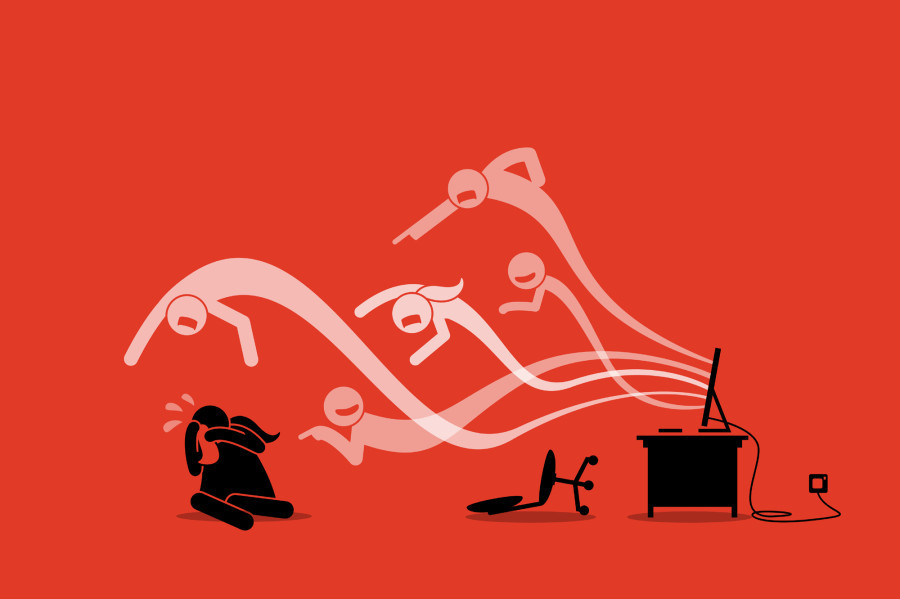
The harassment of women for public expression in Nepal is not a reaction to any single political wave. It is a pattern, and it has a history. Shutterstock
‘‘To ruin a woman’s life, all it takes is assassinating her character.’’
These were National Assembly Vice-President Leela Kumari Bhandari’s first public statement upon assuming office. Calling for strict legal measures against cyberbullying, she warned that even lawmakers have had to walk into the police cyber bureau seeking justice as victims of online abuse, and that unchecked harassment is silencing women from participating in public life.
‘‘Attacks on women’s character have escalated to such a level that, for society to remain civilised, it must be addressed through legal action,’’ she said.
Her remarks come at a time when women who speak out in public are increasingly met not with debate, but with coordinated online attacks.
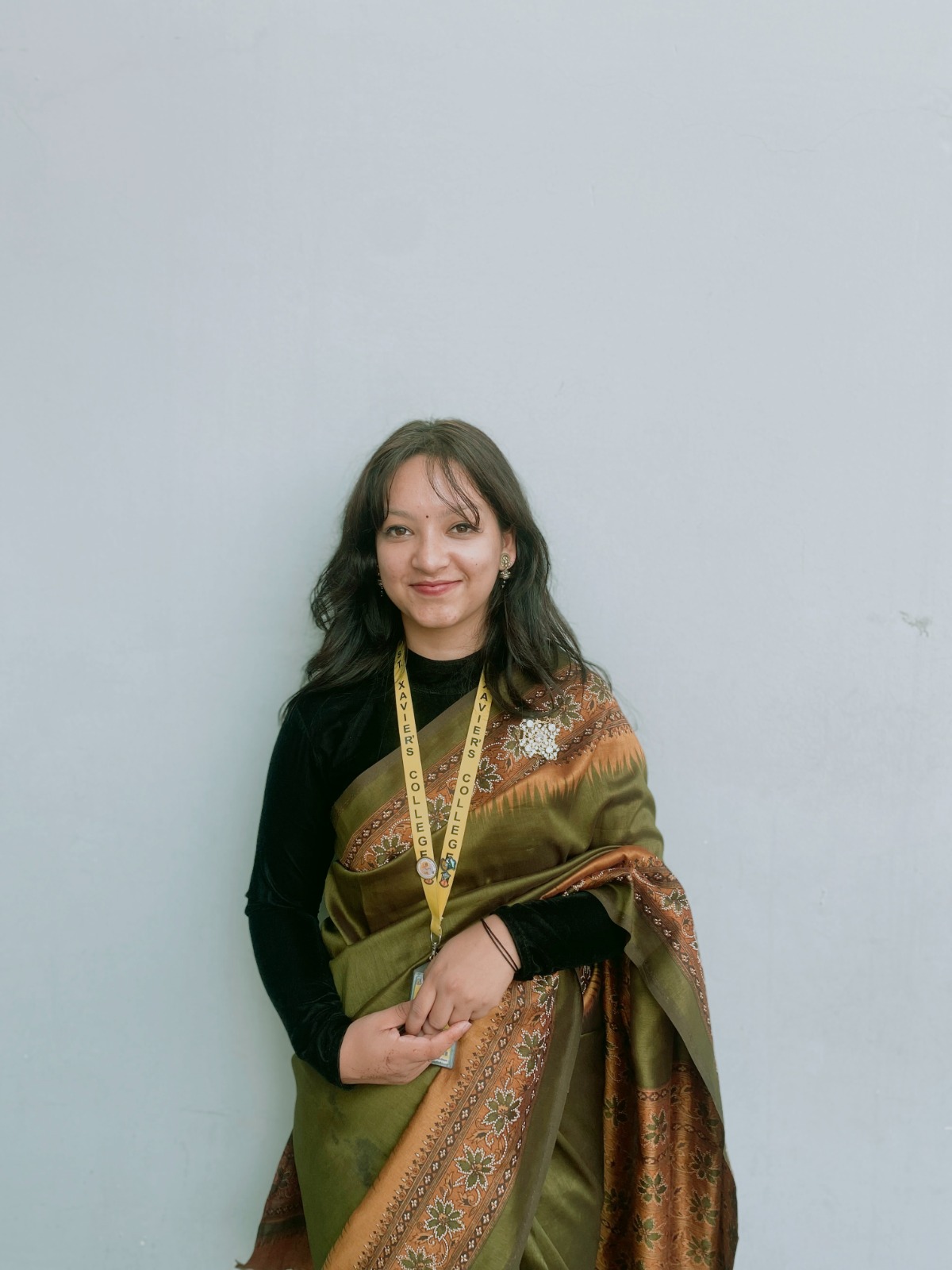
The widely-discussed experience of Amisha Parajuli illustrates how quickly such attacks can escalate.
After CPN-UML leader and former prime minister KP Sharma Oli was arrested for his alleged role in the crackdown on September’s Gen Z protests, UML took to the street to protest. Among them was Parajuli, a student raising her voice in support of party chair Oli even as she condemned Home Minister Sudan Gurung.
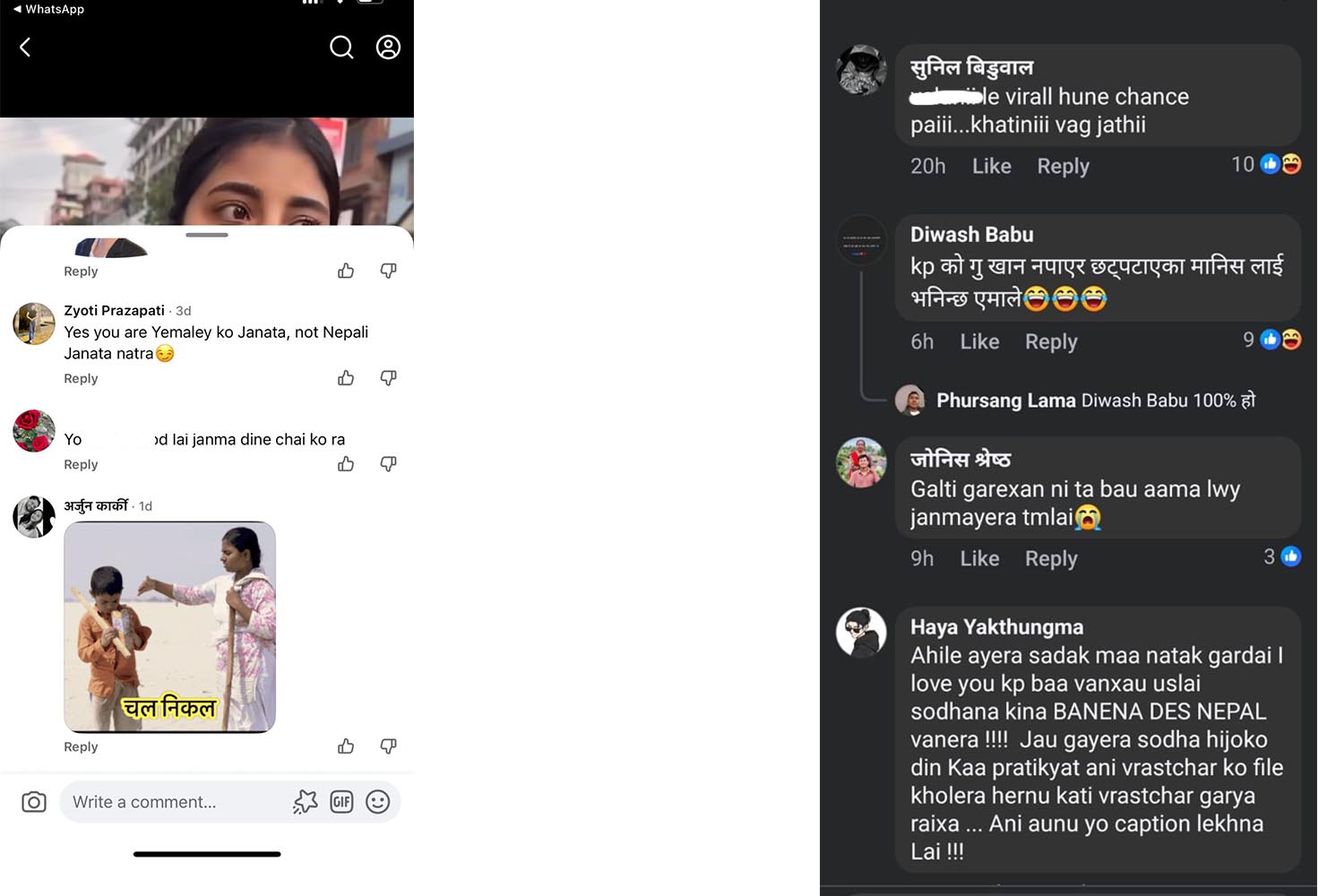
By that evening, Parajuli’s online posts were flooded with abusive comments. Within a day, she had been reduced to a caricature—labelled a troll, a hater, a jholey (a derogatory label for someone who blindly backs a politician)—and paradoxically cast as a victim, all for publicly voicing her political opinion. The comments were not just dismissive. They were graphic.
“The responses were disturbing. I received comments saying I should be raped. Some men went as far as describing how it should be done, while others suggested that what happened to Inisha BK should happen to me as well,” Parajuli said. “There were even statements encouraging gang rape.”
The comments beneath her posts tell their own story. One user, Diwash Babu, dismissed her as a woman of loose character who was simply using the protest as a vehicle for online attention. Another declared that a sex worker was a more honourable figure than Parajuli.
The language was not a political critique; it was degradation, methodical and gendered. Parajuli has since filed a complaint with the Nepal Police Cyber Bureau at Bhotahiti against her character assassination on social media. The comments, however, remain visible, and are still being liked, shared, going largely uncontested.
Ultimately, the pressure of the controversy led Parajuli to quit her job.
What happened to Parajuli is a part of an old culture in which women who speak publicly are met not with debate, but threats designed to remind them of their bodies and their vulnerability. The contradiction is sharp and telling: calls for justice in cases like Nirmala Pant coexist, in the same society, with rape threats against women like Parajuli, whose offense was simply having an opinion.
Parajuli’s experience is not isolated. Years before her, others had already walked the same tortuous path.
Bhawana Raut, a public commentator who has long been vocal on political issues, faced a storm when she publicly questioned Keshav Sthapit’s mayoral candidacy at an interaction at National College in April 2022. In a hall full of young voters, she asked Sthapit about sexual harassment allegations against him. Sthapit reacted aggressively and remarked, ‘‘You are a nice lady but thutuno thik chhaina’’, condescendingly implying that Raut’s language was inappropriate. He stood up, wagged a finger at her, and the hall erupted.
Not in her defense, but in his.
Hooting. Claps. Heads nodding in agreement.
‘‘I questioned certain beliefs that some people hold very strongly, sometimes so strongly that even basic questioning feels like a threat to them. And I think that’s where the controversy started—not from hate, but from asking questions,’’ Raut said.
What followed online mirrored what happened in that hall. Rape threats, she said, has been routine.
‘‘There is almost always at least one comment saying she ‘deserves’ something like that, and what’s more worrying is how rarely such commentators are held accountable. It has been normalised to a point where it feels like a part of public engagement, which is honestly concerning for any society.’’
The initial personal toll was big, even for someone who has since learned to weather it.
‘‘It affected me deeply, made me feel unsafe,’’ she said. ‘‘Over time, I’ve learned to handle these things better. But that doesn’t mean they stop affecting you.’’
Raut did, on one occasion, pursue a formal complaint. During the Covid period, she received a threat on the audio platform Clubhouse. As the conversation had been recorded, she filed a complaint with Nepal Police, who tracked down the individual: a 14-year-old boy. She chose not press the case, and spoke to him directly instead. He apologised.
‘‘I hope that moment helped him understand the impact of his words,’’ she said.
Yet despite the cost, she remains resolute.
‘‘Questioning is fundamental to any democracy. If we stop asking questions because of fear, then we are already giving up too much. Those of us who have some level of visibility carry a certain responsibility—our voices reach places where many others’ don’t. So speaking up is not just a choice, it becomes a responsibility.’’
Again, the harassment of women for public expression in Nepal is not a reaction to any single political wave. It is a pattern, and it has a history.
The pattern has not softened. If anything, it has found new targets and new justifications.
On Friday, actor Sangam Bista publicly accused actor Sagar Lamsal, popularly known as Bale, of rape, posting the allegation on social media, tagging him on Facebook. Lamsal was arrested the same day from Budhanilkantha. A formal complaint has yet to be filed.
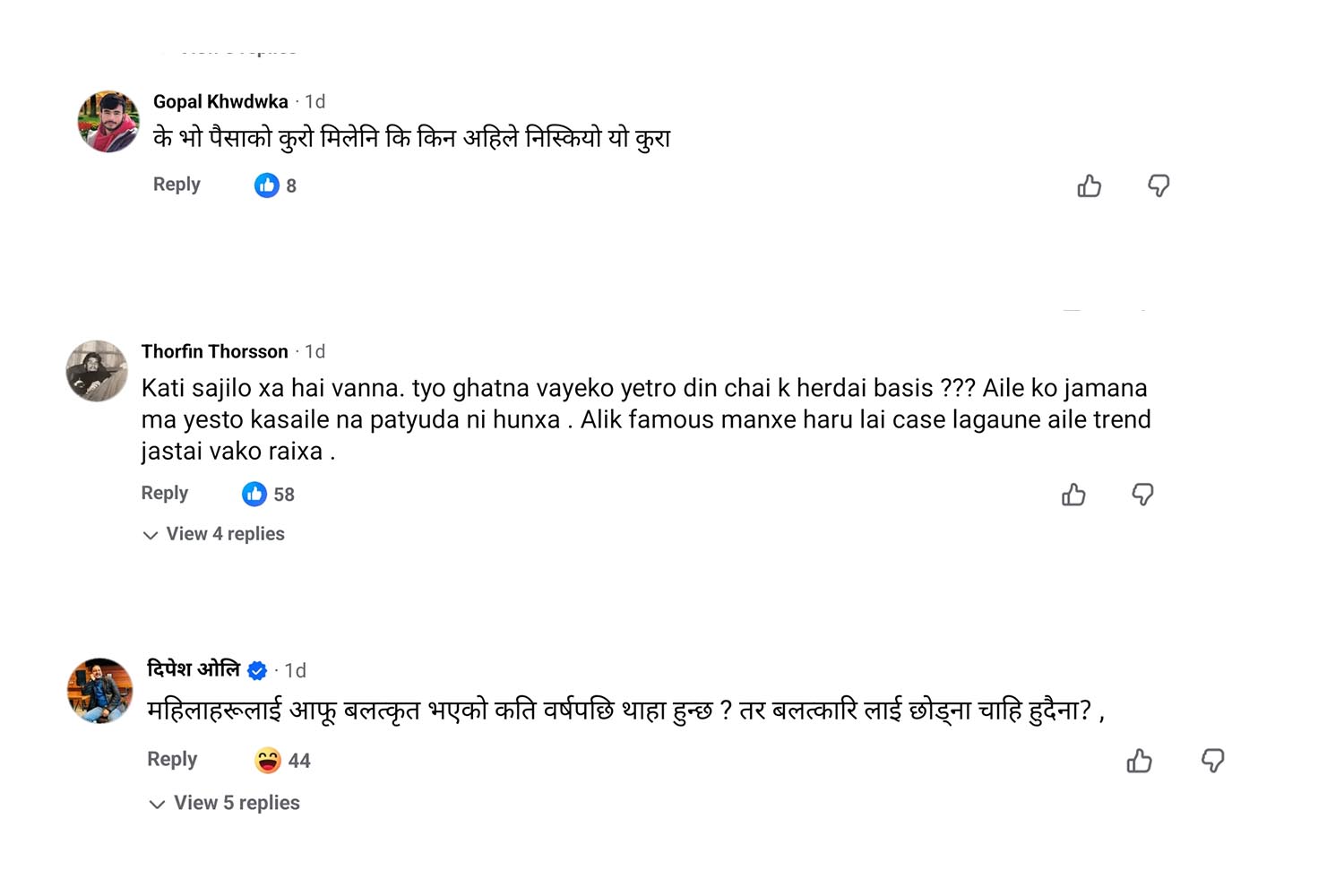
Within hours of Bista’s post, the comments beneath it became a study in how Nepali public discourse greets women who speak about sexual violence. One commenter, Dipesh Khatri, wrote: ‘‘K kurama karobar milena hou’’—suggesting that the accusation was not about assault at all, but about a personal or professional disagreement that had soured, framing rape as a transaction gone wrong. Another, Sudan Pandey, wrote ‘‘1 barsa samma kina chupchap katai paisa kamaune tarika ta haina’’—questioning why Bista had waited a year to speak, suggesting her silence has been financially motivated and that she is now speaking for profit, not because silence is what trauma often looks like.
These comments did not come in isolation. They arrived within a social media ecosystem that had, days earlier, called Parajuli a woman of loose character for supporting a political leader. The vocabulary shifts, there are implications about commercial arrangements, but the mechanics are the same: find an angle that discredits, and repeat it at scale.
For women whose public presence is their profession, that pattern is lived daily.
Singer Jyoti Magar said harassment has been a constant presence, both online and offline.
“When I go to concerts, maybe 75 percent come to enjoy the music, but there are still 10 to 25 percent who intentionally come to harass me,” she said.
Actor Nisha Adhikari described a different kind of trap—one where even a laugh can be turned into a weapon. After appearing on an entertainment show where old clips of herself and Rekha Thapa were played, she reacted the way most people would. She found it funny and laughed.
‘‘Just for laughing, I faced massive backlash. People started labelling me ‘anti-Balen’ [Balendra Shah, former Kathmandu mayor and current prime minister], ‘anti-village’, and so on,” she said.
Her experience reflects societal expectations that women perform within narrowly defined boundaries. Any deviation—supporting Balen or Oli, expressing humour, or reacting publicly, can result in a loss of their status as ‘‘respectable’’. It also raises a broader question: why are women policed so harshly for reactions that would be dismissed if expressed by men? Their experience reflects how visibility itself often becomes a liability for women. The scrutiny is not limited to their work, but extends to their bodies, behaviour, and perceived morality.
For women in politics, the challenges are as entrenched.
Tashi Lahzom, a proportional representative candidate for the lower house from Humla, said that simply entering the political arena comes with an added burden.
“It’s more like, as women candidates, we have to defend our candidacy, whereas men don’t have to defend theirs. That’s what I felt,’’ she said. ‘‘Another thing that I’ve noticed as a minority and as a woman is that there is a high chance your gender being used against you, your identity being used against you.’’
The message, delivered in different forms across different contexts, is consistent: you do not belong here.
A TikToker who shared her prediction about the March 5 parliamentary elections faced similar backlash, leading her to deactivate her social media accounts. Speaking anonymously to thePost, she said, ‘‘I’m taking some time off, as the weight of the harassment has become too much to bear.’’
For Gen Z activist Rakshya Bam, the line between public and private safety has disappeared. She recalled a recent protest, where she was questioned aggressively and in a deeply disrespectful manner.
‘‘It was my first experience of such hostility in real life,’’ she said. ‘‘Now even small interactions feel threatening—I find myself thinking, what if someone actually does something to me? Even while walking, if someone passes too close, I get scared.”
The concern has reached parliament itself. A delegation of female UML lawmakers recently visited the Cyber Bureau to demand urgent intervention, describing the surge in digital sexual violence as a ‘‘moral defeat’’ for the nation’s democracy.
Lawmaker Roshani Meche, who was part of the delegation, said the problem is systemic. ‘‘This is not just a question of personal experience; it is a question of the collective pain of today’s society,’’ she said.
The delegation also pointed to cases beyond those already in the public eye. Lawmaker Tuka Hamal highlighted the case of Renuka Baral, whose casual political comment on then-Kathmandu Mayor Balendra Shah resulted in relentless public shaming—with consequences, Hamal warned, that devastate not only a person’s social standing but also the lives of their children.
Gender studies expert Sucheta Pyakuryal sees a structural problem. Nepali society and its legal framework treat women as belonging to the private, not the public sphere, she said.
‘‘After the Gen Z movement, there has been a wave of populism, anti-establishment sentiments, and opposition against older political forces, including against Oli. One reason for the backlash is that Parajuli stood against that wave,’’ said Pyakuryal. But political timing alone, she emphasised, does not explain the intensity or the form of the response.
Nepal’s Constitution does not grant women equal citizenship rights through their mothers, formally undermining their place in public life. When such citizens raise their voices, those who feel entitled become threatened or uncomfortable.
This, she said, is why expressions of women’s political will are so often met not with debate, but with attempts at erasure.
The specific tools of erasure: rape threats, graphic descriptions of sexual violence, references to murdered women, implications about women’s character or motives—are not random. Pyakuryal described it as a calculated mechanism of degradation.
‘‘Women are fundamentally seen as objects in our art, architecture, literature, movies—and everywhere,’’ Pyakuryal said. ‘‘So when an ‘object’ says, ‘I’m not an object, I’m a citizen, I think,’ the quickest way to reduce and degrade her back into an object is by sexualising her.’’
The comments beneath Parajuli’s posts and beneath Bista’s follow this logic. A woman voices a political opinion: she is called a whore chasing fame. A woman names her rapist: she is accused of running a failed transaction. In each case, the response does not engage with what the woman said. It attacks what she is, or rather, what her attackers insist she must be.
Once reduced to her body or her motives, a woman’s voice is not answered. It is dissolved.
Digital platforms can intensify this pattern.
AI expert Dovan Rai said social media algorithms are designed to amplify content that generates engagement, regardless of its nature. ‘‘Something that gets even five percent more engagement can be boosted to 30 percent by the algorithm,” she said.
A United Nations study on AI-powered online abuse highlights how such systems can disproportionately expose women to harassment, reinforcing cycles of visibility and attack.
These dynamics mean that women like Parajuli and Bista are not only personally threatened but made highly visible targets whose harassment is amplified for public consumption and implicitly endorsed by the platforms that host it.
The cumulative effect is an informal tax on women’s public participation. Every time a woman considers speaking: in politics, media, entertainment, activism or about her own assault, are often left weighing the cost of speaking against the risk of abuse.
Aarya Chand is a reporter at The Kathmandu Post covering social issues. Before moving to the social beat, Chand was an intern covering culture and lifestyle for the Post.




 14.81°C Kathmandu