‘We don’t teach that to females,’ they were told. They learned anyway
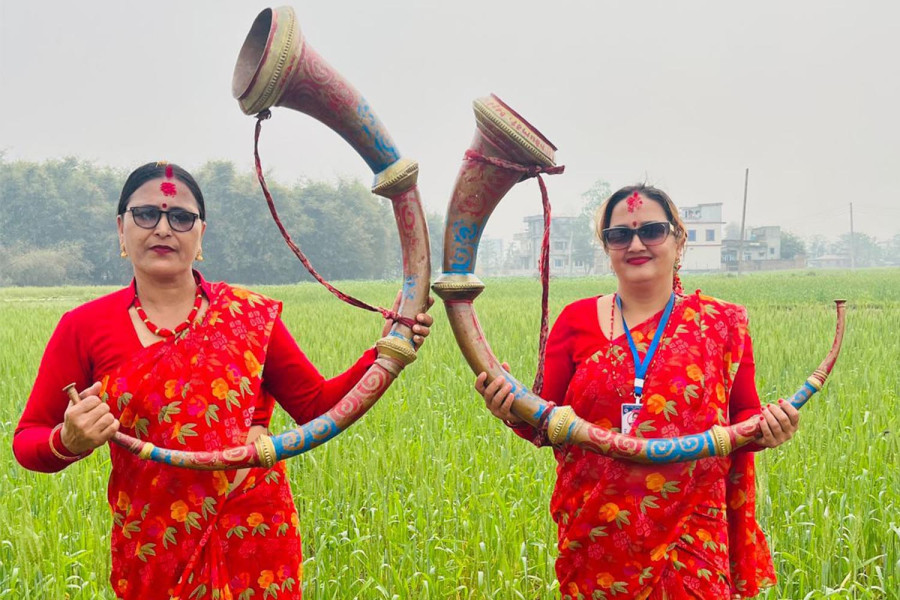
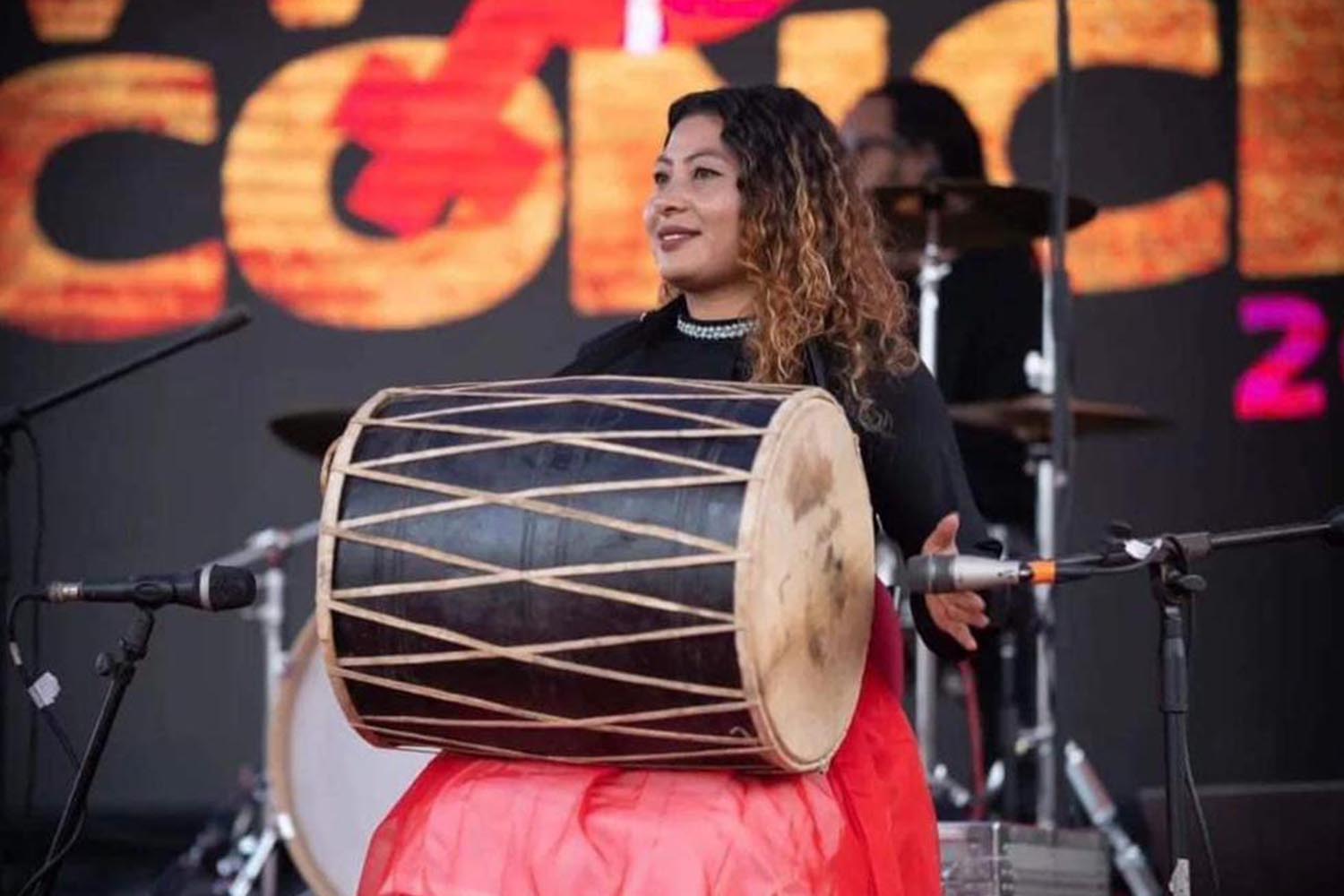
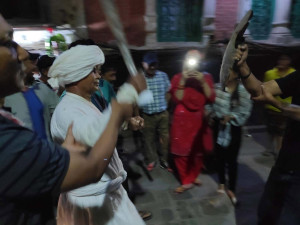
Women across Nepal are breaking long-held gender and caste barriers to reclaim traditional folk instruments once denied to them. Along with her friends, Sangita Karki Bhandari (left) urged the Biratnagar Metropolitan City Office for almost two years, finallysecuring the budget and renting a space to learn naumati baja. Provided to the Post
Four years ago, the Biratnagar Metropolitan City Office allocated Rs0.5 million to support local women in learning the naumati baja. The initiative came after sustained efforts by Sangita Karki Bhandari and two of her friends.
Bhandari had gone to Itahari to attend her relative’s wedding. Returning home, she had developed a growing interest and inspiration to play traditional musical instruments. Along with her friends, she urged the Metropolitan Office for almost two years, finally securing the budget and renting a space to learn naumati baja, which comprises an ensemble of two narsingha, two damahas, two sanais, one tyamko, one dholaki, and one jhyamta.
Restrictive cultural perceptions regarding gender and caste were the main barriers to their initiative. “No women from Chhetri and Bahun communities had participated initially,” says Bhandari. With advocacy and encouragement, they gathered 32 women from all 19 wards of Biratnagar.
The elderly male musicians from the area taught them how to play the instruments. Today, there are four female-led musical groups in Biratnagar, including Bhandari’s 9-member group, ‘Srijansheel Naumati Panchebaja’.
“Currently, we simply enjoy being in a band,” shares Bhandari. “A promising way to spend time, rather than staying alone at home.” She adds that playing in the ceremonies has also been a way for members of the group to cope with stress.
The idea of women playing folk instruments in Nepal was once considered revolutionary. At a time when they were not ‘allowed’ to interact with the instruments, let alone touch them, some musicians refused to conform to the established rules, building a firm and welcoming foundation for the female musicians of the present generation.
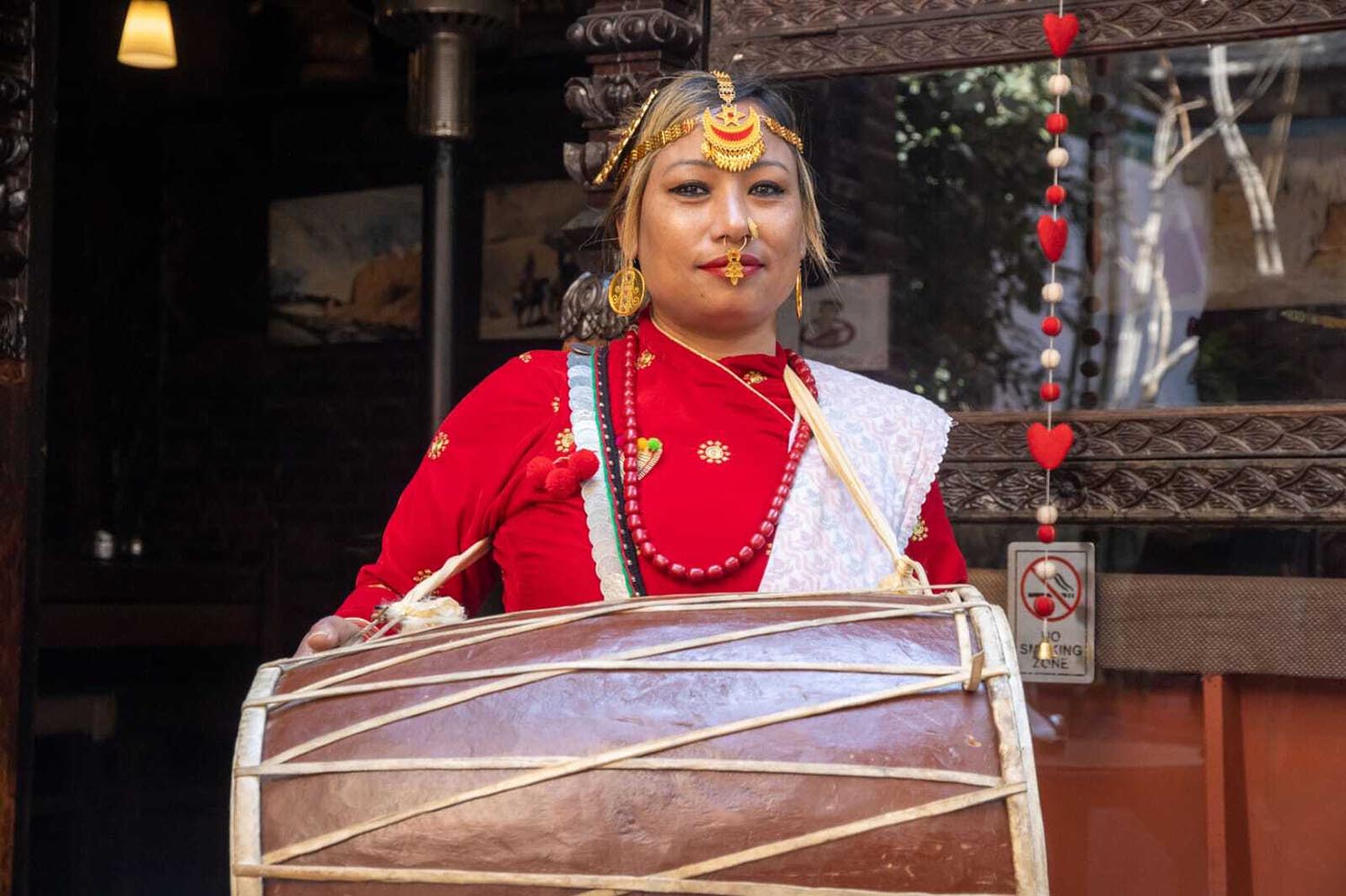
Sarada Dongol, in her traditional attire, playing dhime baja.
In 1994, Indira Lachhimasyu faced daunting criticism for playing the dhime Baja from her own father and grandfather. For generations, patriarchy had dictated hobbies, professions and even artistic expressions for women. Consequently, Lachhimasyu playing the instrument was perceived as strikingly unconventional and eccentric at the time.
Today, Lachhimasyu stands as one of the first female dhime players in Nepal. The triumph still feels personal, tangible and powerful with the growing presence of women in folk instruments. “Change arrives only when we remain persistent,” says Lachhimasyu.
Her story is not an isolated one, but a part of the broader, often overlooked history of women resisting cultural restrictions.
Similar struggles and acts of resistance can be traced in generations of women. Musician Sarada Dongol, who is also the lead folk percussionist in the renowned Newa rap ‘Apwoh Misa’, believes that playing folk instruments as a woman in Nepal is an empowering act of breaking gender and caste stereotypes while preserving and promoting the cultural identity of our society. “I take it as challenging the traditional view as well,” she says. “In our society, we have a small scale of acceptance for female rhythm players compared to singers.”
Dongol had learnedmadal during her school days and says she got emotionally attached to it. However, her parents were hesitant, concerned that music could not provide a stable livelihood. Like many others, she was encouraged to pursue a more conventional academic path and went on to pursue science while joining music classes.
Even as opportunities slowly expanded, certain barriers remained firmly in place. Her determination led her to learn the dhime in 1996 after finishing school. But when she expressed interest in learning the dafa instrument khinfrom a Newa cultural group that taught traditional instruments, the members plainly told her, “We don’t teach that to females.”
Similar to Lachhimasyu, barriers became central to Dongol’s journey. Today, she stands among the few women practising traditional percussion. “Every time I perform, I feel like I carry the stories and traditions of my culture with me,” she says. “It makes me feel connected to my roots and gives me a sense of happiness and pride.”
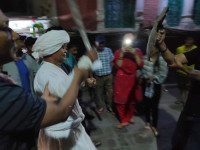
Pragya Shakya playing dhaa baja during Seto Machhindranath Jatra. ‘Today, many girls are interested in and actively learning folk instruments,’ she says.
The transformation led by these women has made the path easier for those who follow. For the present generation, questions about traditions and stereotypes feel more distant, though not entirely gone.
Pragya Shakya plays dhaabaja, a traditional Newa instrument of discipline and heritage. Dhaais played mostly during the Gunla Parba, a sacred period of devotion for Newa Buddhists.
Reflecting on her experience, Shakya observes a clear generational shift. “Today, many girls are interested in and actively learning folk instruments,” she says. “But from what my grandmother tells me, that wasn’t always the case. Earlier, girls didn’t really have the option; they weren’t encouraged.”
For Shakya, learning a traditional instrument is both a personal and cultural journey. “Now it feels different. Folk instruments are being recognised as an important part of our heritage, and younger generations are eager to learn,” she explains. “Being able to play one, as a woman, feels like a moment of pride. It’s not just about music, I’ve learned about its history and significance as well.”
She adds that the support she receives from her family has made the experience even more meaningful. “My parents and grandparents are proud that I’m learning about our culture,” she says.
Shakya also finds inspiration in other female musicians. “Women are more encouraged now, and when I see them perform with such passion and energy, it motivates me to play with the same dedication.”
What was once considered defiance is now a tradition, rewritten, rhythm by rhythm, by women who refused to stay silent.




 22.06°C Kathmandu