



 24.72°C Kathmandu
Sun, Oct 25, 2026
Arts
Where art becomes worship
At Siddhartha Art Gallery, ‘Aarambha’ explores Paubha as a practice rooted in faith, patience and cultural memory.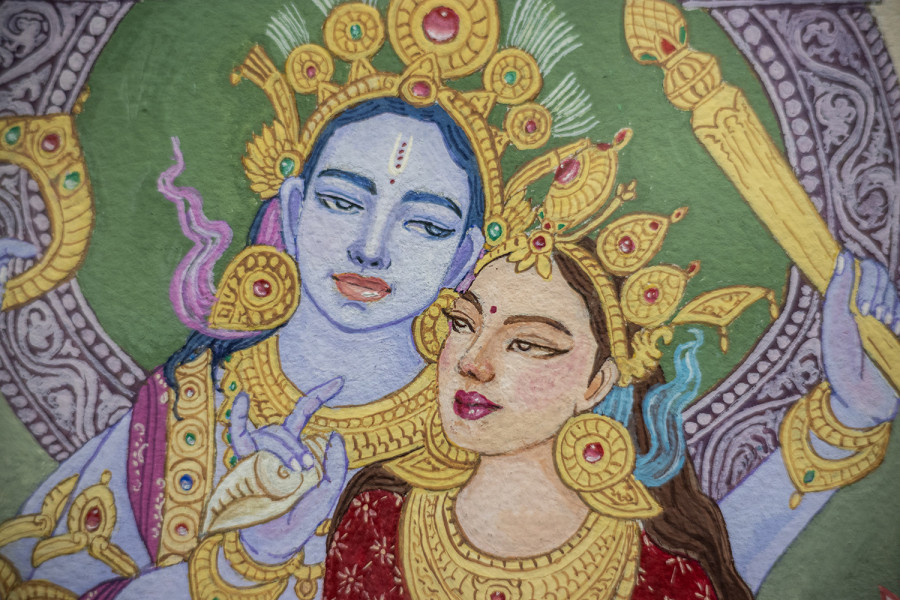
bookmark![]()
![]()
![]()
![]()
Mokshyada Thapa
Published at : June 5, 2026
Updated at : June 5, 2026 06:44
Kathmandu
Paubha painting, a centuries-old sacred art form, has its own ecosystem, one built on devotion, persistence, and patience. Unlike many other art forms that can be easily imitated or traced, the creation of a Paubha follows a meticulous process. To shed light on the making of these intricate paintings and their cultural and spiritual significance, ‘Aarambha’ at the Siddhartha Art Gallery (SAG), organised by Kala Aakar Studio, brings together the works of students and professional artists.
“My great-grandfather was a Paubha artist. His painting had been hung on our wall. Sadly, it was slowly losing its colours. I thought, why not recreate it?” says Lasata Shakya.
Earlier, natural pigments and animal fats were used, but today the process is much more convenient with synthetic colours.
In her childhood, Shakya couldn’t even categorise the piece as ‘Paubha’. Yet, she now believes a series of generations have connected through art, referring to her work as a ‘calling’.
An architect by profession, she was always drawn towards a creative pursuit. Although art was her passion, reviving ‘Wheel of Life’ felt more like giving a tribute to her late great-grandfather.
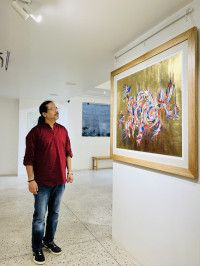
The painting stands tall, demanding attention first when you enter the hall. The large embodiment of Hayagriva Bhairav, in mud-red, gives the painting a fierce look.
In the ‘wheel’, six different worlds are represented with assorted characteristics of their own. The god’s world has lavish palaces, with no sign of any trouble or hardship. Completely absorbed in luxurious comforts, the deities forget their own duties. Their world collides with the Asura’s.
Often, deities are not supposed to act foolishly. Contradictorily, in this work, they can be seen stealing fruits from the monster’s realm.
“Earlier, I thought of it as the intersectionality of humans’ emotions, but recently I found that there is a greater meaning to the six realms of Devas, Asuras, Pretas, animals, hell and humans. In Buddhism, the outer ring, which I have painted, symbolises different states of existence,” Shakya expresses.
Like Shakya’s realisation, the implications of each element in Paubha interpret to something deeper, mostly in relation to humans: the pig represents ignorance and delusion, the snake shows hatred and anger, and lastly, the rooster is a symbol for greed and attachment
Another exhibitor, Sujit Maharjan, Kala Aakar Studio’s co-founder and a Paubha artist for the last 13 years, has five of his paintings on display, each with a different approach to Paubha.
“‘Aarambha’ began as a thought of exhibiting Paubha art from 40 artists, mainly to introduce this traditional style to the youth. People unfamiliar with Paubha are often intimidated by it. It is an intensive practice but doable too,” shares Maharjan, who hopes viewers from non-art backgrounds would try to connect with Paubha.
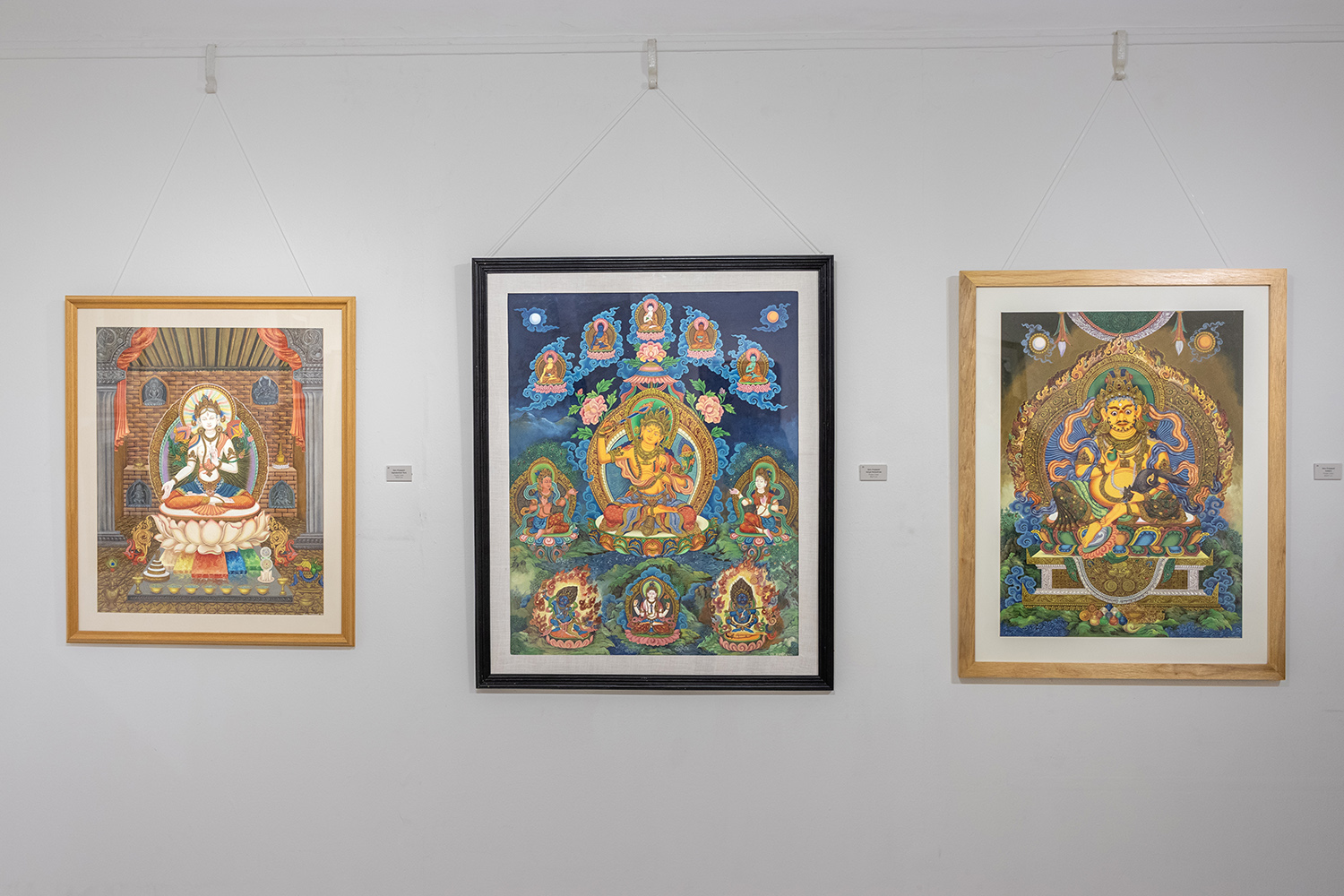
For Maharjan, Paubha painting is a medium for self-expression. In his work, ‘Path and Initiation’, the gods ‘Arya Tara’, ‘Lokeshwor’, ‘Padmasambhava (Guru Rinpoche)’, and ‘Dharmapalak’ (guards) are at the centre. The Tara at the bottom is carrying a brush; beneath him lie porcelain, mortar and a bottle of poster colour. Maharjan’s safe space is art, and that is his identity.
His ‘Ganesh’ follows the style of the 17th-18th-century Paubha, with an elaborate yet simple iconography of the god.
Another painting, ‘Arya Manjushri’, tries to replicate the Tibetan wall paintings. Unlike conventional Paubha, it follows a landscape model. Also, in this art form, nudity, rather than serving as an artistic expression, symbolises freedom.
“When we let go of ‘Maya’, physical possessions, even clothes, that’s when we return to our uncorrupted state of nature,” claims Maharjan.
In this context, nudity is not intended to be perceived as obscene. It serves as an expression of purity, spiritual liberation, and detachment from the material world.
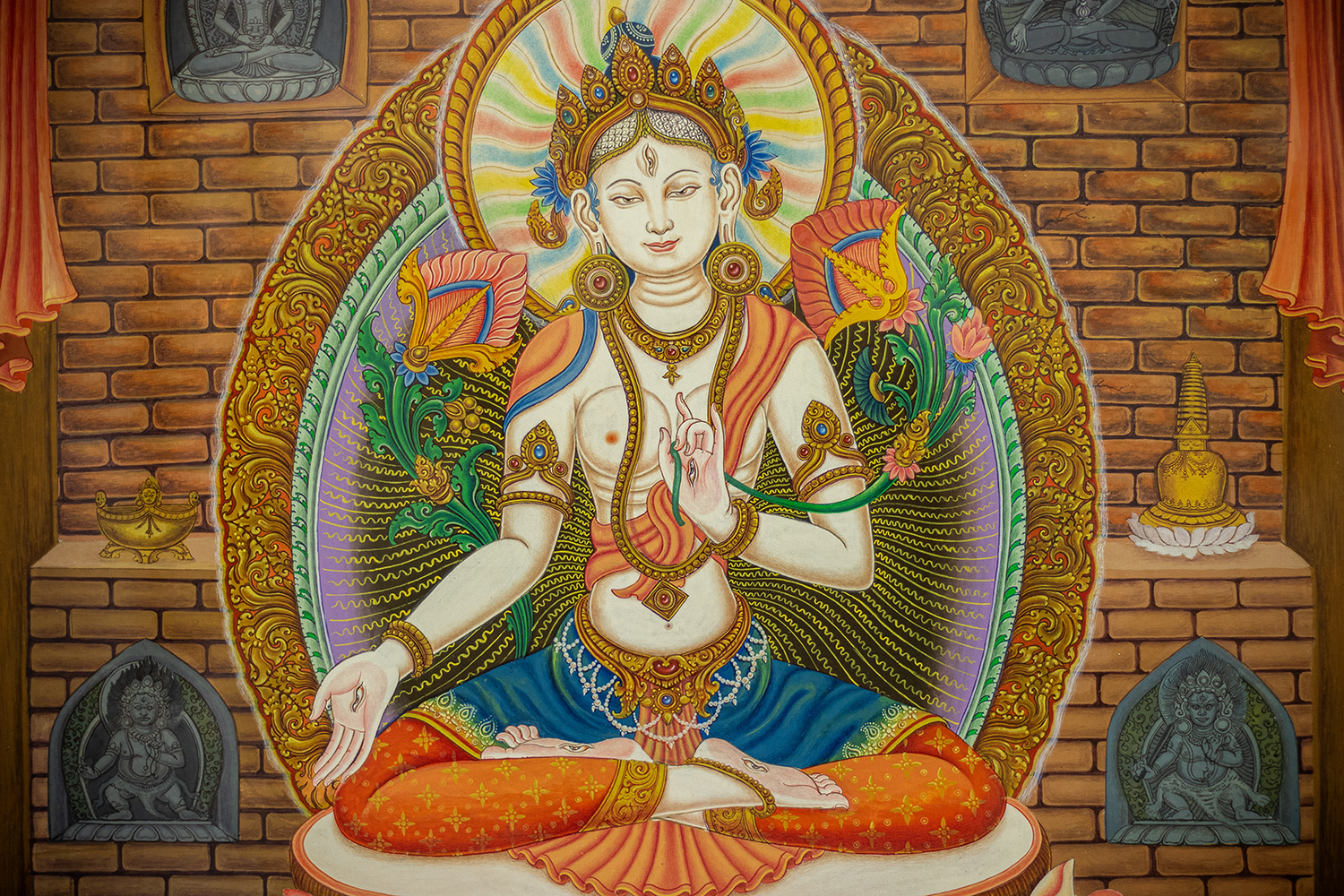
Saru Prajapati, another co-founder of Kala Aakar Studio, has two of her paintings in the exhibition. ‘Shrine’ is one of them.
‘Saptalochani Tara’ sits peacefully in a shrine, surrounded by offerings, a peacock’s feather and a Tibetan Kalash in Dhuku Kotha, a sacred room where gods are worshipped. The painting’s backdrop has a vintage look, with Prajapati replicating the interior of her old home before the 2015 earthquake.
Combining her personal memory, devotion to religion and artistic practice, ‘Shrine’ possesses an aesthetic charm.
Another interesting aspect of Paubha painting is the sheer amount of dedication it requires. Mainly because of its intricate lines, dense backgrounds, and strict guidelines when painting deities. This art form is a historical testament to the Hindu and Buddhist practices believed to have originated from the Licchavi period in Nepal.
Traditionally, the art form couldn’t be learned by joining courses or workshops. Wanting to learn Paubha would mean entering a ‘Guru-Shisya Parampara’, which translates to a teacher-student relationship, just like in the epic tales of the Mahabharata.
“In the ‘Guru Shisya’ relationship, sharing knowledge and honing it comes before everything. I learnt the art from my guru for a few years, full-time,” says Prajapati.
There is no certification, no money involved. However, the experience and learning throughout the Paubha learning period far outweigh everything else.
In an age when everything has become fast-paced, patience for art has declined sharply, and so has the attention span to complete it. But Prajapati thinks there is a justification for it. Kala Aakar Studio’s students have to divide their time and energy between learning Paubha and going to the office or attending academic classes. It is not easy, yet they try their best to understand the centuries-old tradition of Paubha.
Beyond the exhibition, the iconography is based on Buddhist practices. In Paubhas made for religious worship, the eyes are painted at the very end, almost as if giving the painting real life and presence.
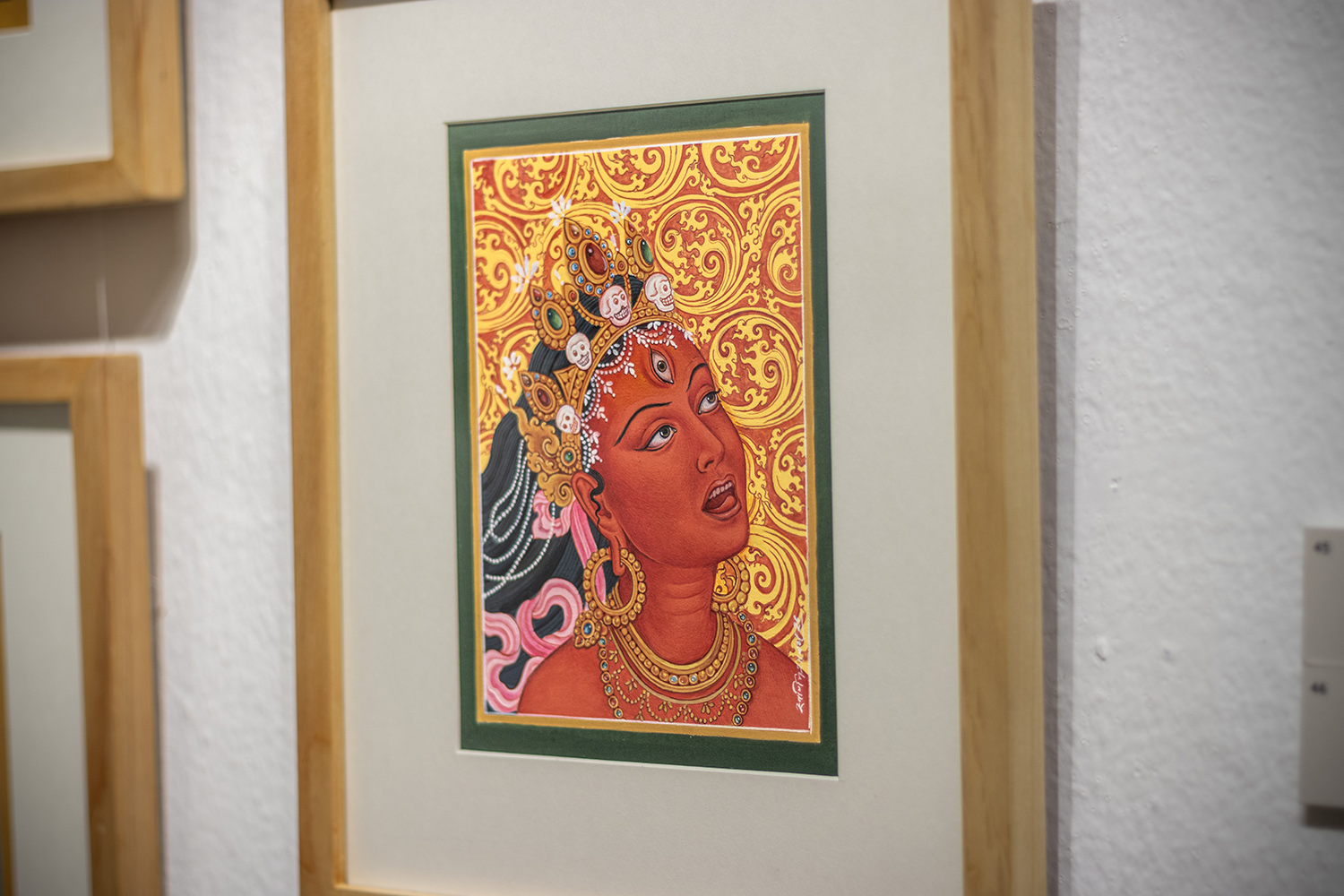
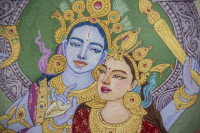
Sundar Shrestha, a Paubha artist, presents his work, ‘Green Tara’, which has the portrait of Buddhism’s most revered female goddess. The painting emphasises the goddess's facial structure.
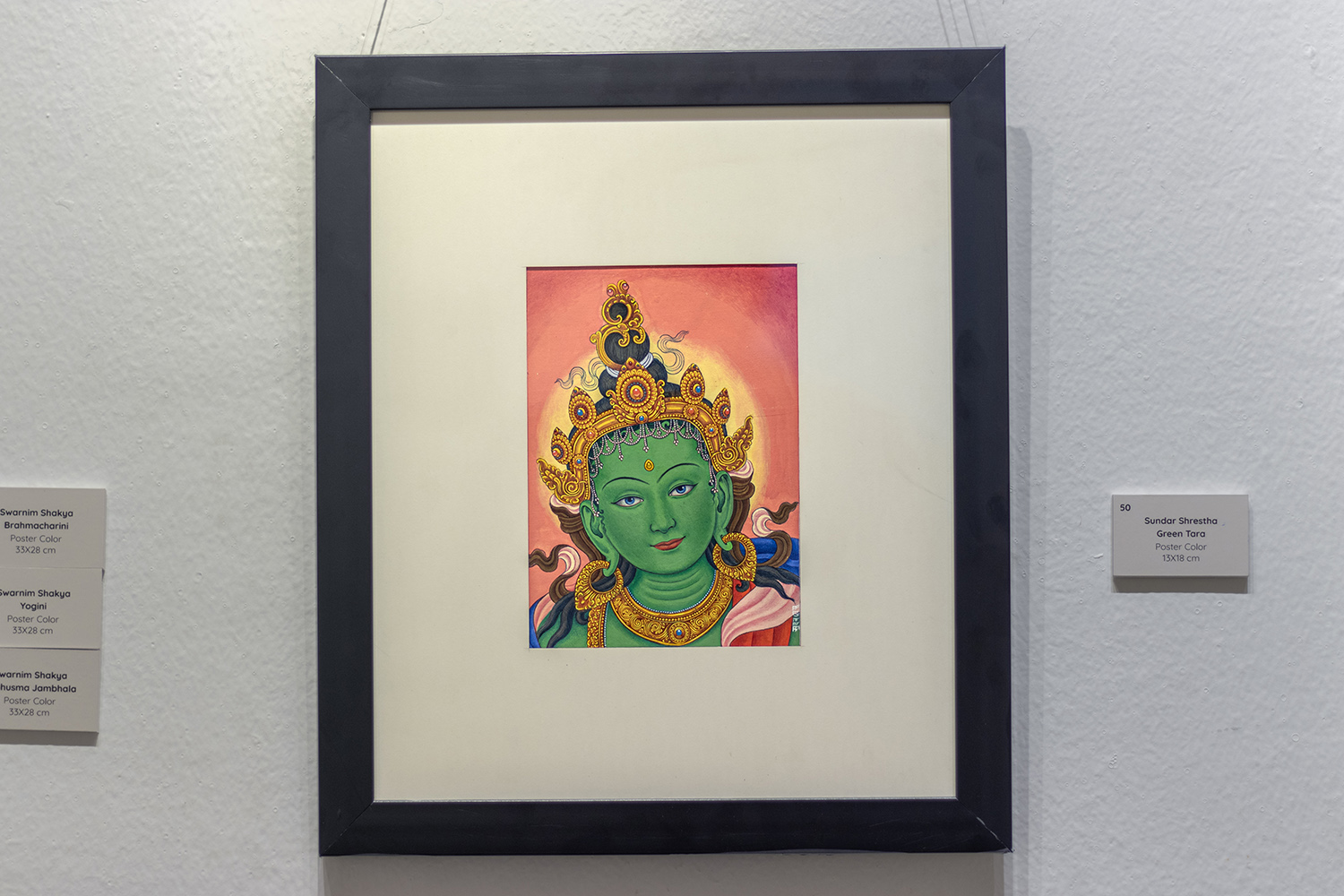
“The face, hands, and legs are the primary blocks of Paubha, and probably the most difficult too. But differentiating deities from faces is not possible," explains Shrestha. Mudras, asanas and the objects they carry distinguish their nature.
For Shrestha, Paubha is a practice that shows his devotion to deities. It is also where he gets to exhibit divinity through art.
“How I imagine and perceive a god or a goddess makes my paintings. You have to have a lot of fortune to be able to create the figures of such sacred figures. That is what I believe and say to my students all the time,” shares Shrestha.
The other paintings include works by student artists who participated in Kala Aakar’s 15-day workshop on Paubha painting.
Aarambha
When: Till June 7
Where: Siddhartha Art Gallery, Baber Mahal
Time: 11:00 am to 5:00 pm
Entry: Free
Mokshyada Thapa
Mokshyada Thapa is a Culture & lifestyle intern at the post. She is an A-level graduate from St. Xavier’s College.
Editor's Picks





E-PAPER | October 25, 2026

×