



 14.7°C Kathmandu
Fri, Oct 23, 2026
Arts
The weight of history, the burden of memory
Through neon texts, landscapes and recorded testimonies, ‘Silent Bone’ challenges viewers to confront histories that are often forgotten.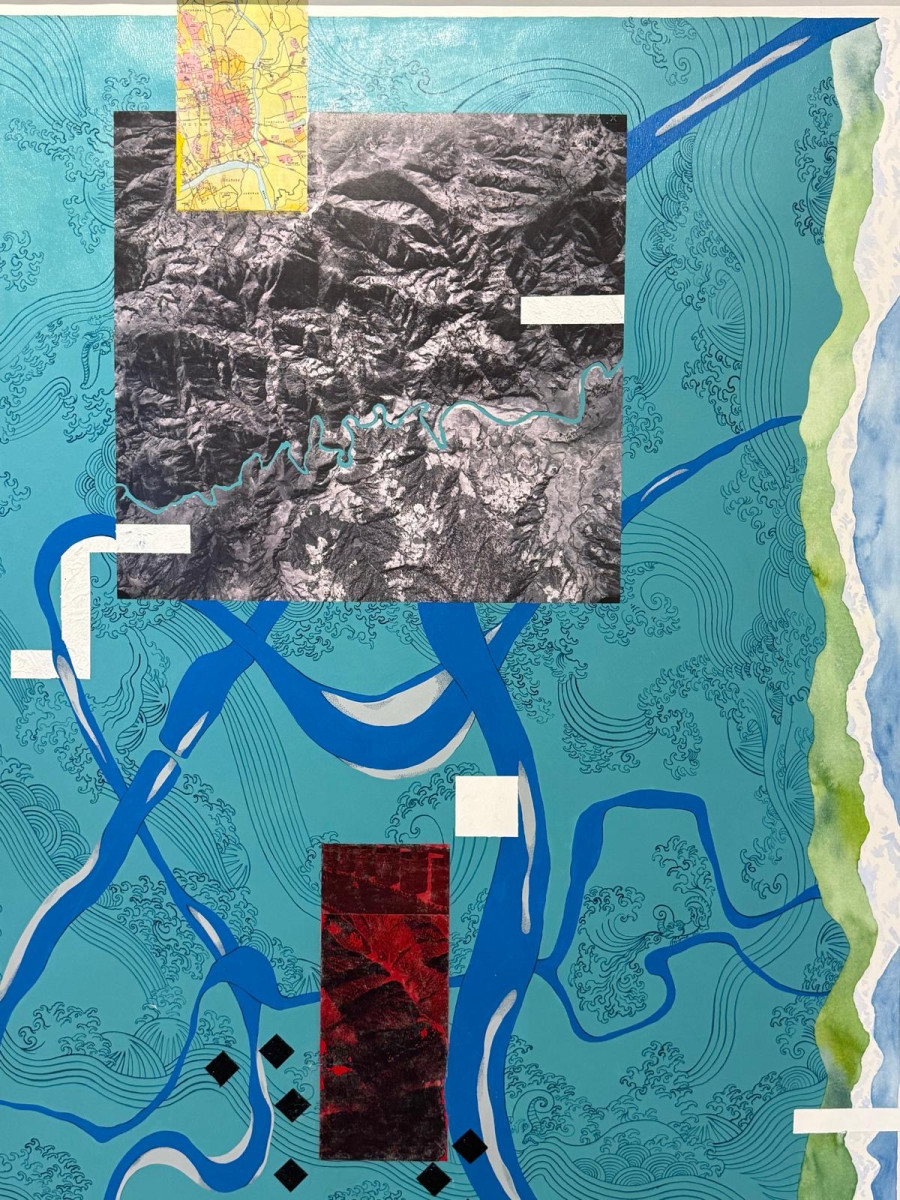
bookmark![]()
Binod Shrestha insists that memory is not only a private feeling but a shared responsibility. Photo: Courtesy of SAG ![]()
Photo: Courtesy of SAG ![]()
Kian Lee Mitty
Published at : June 19, 2026
Updated at : June 19, 2026 06:48
‘Silent Bone’, created by Binod Shrestha, is an exhibition shown throughout Kathmandu, displaying memory, body, and space through mixed media.
Nepali history is rich. However, many people seem to forget the foundation of what brings many people together as a culture. The ten-year civil war has left deep marks on the land and on the bodies of the people who endured it. It is the kind of forgetting that ‘Silent Bone’ pushes back against. The exhibition does not allow the viewer to pass through comfortably. It insists on remembrance, on sitting with what has been buried beneath the ordinary rhythms of daily life.
Shrestha has had an extensive career. Born in Nepal, he experienced years of civil unrest and saw firsthand how it affected people. That experience of witnessing has become the central language of his art. He first attended Bangalore University in India to start his fine arts education. He then attended the Pennsylvania Academy of the Fine Arts in Philadelphia, where his practice deepened and expanded beyond Nepal, taking on international influences while remaining rooted in the culture and pain of home.
Since the early 2000’s, he has been creating many exhibits, working with artists in joint exhibitions as well as exhibiting his art solo. He has since taught at many universities, as a Professor at the University of North Texas and the University of Tulsa, and has lectured at the Siddhartha Art Gallery and Yala Maya Kedra back home.
This exhibit in Nepal comes after a 26-year hiatus, and he continues to develop work that speaks directly to Nepali viewers.
‘Silent Bone’ starts a conversation with the viewer, in which they find comfort in recognising many motifs, texts, and locations they remember fondly, but also discomfort with some of the upfront and abstract interpretations of death, civil conflict, and bodily movement. The exhibit features different media across its locations, including neon lighting, metal, velvet, sand, stone, salt, and watercolour on paper. This variety of material is meaningful. Each medium carries its own texture of memory, its own relationship to the body and the earth. Salt preserves, stone endures, while velvet acts as a gilded softener to the grief of the art.
In the Dalai La Art Space, featuring only a single chapter of this novel of an exhibition, you enter a quiet oasis of the city where these contemporary pieces are juxtaposed against neon lighting featuring many common phrases of the Nepali language, which translate to "it will happen, right?" and "What to do then?" These common phrases ground the viewer amid uncertainty, embodying the resilience they carry, even though so much has happened in Nepali history.
Phrases spoken in kitchens and on street corners, at funerals and at festivals, are now suspended in a gallery space by Shrestha.
The other side of the exhibit in the Dalai La Art Space features red spheres weighted down by a rock and surrounded by a house-shaped cage. The rock of one of the pieces symbolises history being a force that weighs the body down, while the house in the other can be interpreted as a cage, a ribcage, or a space for memory. The red spheres evoke balloons, childhood happiness, and the body’s rawness. Shrestha calls on people to consider Nepali history, recall the weight of conflict, and recognise how these memories can also act as a cage for the human soul.
The Siddhartha Art Gallery offers something different. This specific part of the Silent Bone series, named ‘Of Memory, Place, and Residue’, offers new media and new interpretations of memory, death, and the body.
Walking into the first floor of the gallery, the viewer is confronted with abstract interpretations of the body, familiar bird's-eye views of the land, and a contemporary sculpture. Each drawing in ‘Residue’ features a body that seems like an amalgamation of what we know. When looking at this series, one can make out legs, arms, and torsos stretching out of the abstract form. The bodies are not broken so much as they are in the process of becoming something else, dissolving into one another. Shrestha allows the viewer to see the body in ways that seem grotesque but are in the process of being transformed into something else. This is perhaps Shrestha’s most delicate achievement. Even in destruction, the human form retains a kind of dignity.
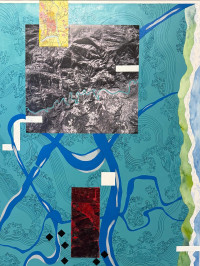
The landscapes feature simplified but familiar versions of places in Nepal, featuring rivers, important landmarks, and mountains. Shrestha overlays this canvas with photographs of temples and geographic terrain. These are places where Nepali people carry their earliest childhood memories.
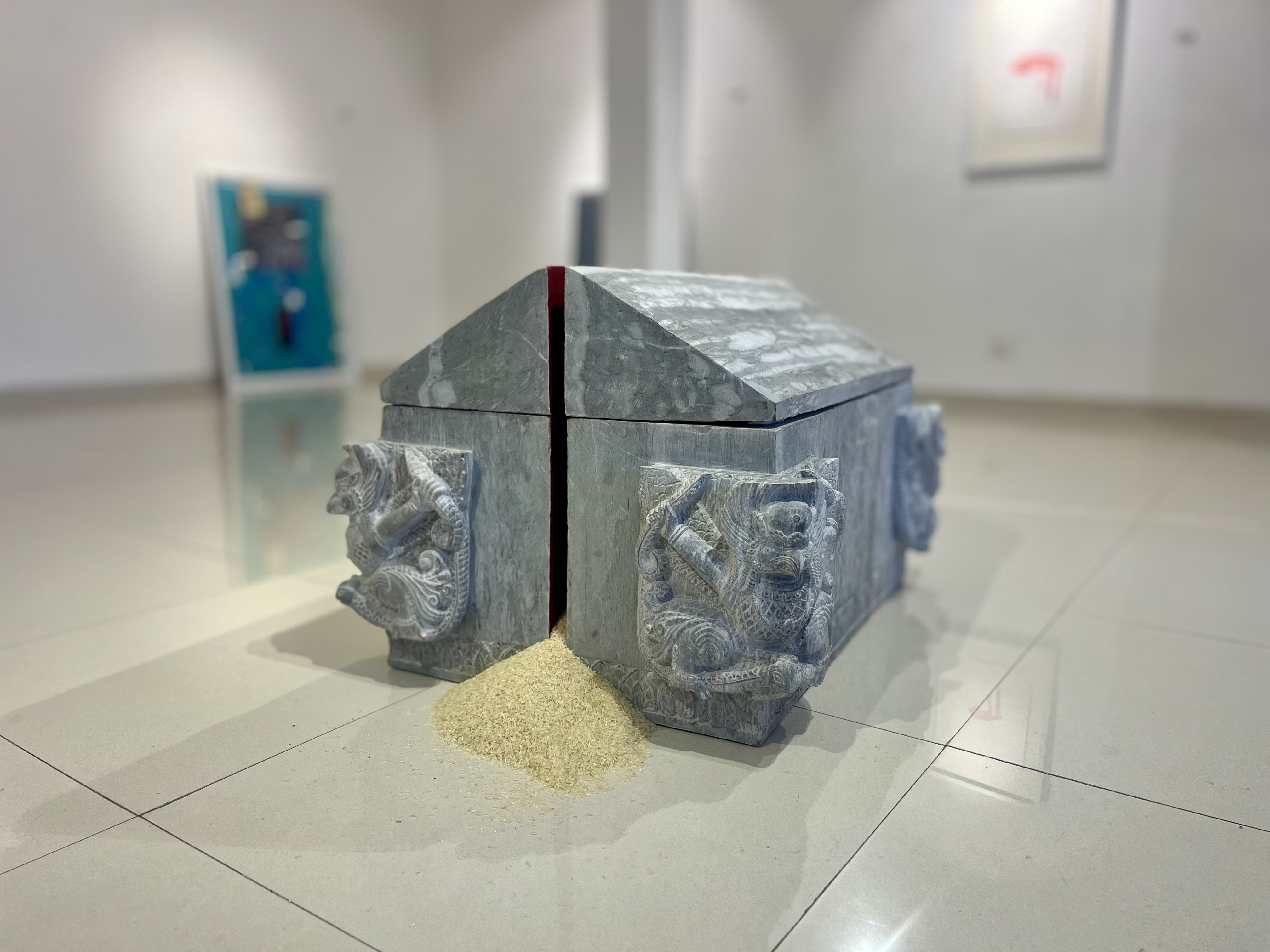
Thus, his works evoke nostalgia, a sense of belonging, love for the country and heritage. Shrestha surmises that people may forget these connections as civil conflicts increase. The final piece on the first floor, ‘What It Can Not Hold: Reliquary for a Place,’ stands in the centre, drawing attention to it as soon as you walk in. Made of stone with rice spilling out from the split centre, the piece is impossible to ignore.
Shrestha wants the viewer to interpret this piece as whatever memory it resonates with. It can look like a crypt, holding the red interior like a body, a house being broken, or even finding comfort in the familiar rice grain that spills out of the split stone. Rice is a staple food in almost all Asian cultures. Depending on the interpretation, the viewer can experience many emotions, but one always prevails over all others: memory.
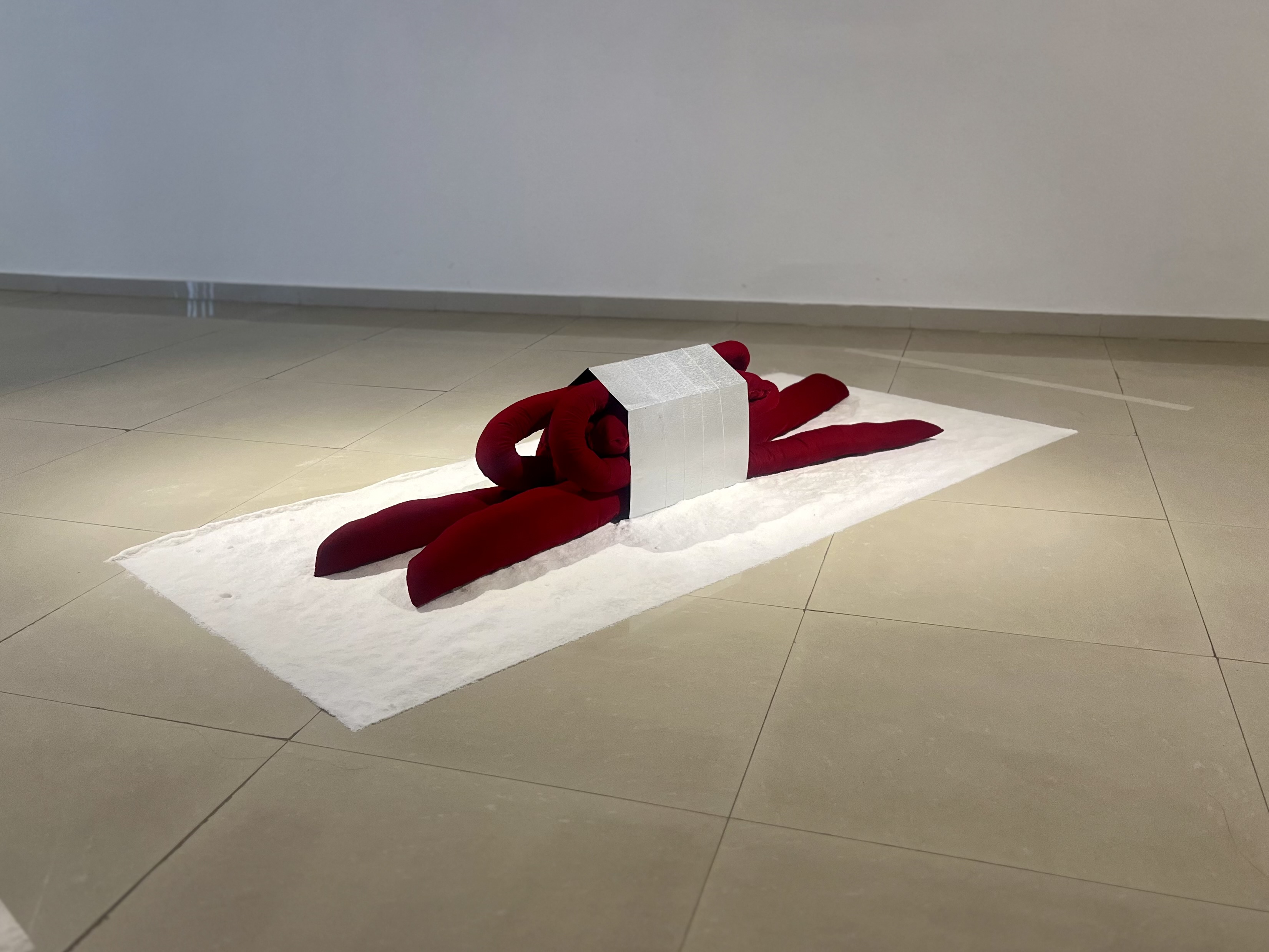
As you walk up to the second floor of the gallery, there are two pieces. This floor starts the unspoken conversation about death and grief. The piece that catches your eye most has many red velvet appendages, which are tied or bundled together into a single small, house-like metal structure. This installation is placed on a bed of salt. In this piece named ‘The Weight of Shelter’, Shrestha recalls his childhood, when a letter, tied or wrapped with unprocessed cotton string, signified the death of an individual.
This calls on the viewer to remember the horrors of the many conflicts Nepal has endured. The use of salt beneath these forms amplifies the sense of preservation and grief. Salt is an enduring ingredient that is used in all cuisines, and it is also what remains in tears. This feeling is only amplified by another piece titled ‘Neither Inside nor Outside, Neither Day or Night What the Ground Keeps, What the Voice Returns,’ which displays a screen that records multiple victims' accounts of the ten-year civil war in Nepal. The screen is placed on the ground and inserted inside a traditional street marker or pikha lakhyu.
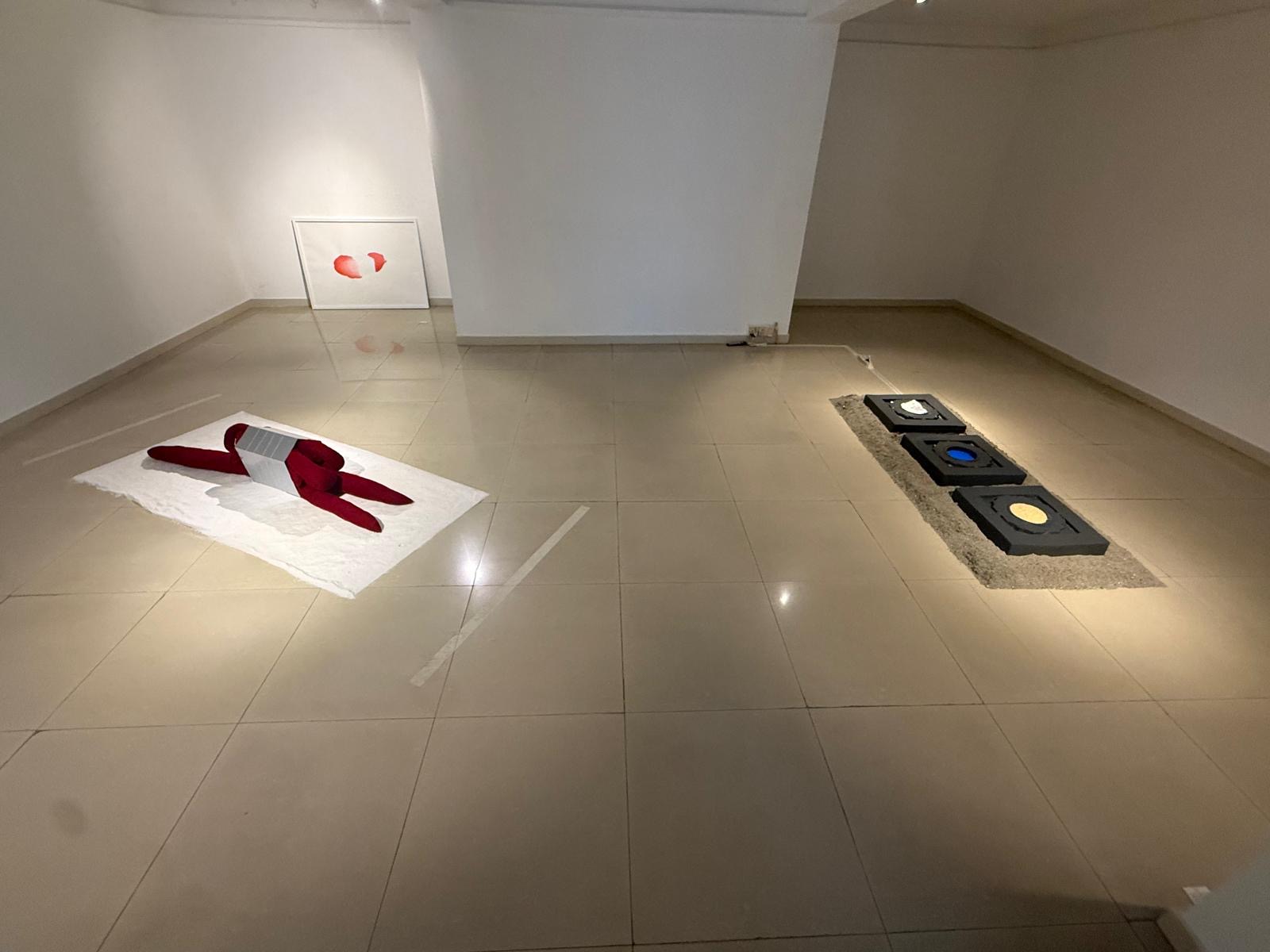
The volume of the voices carries weight as well, because they are muffled, signifying how these accounts slowly fade into memory. However, in this area, not only are the pieces powerful, but so is the space's echo. The accounts given through the screen echo, making the viewer unable to concentrate on their own thoughts and forcing them to remember and hear all the horrors of that time. There is no escape into private thought. The space itself becomes a vessel of collective grief.
‘Silent Bone’ asks what remains when bodies are broken by conflict and memories are buried beneath the rush of daily life. Across neon phrases, weighted balloons, fractured landscapes, echoing testimonies, and fused bodies, Shrestha insists that memory is not only a private feeling but a shared responsibility.
‘Silent Bone’ does not offer resolution or consolation, but the space to remember together, which is perhaps the only beginning that healing ever truly has.
______________
Silent Bone
When: Until July 10
Where: Different parts of Kathmandu. Currently at Siddhartha Art Gallery, Baber Mahal Revisited (Until June 26)
Entry: Free
Kian Lee Mitty
Mitty is majoring in art history and minoring in finance at Princeton University and is an intern at the Siddhartha Art Gallery.
Editor's Picks





E-PAPER | October 23, 2026

×