



 15.76°C Kathmandu
Thu, Oct 15, 2026
Arts
Eleven artists, countless stories of belonging
The Next II’ is less an exhibition of individual artworks than a collective conversation about culture and the changing rhythms of Nepali life.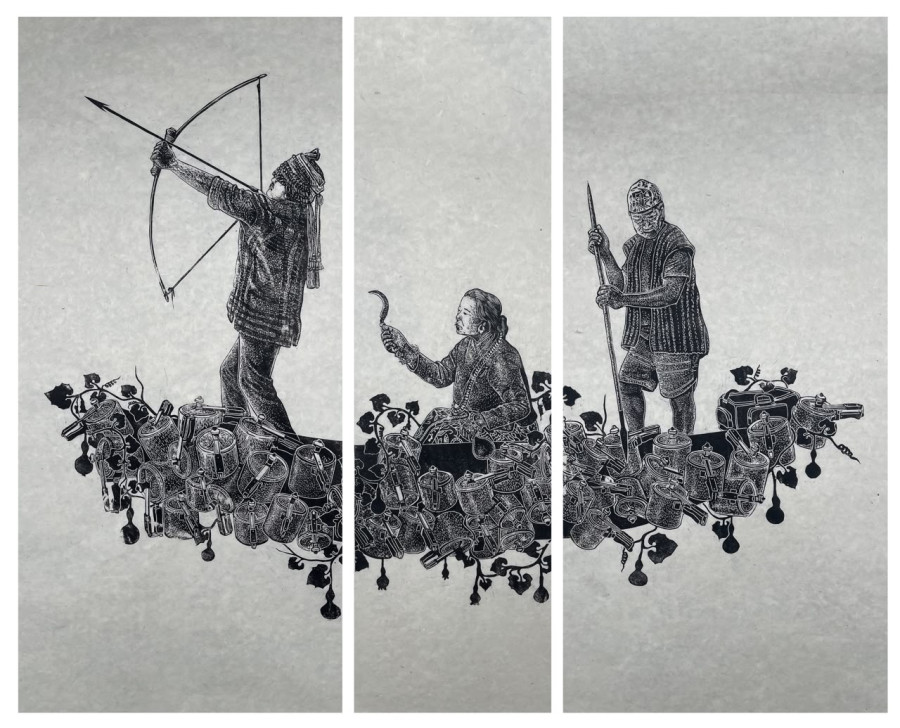
bookmark![]()
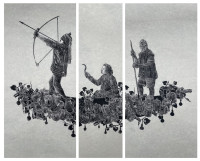
A piece from ‘Spirits of Hunters’ ![]()
![]()
Jony Nepal
Published at : July 6, 2026
Updated at : July 6, 2026 12:24
Kathmandu
The sublimity of contemporary Nepali art finds its way onto the white walls of Takpa Gallery.
Strokes of grief, memories of fading culture, fragmented observations, and the impermanence of life flow through the gallery’s enclaves with an assuring dedication to contemporary aesthetics.
“I get jealous almost,” says curator Roshan Bhandari as he reflects on his experience of bringing together the artworks of eleven emerging artists. “Listening to their stories and observing their mediums, it feels as though there is so much I have missed. Being a curator amongst such promising artists helps me evolve.”
Bhandari’s emotions are universal. Walking through the watercolour mediums, emboss, woodcut prints, punch needlings, obvara ceramics, and aquatints, the reverence for the contemporary nuance is undeniable.
Artists including Ranjan Khadka, Yambang Thapa Magar, Anush Khaiju, Mukta Rani Singh, Rudrakshya Man Pradhan, Rahul Yakami, Amisha Maharjan, Sonam Rai, Anil Nepali, Lijen Maharjan, and Smarika Maharjan articulate themes of memory, mythology, spirituality, cultural heritage, and identity.
Anush Khaiju presents the impermanence of communal gatherings in traditional spaces and the inability to pause the transformation in his series ‘Same Space Fading Experience’. With watercolour demonstrations of temples and falchas of Bhaktapur juxtaposed by the plain emboss of people sitting on the edges, Khaiju laments the overshadowing of the digitally connected world.
In every painting of the series, an inset frame reveals the tangible contours of people sitting in traditional attire. Within the white expanse of the emboss, sparrows, painted in various shades of brown, are dispersed.
“Sparrows are known to spend their entire lifetime around one particular place,” says Khaiju. “I painted them as a metaphor to represent the disappearing communal experiences. People rarely gather in one shared space today. They are either on their phones or abroad.”
In embossing, wet paper is placed on wood carvings and is compressed to bring a raised, three-dimensional effect. Aligning perfectly with its lines, Khaiju painted the remaining spaces of the paper with vibrant watercolour, presenting the absence of life.
The artworks stand as a rhetorical question about how lives have evolved. The evocative contrast between what once was and what there is now makes us reflect on the societal intimacy we lost while chasing individualistic lifestyles.
“I was inspired by the thought of how beautiful communal exchanges used to be, which now are replaced by the feeling of detachment,” says Khaiju.
As the pressures of present life compel us to fit neatly into modern categories for survival, it takes away a substantial part of our identity: traditions and culture.
Fighting against that disappearance is Sonam Rai with his series ‘Spirits of Hunters’. Reminiscent of his traditional practice of hunting for survival, Rai’s artworks depict a search for safety and belonging. Permanence is not guaranteed, and the world ruthlessly demands things beyond cultural identity. The inability to resist modern survival juxtaposed with the devoted search for identity and culture becomes Rai’s most compelling creative vision.
“I have been researching a lot for the series,” says Rai. “I belong to the Khambu community where we do hunting rituals: a continuum of practice across generations, which was the prominent inspiration for the series ‘Spirits of Hunters’.”
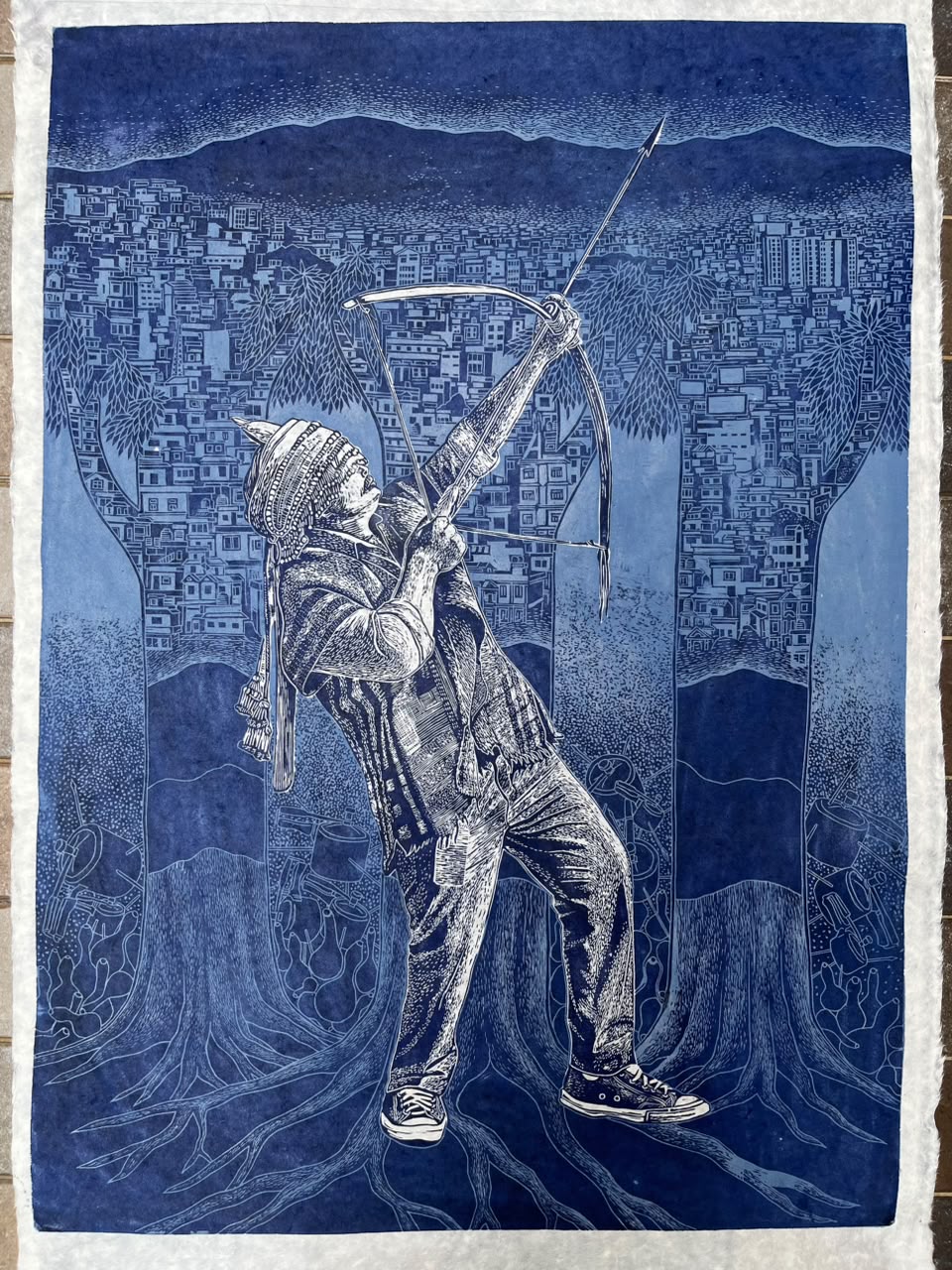
In ‘Beneath Concrete Forest’, Rai's self-portrait points a bow and arrow toward the sky. Contrasted against the outlines of crowded urban houses, the figure absorbs brighter light in the composition, becoming the central attraction of the frame. With the upper body slightly tilted outward toward the sky, the figure, wearing Converse, carrying a phone in the right pocket and covering his head with a tadam [a crown for wise individuals] that extends to his eyes, stands on the roots of forest trees.
“While I try to preserve the ancestral practice, adapting to modernity for survival is inevitable,” Rai says.
In the absence of shadows, the woodcut print on Nepali paper with tints of blue is a visually striking piece. Pressure Cooker, in the series, emerges as a symbol of modernism contrasted with the tendrils of Solewa [bottle guards, a traditional utensil in the Rai community, now used for ritual purposes].
When asked about the reason to choose woodcarvings, Rai’s answer was painfully visceral. “We are expected to work endlessly in today’s world,” he says. “Woodcarving is a laborious job, and therefore my message would only feel relatable this way.”
With his projection of indigenous identity and struggle for survival, he leaves a powerful message: art is political.
Moving from a socio-political scenario to the deepest introspection of vulnerability and grief, Smarika Maharjan’s emotional reliance on art and traditions stands poignantly in the exhibit.
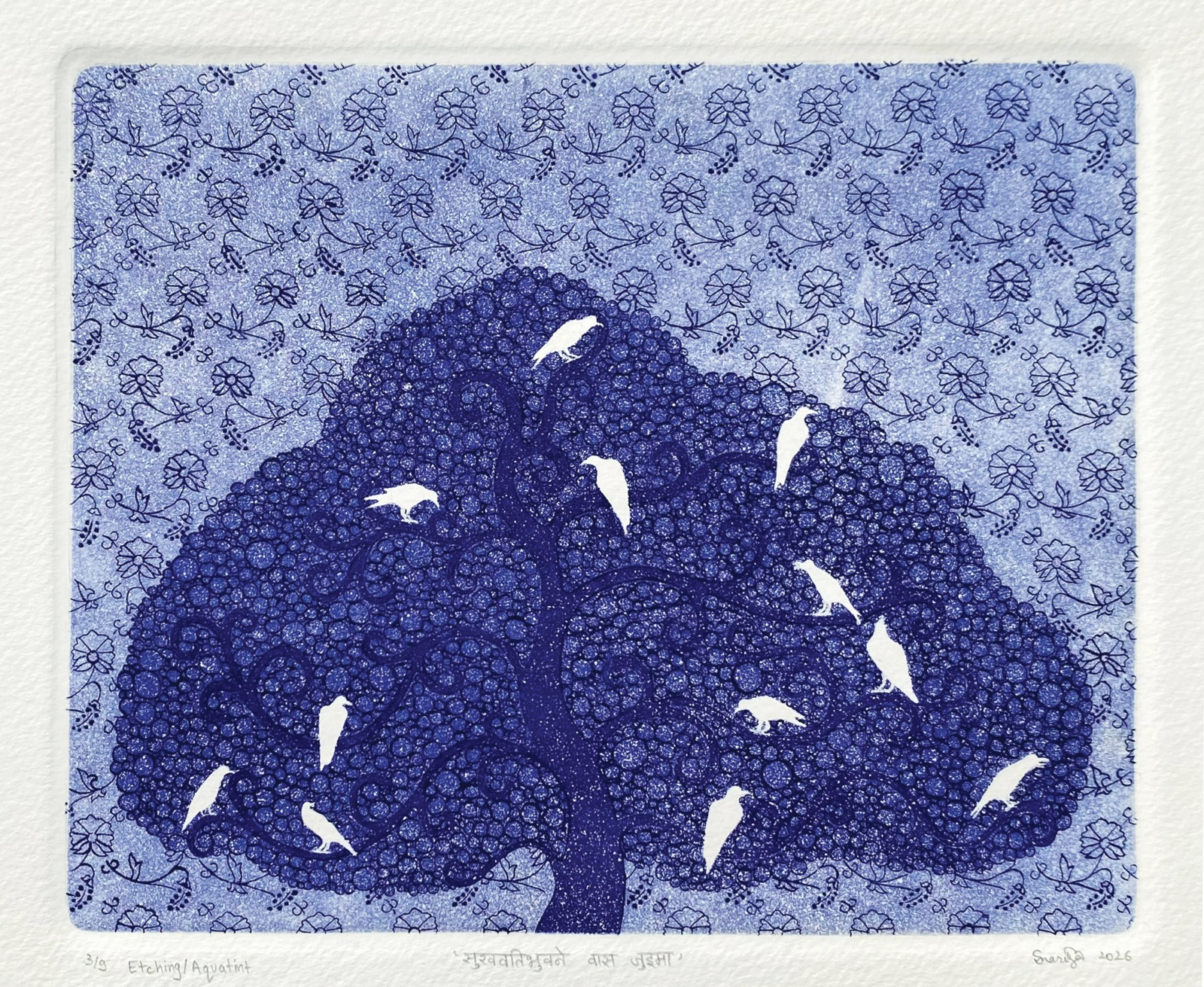
Her artwork, ‘Everything I offer, I hope it reaches you’, depicts a white crow carrying an offering in its beak as it crosses a river. As it seems to be in motion from left to right [for viewers], the crow’s unconventionality becomes definitive: bright white and walking despite having feathers.
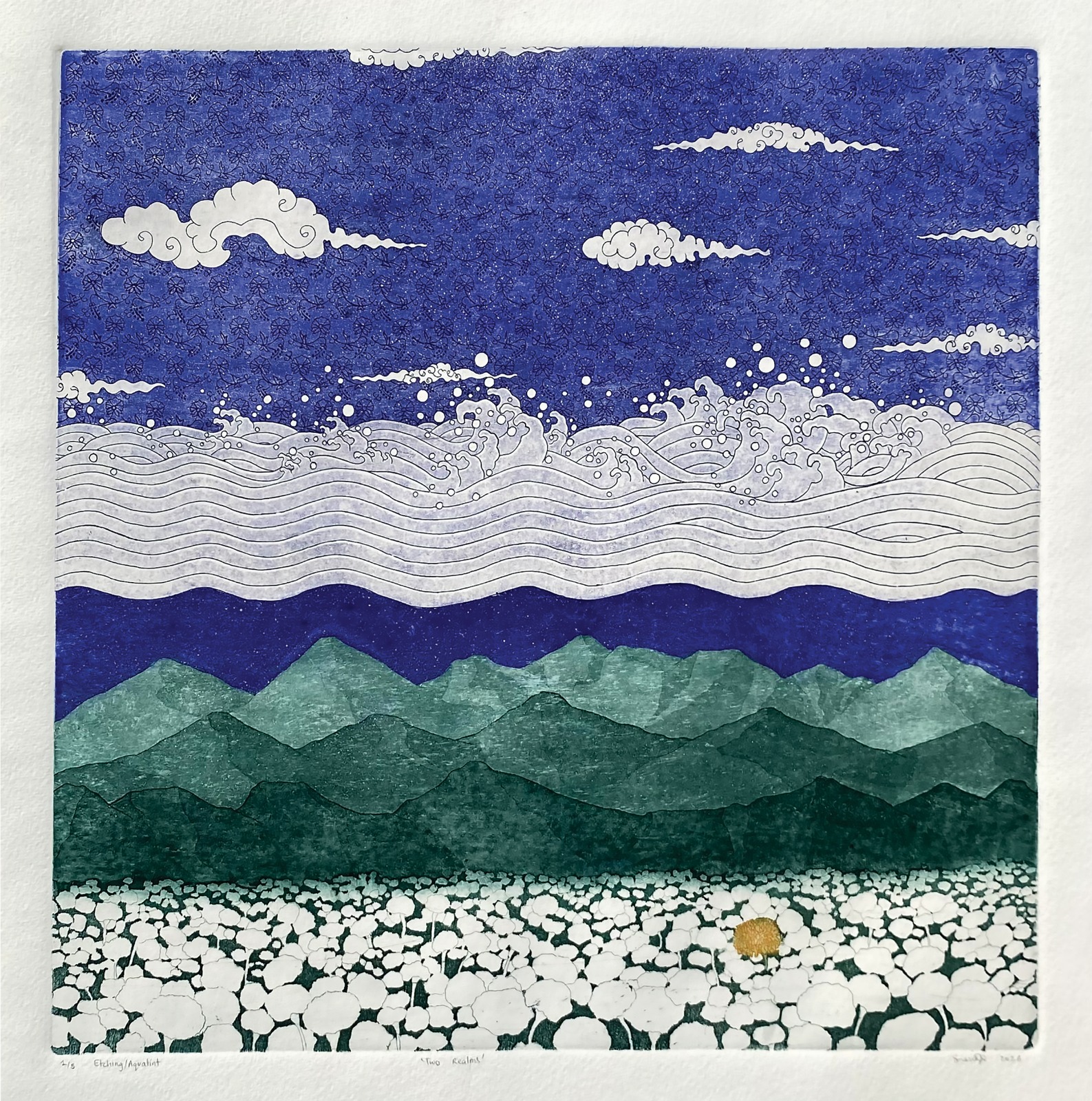
“The crow is crossing the Baitarni River,” says Maharjan. “Traditionally, the river is said to be a border between the earth and heaven, and only crows can cross them.”
With the frame’s bottom encompassing waves of the river, followed by a consistent pattern of flowers over the rest of the paper, the layers of woodcarvings and aquatints together form a sublime art of grief that transforms into hope, love and care.
“It is the pattern of a cloth,” explains Maharjan. “Cloth that is used for the cremation rituals and is brought back to the same place after everything is over.”
Maharjan’s artworks echo the vulnerability of understanding someone’s absence. Bringing hints of traditional Pauba art, she attempts to bridge the gap between ancestral heritage and her own identity.
One of the most noticeable aspects of the exhibit was the space it provided to each artist. Instead of limiting them to a singular piece, it presented a cohesive series of their artworks. Together, these eleven artists show that contemporary practice is a way of returning to traditions.
The Next II
When: Until July 11
Where: Takpa Gallery, Lazimpat
Time: 11:00 am to 6:00 pm
Entry: Free
Jony Nepal
Nepal is a culture and lifestyle reporter/sub-editor at the Post. She is also a Psychology and English literature student.
Editor's Picks

Constitutional Bench caught in seniority, ‘pick and choose’ dispute

A Dom boy’s long road to becoming a doctor

From blankets to handmade dolls, two foreign women bring comfort to flood survivors

News Analysis: When institutional defence exposes institutional fault lines

It’s a bird … it’s a plane … it’s the Indian ambassador’s farewell tweets
E-PAPER | October 15, 2026

×