Temperatures in several Tarai districts hit 40 degrees. Met office warns of heatwave conditions
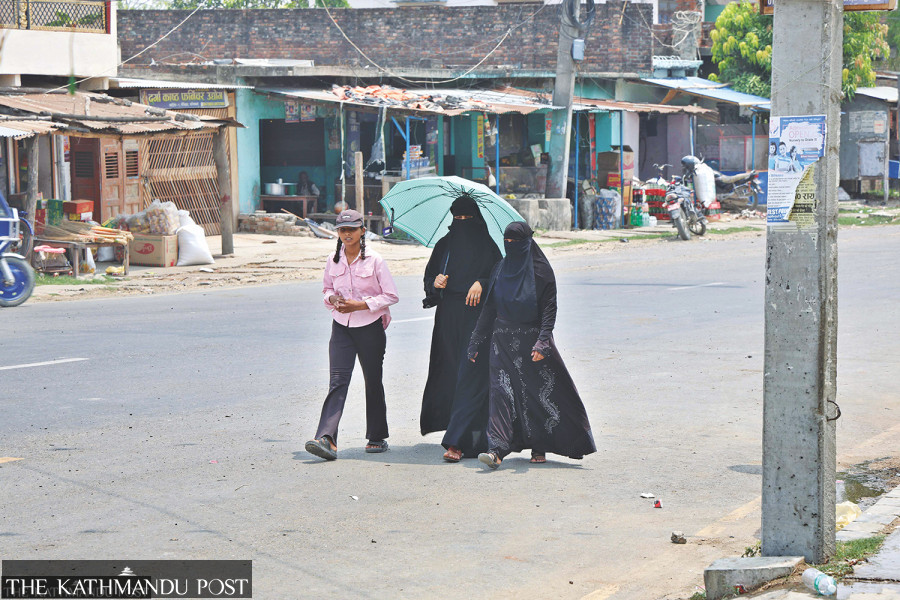
Experts say this is just a start as temperatures could reach 45 degrees Celsius in the coming days. Residents advised to avoid going out in the afternoon.File Photo
With temperatures in the Tarai districts of Sudurpaschim and Lumbini provinces approaching 40 degrees Celsius, the Meteorological Forecasting Division has issued a heatwave warning.
According to the division, under the Department of Hydrology and Meteorology, temperatures are on the rise in most parts of the country. There is a likelihood of hot days in the plains, as well as in the valleys and basins of the other provinces, the met office said on Thursday.
The met office advised people to follow weather updates and take necessary precautions.
“Heat wave conditions will continue on Friday and Saturday in the western Tarai,” said David Dhakal, a meteorologist at the division. “Some hilly districts of Koshi, Bagmati and Gandaki provinces could witness light rainfall on Saturday.”
Doctors at the Seti Provincial Hospital in Dhangadhi say the number of patients suffering from fever and diarrhoeal diseases has begun to rise. Along with cases of fever and diarrhoea, the hospital has been witnessing a rise in the number of patients with respiratory illnesses, dust and heat allergies, and heart ailments, among others.
“With a rise in temperatures, the number of fever and diarrheal cases have also increased,” said Dr Sher Bahadur Kamar, chief consultant physician at the hospital. “Over 40 patients suffering from fever and diarrhoeal disease seek treatment in our hospital everyday.”
Health facilities across the country generally see a rise in the flow of patients suffering from infectious and vector-borne diseases in the summer season. However, doctors have warned that health facilities in the Tarai could be overwhelmed with patients in the coming days, as most of them have remained ill-equipped and understaffed for years.
They say that infectious diseases including water-born diseases—diarrhoea, dysentery, cholera, hepatitis A, hepatitis E, infection of vector-born diseases—malaria, dengue, scrub typhus and others—will rise in the coming days due to rise in temperature level and contamination of drinking water sources. Moreover, cases of snakebite, which are already being reported from various districts, will surge with a rise in temperatures.
Doctors at Bheri Hospital in Nepalgunj said that they do not take the ongoing temperature rise as a serious issue, as the worst has yet to come.
“Incidents of heat stroke and renal problems, among others, have not yet started,” said Rajan Pandey, chief consultant physician at the hospital. “Cases of water-borne and food-borne, and vector-borne diseases will increase once rainfall starts.”
On Wednesday, Bhairahawa recorded 40.8 degrees Celsius. Nepalgunj recorded 39.5 degrees Celsius, Dipayal and Dhangadhi recorded 39 degrees.
Last year, heat wave conditions affected hundreds of people in the country’s southern belt. Heatwave occurs when the maximum and minimum temperatures at a location are unusually high continuously over a three-day period.
Exposure to excessive heat can result in headache, nausea, weakness, dizziness and fainting. Heat-related illnesses include heat stroke, heat exhaustion, heat cramps and heat syncope (fainting). Heat stroke is the most severe form of heat-related illness and requires immediate medical attention. Doctors ask people residing in the Tarai region to take precautions against the risk, remain hydrated and avoid outdoor activities during the day if possible.
Nepal is one of the world’s most vulnerable countries to the climate crisis and has witnessed frequent extreme weather events over the past decade and a half. The country saw some unusual patterns of rainfall triggering devastating landslides and floods in the past couple of years. Experts have linked these incidents to the recent phenomenon of climate change.
The average annual maximum temperature of Nepal rose by 0.056 degrees Celsius between 1971 and 2014, according to a study conducted by the Department of Hydrology and Meteorology in 2017.
Globally, extreme temperature events are increasing in frequency, duration and magnitude. Scientists blame climate change for an early onset of summer and intense heat.
What to do to avoid heatwave:
Drink plenty of water
Bathe with cold water
Use an umbrella when going out in the afternoon; cover your head with a thin cloth and wear light cotton clothes.
Work in the field during the morning and evening.
Drink lemon water, coconut water, and fruit juice; eat fruits, cucumber, and freshly cooked homemade food.
What not to do
Avoid tea, coffee, soda, and other caffeinated drinks, as they can increase urination frequency.
Do not go out of the house in the afternoon
Avoid staying in the kitchen for long periods; if you must, drink plenty of water.
Avoid smoking and consuming alcohol.
The Ministry of Health and Population has urged everyone to seek immediate medical attention if they experience increased heartbeat, breathing difficulties, low blood pressure, absence of sweating, severe headache, nausea, or high fever.
Arjun Poudel is a health reporter for The Kathmandu Post. Before joining the Post, he worked for Sagarmatha Television, Naya Patrika, Republica and The Himalayan Times.




 16.53°C Kathmandu