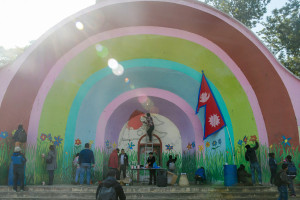
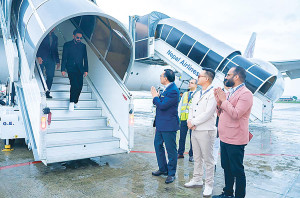
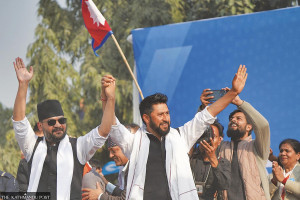
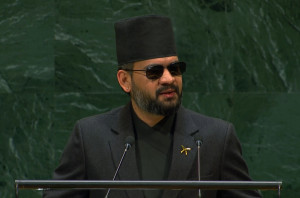
Nepalis celebrate Constitution Day with speeches, but what does the 2015 charter actually mean for those left behind? Photo: Courtesy of Prime Minister's Office
Every year on Constitution Day, Nepal stands astride an odd contradiction. Governments hold ceremonies, politicians deliver speeches, and social media feeds fill with talk of democracy, inclusion, federalism and national unity. For ordinary citizens, though, the day cannot mean only that. For some, it marks the culmination of decades of democratic struggle and the formal birth of a federal democratic republic. For others, it is a reminder of promises unmet, movements unaddressed, and a state that still claims to represent them while remaining distant from their lives.
I find myself caught in that same contradiction. I cannot say I am fully at peace with the 2015 Constitution. I have grown up watching the unresolved questions of the Tharuhat-Tharuwan movement, the demands of Madhesh, the struggles of indigenous nationalities, Dalits, women and other marginalised communities, and the steady concentration of political and economic power in the same old hands.
And yet I believe certain foundational principles established in 2015 are too important to abandon lightly. Republicanism, federalism, secularism, parliamentary democracy, fundamental rights, proportional inclusion and constitutionalism are not merely words on paper. They represent political and social transformation that generations fought for. To defend the constitution, then, cannot mean defending everything written in it exactly as it stands. And to criticise it does not mean rejecting the republic or democracy itself. A mature constitutional culture must do both at once: Protect the democratic foundations of the constitutional order while continuously asking hard questions to make it more inclusive, accountable and responsive.
But the Constitution was also born amid deep disagreement. Its promulgation triggered protests, particularly in the southern Tarai belt. Madhesi and Tharu communities voiced serious dissatisfaction over federal demarcation, representation, citizenship and historical discrimination, and continue to do so. Kathmandu’s debates and ceremonies alone cannot explain the Constitution’s history. It is also the history of citizens who took to the streets, lost lives, were maimed, disappeared, felt excluded, and demanded that the new federal republic recognise their political existence.
For the Tharu community, this history feels especially raw. The Tharuhat movement was never only about provincial boundaries. At its core lay a deeper question: Who holds the right to exercise political power over a geography its people have inhabited since time immemorial? If historically excluded communities remain politically marginalised, what does federalism actually mean? If indigenous communities are culturally recognised but excluded from meaningful decisions over their land, forests, development and governance, what does inclusion mean? Reducing the Tharuhat struggle to the violence at Tikapur, and suppressing its wounds in the name of national unity, does a disservice to that broader history. Reconciliation requires truth, accountability and acknowledgement, not suppression. Constitutionalism must treat dissent not as a threat to the state but as something requiring space for dialogue.
Much the same applies to Madhesh. Federalism did not appear suddenly in Nepal’s constitutional vocabulary. The Madhesh movement forced the state to confront the weaknesses of its centralised structure. But Madhesh itself is not socially or politically homogeneous. It contains Madheshi, Tharu, Dalit, Muslim, indigenous and other communities whose experiences of exclusion differ. A struggle for regional political identity must also address the social discrimination within that region itself.
Political liberation and social liberation cannot be separated. Article 18 guarantees equality before the law and prohibits discrimination on grounds of caste, ethnicity, gender, language, region or economic condition. Article 42 grants historically marginalised groups, including women, Dalits, indigenous nationalities, Madheshis, Tharus, Muslims, persons with disabilities and people from backward regions, the right to proportional inclusion in state bodies. These are meaningful departures from Nepal’s exclusionary past.
But representation and power are not the same thing. A person’s presence in parliament does not guarantee influence over policy. A community’s representative in government does not guarantee meaningful influence over budgets, natural resources or administrative decisions. If the underlying structure of decision-making remains unchanged, inclusion risks becoming merely symbolic.
This is where federalism’s real meaning matters. It was never about creating seven provincial governments or relocating a few offices from Kathmandu; its purpose is to redistribute political power and bring decision-making closer to citizens. That project remains unfinished, with delayed federal legislation, administrative centralisation and provinces struggling to exercise their constitutional authority. Development, too, must be treated as a constitutional question: What does democracy mean to a young person without access to education or employment, or equality to a community displaced by a project it was never meaningfully consulted about?
The Gen Z movement of 2025 has made this constitutional debate more urgent still. Churning out of frustration with corruption, inequality, misgovernance and a social media ban, it thrust a generation long dismissed as politically indifferent into the centre of national politics, eventually toppling a government and pushing Nepal’s constitutional transition into new territory. Accountability was among its central demands, one directly tied to constitutional democracy. A movement that demands adherence to the constitution must also grapple with constitutional process itself. In opposing arbitrary state power, we must remain alert to the risk of replacing it with an equally arbitrary power exercised in the name of the people. Peaceful protest remains democracy’s essential corrective mechanism, but movements and constitutional institutions must strengthen each other, not weaken either.
What Nepal needs are institutions capable of absorbing democratic energy, so citizens are never forced to choose between institutions and the street. A constitution worth defending is one citizens can challenge. A constitution worth changing is one that safeguards the right to change it. And the democracy worth building does not merely invite previously excluded citizens into the room, but lets them help decide what happens inside it. Our republic remains unfinished. So does our federalism, our inclusion, our democracy. But being unfinished need not mean being weak.




 16.82°C Kathmandu