



 14.2°C Kathmandu

Fri, Oct 16, 2026
Columns
Balendra Shah dropped the mic at UNGA. But is that enough?
Can a brilliant UN speech fix Nepal’s climate crisis? (Spoiler: Not without fixing our own backyard)
bookmark
Sajal Mani Dhital
Published at : September 25, 2026
Updated at : September 25, 2026 17:51
Nepal’s Prime Minister Balendra Shah’s speech at the UN General Assembly in New York was unusually forthright in its assessment of climate change risks in Nepal. Shah showed himself to be surprisingly adroit in deploying the facts and figures, especially from ICIMOD’s recent reports, to make his case. His remarks struck me as thoughtful, nuanced, and compelling.
Shah called for a Himalayan Climate Resilience Mechanism that brings together China, India and Nepal to coordinate on climate-resilient development. Such a mechanism, he proposed, should facilitate the sharing of satellite imagery, early-warning systems, climate-change-induced disaster monitoring and response, and post-event humanitarian assistance.
Nepal’s NDC 3.0 recognises that the country cannot achieve its NDC targets using national resources alone, and calls upon developed countries to provide financial support in the form of grants. According to a recent World Bank report, climate change could shave off at least 7 percent of Nepal’s GDP by 2050 if no actions are undertaken. Shah said Nepal is entitled to climate finance and climate justice. He also stated that our baselines are no longer relevant.
This is a big ask at the UN, especially for a country like Nepal. Shah’s UN address will go down as one of the most effective speeches Nepal has given in recent times on climate change. Shah showed political acumen and courage to admit that the political class’s performance has not matched the urgency of climate change, as there was a failure to move from science to action at the requisite pace and scale to protect lives, livelihoods, and the economy.
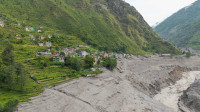
However, it’s important to recognise that this speech alone will not solve Nepal’s development challenges. While the message of climate-change-induced disasters may be loud and clear now, it is important to ask what went wrong at Bhotekoshi. This can be done only if we accept that we allowed disaster to visit us, not just because of climate change, but also because of poor planning and shoddy implementation.
Framing global warming as the sole reason for natural disasters conveniently sidesteps institutional responsibility. For example, there’s a need for accountability for allowing settlements, hydropower projects, roads, and other physical infrastructure to be built in disaster-prone areas. How did our institutions approve these projects in hazardous areas? Our institutions could have avoided the bulk of this Rs723.31 billion reconstruction and recovery costs, as calculated in the government’s own Rapid Damage and Needs Assessment, if they had ensured resilient designs for infrastructure; comprehensive early-warning systems that take into account climate-change-induced disasters; disaster preparedness and contingency plans; and evacuation drills, but they didn’t. If we rebuild these assets in the same locations, we’re signing cheques for disasters to come.
It is possible—and necessary—to claim climate injustice and finance while accepting responsibility for poor planning. For instance, climate-change-related disaster risks could be managed by establishing baseline data on climate-change-induced disasters, conducting risk assessments, developing protocols for cross-border data-sharing and disaster management. This may require international support in the short-term, but the responsibility for planning lies squarely with Nepal.
Climate change has become a catch-word used by leaders, bureaucrats and even aid workers when disaster strikes. There’s a danger that the phrase can obscure accountability for our own failures, especially when it comes to disaster-induced loss of life. Balendra Shah’s UN address has the ring of a catchphrase that people will remember when they think about climate change and Bhotekoshi. That said, a catchy line at an international forum cannot substitute for accountability at home, for poor planning and spending money recklessly.
Singha Durbar can’t afford to rest on the laurels of a well-delivered speech. We can’t allow climate change to become a blanket excuse for poor planning and shoddy governance. The people deserve more.
PM Shah’s provocative speech about weapons and bullets crossing borders readily for powerful and wealthy states, whereas fertilisers and petroleum products take ages to reach farmers’ fields in Nepal, deserves attention. While it is important for Shah and others to highlight the glaring inequalities in the existing global economic order, it is equally important to look into our own backyard and ask why there are recurring problems of supply of fertilisers or other inputs needed for infrastructure projects in Nepal. The answer, unfortunately, is quite obvious, being ineffective governance.
While Shah rightly told the General Assembly the other day that Nepal wants the world to listen to the message from the Himalayas, he did well to add that our political leaders have been tardy in responding to it. After all, we hear about glitches in Nepal’s disaster-response system only when someone dies.
The Bhotekoshi catastrophe, however, offers Nepal an opportunity to reassess guidelines on hazard-sensitive infrastructure and implement existing land-use regulations. The disaster also calls for scaling up disaster-related investments, specifically improved early warning systems, better guidelines for safer hydropower projects, and an integrated Himalayan risk information system. The reconstruction effort can be made conditional on disaster risk mitigation, and not just rebuilding.
All these would amount to progress towards disaster-resilient development. More importantly, documenting risks, challenges and responses would come in handy in climate change negotiations to strengthen Nepal’s case for climate justice. After all, it’s difficult to lecture the world on climate change and demand climate justice from rich and powerful countries without credible evidence to support our case.
Sajal Mani Dhital
Dhital is an economist and a public policy analyst. He holds a master’s degree in Public Policy and Management.


.PNG&w=200&height=120)

Most Read from Columns

Before you take credit for Khula Manch, read its history

Shah went to the UN to speak for Nepal, then left before he could make the most of it

Bhotekoshi flood wasn’t a freak event. It’s the Himalaya doing what it does

Lesson learned after the death of Ronaldo
Why passive neutrality won’t take Nepal anywhere
Editor's Picks

Constitutional Bench caught in seniority, ‘pick and choose’ dispute

A Dom boy’s long road to becoming a doctor

From blankets to handmade dolls, two foreign women bring comfort to flood survivors

News Analysis: When institutional defence exposes institutional fault lines

It’s a bird … it’s a plane … it’s the Indian ambassador’s farewell tweets
E-PAPER | October 16, 2026

×