



 12.61°C Kathmandu
Tue, Nov 3, 2026
Columns
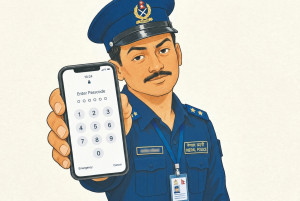
You’re not plainclothes police, are you?
Nepalis joke about plainclothes police at the door. The laughter hides a fear, and a state too busy quarrelling with itself to answer it.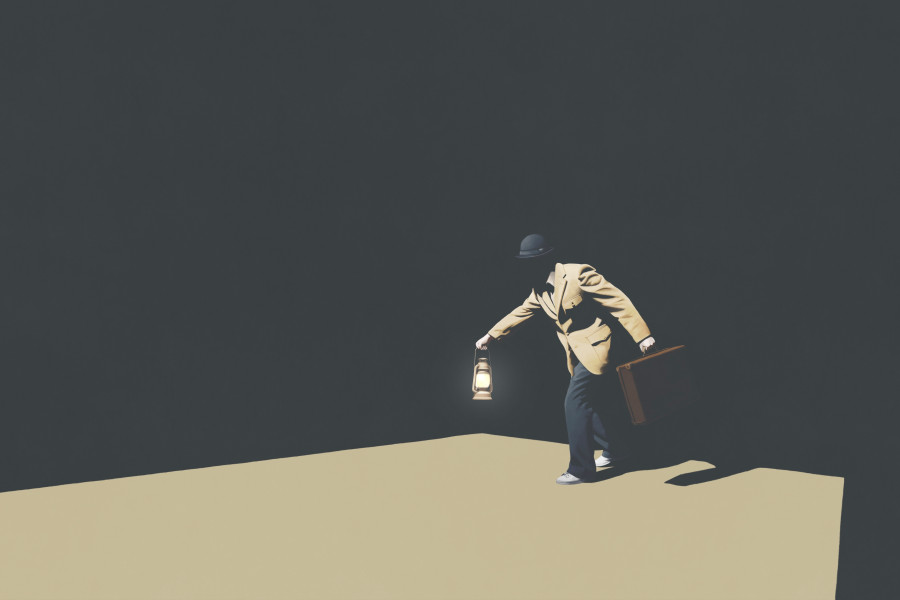
bookmark
Chandrakishore
Published at : November 3, 2026
Updated at : November 3, 2026 06:31
For some time now, a new joke has entered Nepali households. When guests arrive at someone’s house, people welcome them by asking, “You’re not plainclothes policemen, are you?” Both the host and the guests burst out laughing. Tea arrives, the laughter continues, and for a while the atmosphere lightens.
Underneath the laughter lies a fear. When society cannot express its fear directly, it turns it into humour. The laughter is directed less at the police and more at a system in which a citizen, upon hearing a knock at the door, must first wonder whether it is a neighbour or an unfamiliar face of the law.
The presence of law should give a citizen a sense of security, not the uncertain fear of arrest. Yet even as citizens wonder who is at the door, the organs of the state are quarrelling in public over one another’s authority and boundaries.
These days Nepal is observing festivals, one after another. But another kind of firework display is also underway. The different organs of the state are setting off crackers at one another. The government’s machinery is gradually turning into a ‘cracker-house’ of allegations. Interestingly, the smoke from these crackers rises upwards, but it is the eyes of common people that burn. In power corridors, there is no shortage of news about who got the better of whom, who answered whom and which institution crossed whose limits. But who will take note of how much lighter a person’s pocket has grown and how much their trust in the system has diminished?
Nepal’s villages have become lively again, albeit for a few days. On the occasions of Dashain, Deepawali and Chhath, people who had gone away return. Distances shrink for a while. Yet amidst this return, one question remains as it is. People are returning to the village—is politics also returning to the village? At first glance, it seems that this is not merely a religious or cultural festival but a great reunion of Nepal’s social life. But if one pauses to look a little more carefully, several layers open within it—the changing economy, social prestige, family relationships and democratic life.
Nepal’s communities celebrate differently. Yet some scenes are converging. New clothes, gifts, expensive shopping, travel, decoration and festival pictures on social media. The role of the market in the way festivals are celebrated is increasing. It is no longer only important what the family experienced during festivals; it is also becoming important what it showed others.
But this is no joke. The market has a characteristic. First, it recognises our needs, then it expands our desires, and finally it links those desires to social prestige. Festivals are a convenient opportunity for them. It can turn faith into packaging, love into gifts and family reunion into a list of expenses. In this process, no single form of the festival is imposed on everyone, but a standard gradually takes shape. Those with less capacity to spend begin, without realising it, to compare their festival with someone else’s. The market has given human beings a new freedom: they can be happy according to their pocket, provided the neighbour’s happiness is not more expensive than theirs. But this is not merely a matter of humour. When the social meaning of a festival begins to be decided by the capacity to spend, economic inequality has already entered culture.
In times of inflation, the economics of festivals become even more interesting. Shopping is visible in the market. Crowds are visible on the roads and bustle is visible in the shops. From these scenes, it is difficult to conclude that people’s enthusiasm has cooled. But neither can prosperity be inferred from crowds nor economic ease from shopping. One family buys new clothes for a festival because the children desire them. Another family does not want to appear economically weak before relatives. A third family takes a loan to return home and fulfil the social expectation of giving gifts. In a consumption economy, spending is not always proof of purchasing power. Sometimes it is also proof of social pressure.
The condition of poor families also cannot be understood merely from their shopping. If they spend less, it can be called a lack of enthusiasm, whereas in reality they are making hard choices of priorities. Extracting money for festivals from among food, education, medicine and loan instalments is an economic decision. On the other hand, the situation of the middle class is different. It has some purchasing power but along with it also the burden of aspirations. It wants to maintain its social standing. Children’s desires, relatives’ expectations, the lifestyle visible in the digital world and the uncertainty of the future—caught between all these, it remains trapped in the conflict between spending and saving. The crisis of the middle class is not always poverty. Sometimes it is also the compulsion to keep constantly proving its social identity. Therefore, an analysis of consumerism will not be complete merely through the luxury of the rich or the deprivation of the poor. We must also look at that middle class which, while being a customer of the market, can also become the most eager carrier of its aspirations.
With them come aspirants for local elections. Someone reconnects old relationships, someone starts appearing at public programs, someone talks about their contribution. Even those people who are seen very little in public life on ordinary days can suddenly become more active in the community.
This is a natural aspect of democracy. Elections begin long before the voting day, in the form of relationships, expectations and political claims. The presence of a candidate in the village and the presence of the village’s politics are not the same thing. A candidate can return, but do the questions of the village also return with them? Do they discuss the cost of agriculture and the price of produce? Do the houses emptying because of migration, the condition of local schools, the availability of health services, irrigation, roads, drinking water and employment become part of their political conversation?
The conflict between security and fear in citizens’ minds; the struggle among institutions of the state and the common person who pays its price; and the citizen returning for festival but their questions still being absent from politics—these three scenes together raise a larger question: ultimately, on whose trust should a citizen live an ordinary life? When citizens find no space to express their fear, to speak their mind and to place their problems, then where ultimately will they go?
Chandrakishore
The author is a veteran journalist.
Most Read from Columns
Editor's Picks

What Balendra Shah can learn from Zohran Mamdani
Explained: The leaked WhatsApp chats that have shaken Nepal’s judiciary
Who is Inam Sapkota, the man linked to Cholendra Rana and top police officials?
The police chief who objects, delays—and ultimately complies
Shabana Azmi on acting, equality and the power of cinema
E-PAPER | November 03, 2026

×