



 17.46°C Kathmandu

Mon, Oct 26, 2026
Columns
Choose your words carefully, minister
Finance Minister Swarnim Wagle was half right on nationalism and India. But a finance minister abroad speaks for the country, not just his party.
bookmark
Anurag Acharya
Published at : October 26, 2026
Updated at : October 26, 2026 15:19
Swarnim Wagle is not an ordinary political cadre or a sub-national figure. As finance minister and vice-chairman of the Rastriya Swatantra Party (RSP), he is among the principal voices explaining Nepal’s recent political transition to the outside world. He is also one of the more intellectually articulate members of a government that came to power promising to do politics differently.
That is precisely why some of his recent remarks in New Delhi deserve more reflection and scrutiny than the predictable partisan outrage they have generated over the past few days.
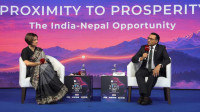
Wagle’s remarks about nationalism and India have created much outrage in the mainstream and on social media. At the NDTV World Summit, he said that there was a time when Nepali nationalism was associated with anti-India sentiment, but that era is over. Speaking in New Delhi, in the context of advocating a reset in Nepal-India relations, greater economic integration and closer cooperation, his broader argument was that Nepal should not confuse economic nationalism or national identity with hostility towards its southern neighbour. This argument is neither unreasonable nor particularly controversial. There is an important truth in it.
Nepali nationalism has, at different moments, been instrumentalised by political actors who found it useful to portray India as an external threat. King Mahendra and his successors did it in the past, as have the communist parties and pro-monarchy forces in recent decades. The political logic is easy to comprehend. When you lack the mandate to control domestic narrative, externalising public grievances is an effective way to mobilise political sentiment. India has been a convenient punching bag in Nepal’s domestic political battles.
The constitutional struggles of 2015 offer perhaps the clearest reminder. Madheshi and Tharu communities protested because they believed the emerging constitutional settlement failed to adequately address questions of representation, federal boundaries and political inclusion. Those protests were met with serious state violence, condemned by national and international human rights bodies. Yet mainstream discourse overlooked the state repression and generally portrayed their demands through the prism of Indian influence. Their leaders were accused of being proxies of New Delhi, and legitimate questions of citizenship, representation and federalism were reduced to questions of loyalty and external influence. The nationalist baton against Madhesis and Tharus then was not just a political construct of the communists or the pro-monarchists. It became part of a wider elite discourse that struggled to accept that marginalised Nepalis could articulate grievances independent of Kathmandu’s direction.
But that is only half the story. India’s own approach has sometimes contributed to the very sentiment it later finds uncomfortable. New Delhi has cultivated close relationships with certain political parties, leaders and elites in Kathmandu. From the Indian perspective, that may be understandable as an effort to protect strategic interests and maintain influence in a country of enormous geopolitical importance. But a neighbouring power that appears to micro-manage domestic political relationships is bound to get caught in the domestic crossfire.
Wagle’s observation, then, was not entirely wrong. But it was made in the wrong setting and with insufficient diplomatic sensitivity. A finance minister speaking abroad in an official capacity does not speak merely as an individual politician. His language and messaging should reflect the ambassadorial role he plays for the country. There is nothing clever about dragging a contentious domestic conversation on nationalism onto an international stage.
It is also telling that some of the strongest backlash has come from precisely those political constituencies that have, at different points, benefited from invoking nationalism against India. Their outrage should not automatically invalidate Wagle’s argument. But their history should not give him immunity from criticism.
The same carelessness with language ran through two other remarks from the same trip.
From the same NDTV platform, Wagle called the March 2026 elections the “cleanest, fairest, and most peaceful elections in Nepali history”. The RSP’s sweeping victory was a remarkable democratic verdict, and it can be celebrated without the superlative. The claim implicitly questions the integrity of opponents who also won popular mandates, and the credibility of earlier elections run by the same non-partisan Election Commission he credits for this one. Whatever its flaws, Nepal has a strong record of broadly credible elections, including two Constituent Assembly polls held amid serious turmoil. Democratic legitimacy should not depend on which party wins.
More consequential was his answer on the scale of the victory. Rather than speak of a mandate, Wagle seemed to indicate that the party only “controls” Parliament and lacks a comparable presence in the judiciary, bureaucracy and security institutions, and he spoke of the need for a “broader and deeper presence”. He may not have intended to suggest that the party should control these institutions; the wording alone does not establish that. But even if it was merely a Freudian slip, it deserves scrutiny. A party winning Parliament is democracy. A party aspiring to control the judiciary, bureaucracy and security apparatus is something else. Saying so in a neighbouring capital that is witnessing unprecedented protests over the sanctity of its own institutions is baffling.
The larger lesson for the RSP is not about India at all. It is about the power of language, and the language of power.
The party was elected because Nepalis wanted something different. They wanted politics without the old shenanigans and institutions without partisan capture. A government that catered to every citizen, and not the powerful few. That places an unusually high burden on the new ruling party. The test of a political transition is not whether the newcomers can occupy the institutions left behind by the old establishment. It is whether they can change the relationship between political power and those institutions.
The RSP has won the federal parliament. It has won an extraordinary mandate. It has every right to govern decisively. But it should not confuse the mandate to govern, or rather resist the temptation to do so, with a mandate to control all levers of the state. In a party of political novices, perhaps a senior figure like Wagle should understand the difference.
Anurag Acharya
Acharya is a former journalist and Kathmandu-based researcher who writes on South Asian politics and governance.




Most Read from Columns



Editor's Picks

What to know about the US trial over Mamta Kafle’s disappearance
NPL returns with bigger ambitions and global recognition
What’s new in the Nepal Premier League’s third season?
After Nepal’s recent disaster, it wants to test whether COP31 can deliver climate justice
Why does an hour long flight to Dhangadhi cost more than a flight to New Delhi?
E-PAPER | October 26, 2026

×