



 16.53°C Kathmandu
Sun, Oct 25, 2026
Columns
Before you take credit for Khula Manch, read its history
Balendra Shah’s social media quip ignores his own mixed record with the space as mayor and a record that predates him by decades.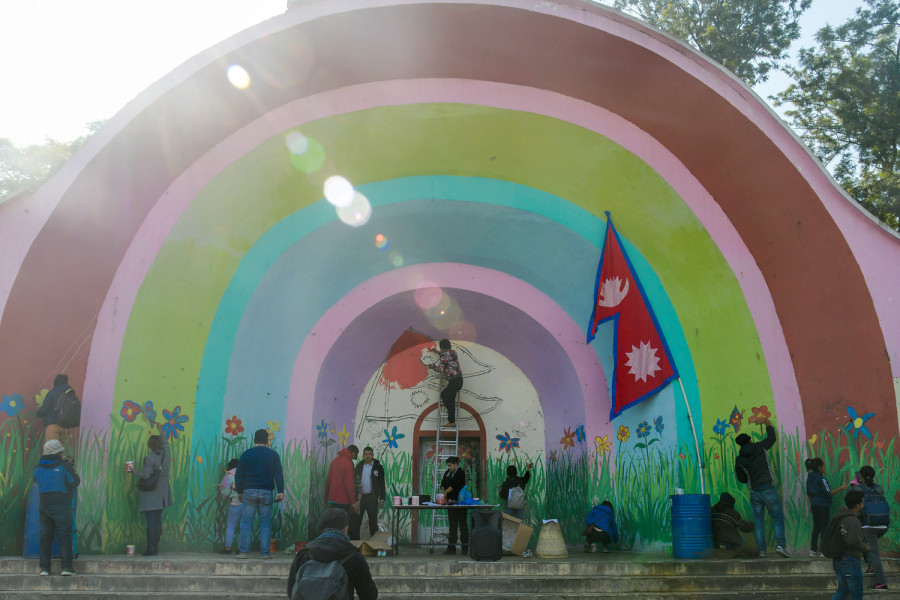
bookmark![]()
Nepal Photo Library ![]()
A maoist cadre paints the Khula Manch stage in preparation for the mass gathering. Photo: Courtesy of United We Blog ![]()
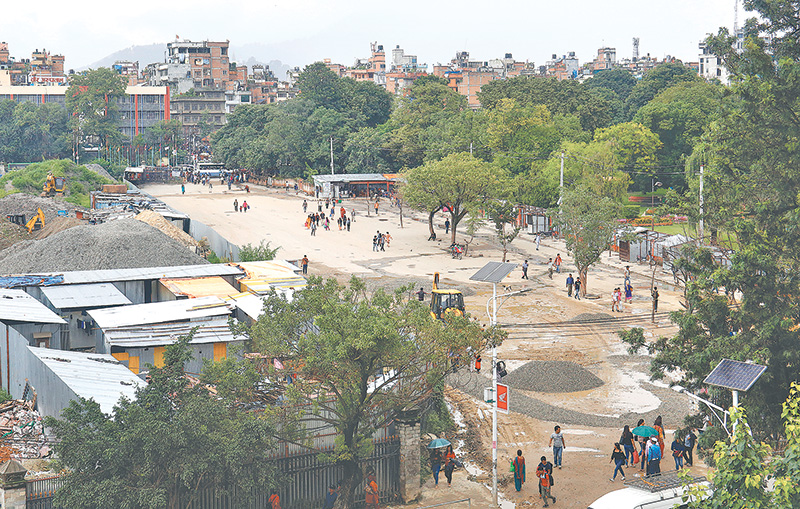
Khula Manch was used as a temporary bus park and a storage space for construction materials. File Photo ![]()
File Photo
Majid Ansari
Published at : October 5, 2026
Updated at : October 5, 2026 19:58
Yesterday, Gagan Kumar Thapa spoke at the 15th General Convention of the Nepali Congress held at Khula Manch. The party chair reflected on the political history of the venue and argued that an open public space as such is necessary for both the government led by the ruling Rastriya Swatantra Party (RSP) and the Parliament. This statement sparked a debate on social media platforms.
That debate intensified after Prime Minister Balendra Shah posted a sarcastic Facebook post later that same night, saying: “Thankfully, we made the Khula Manch good enough for the new party to hold a programme and criticise us!”
But Khula Manch did not open that day, nor during Shah’s mayoralty of Kathmandu metropolis. The venue, as a historical witness to various political transformations, has a long and deeply significant place in Nepali political history.
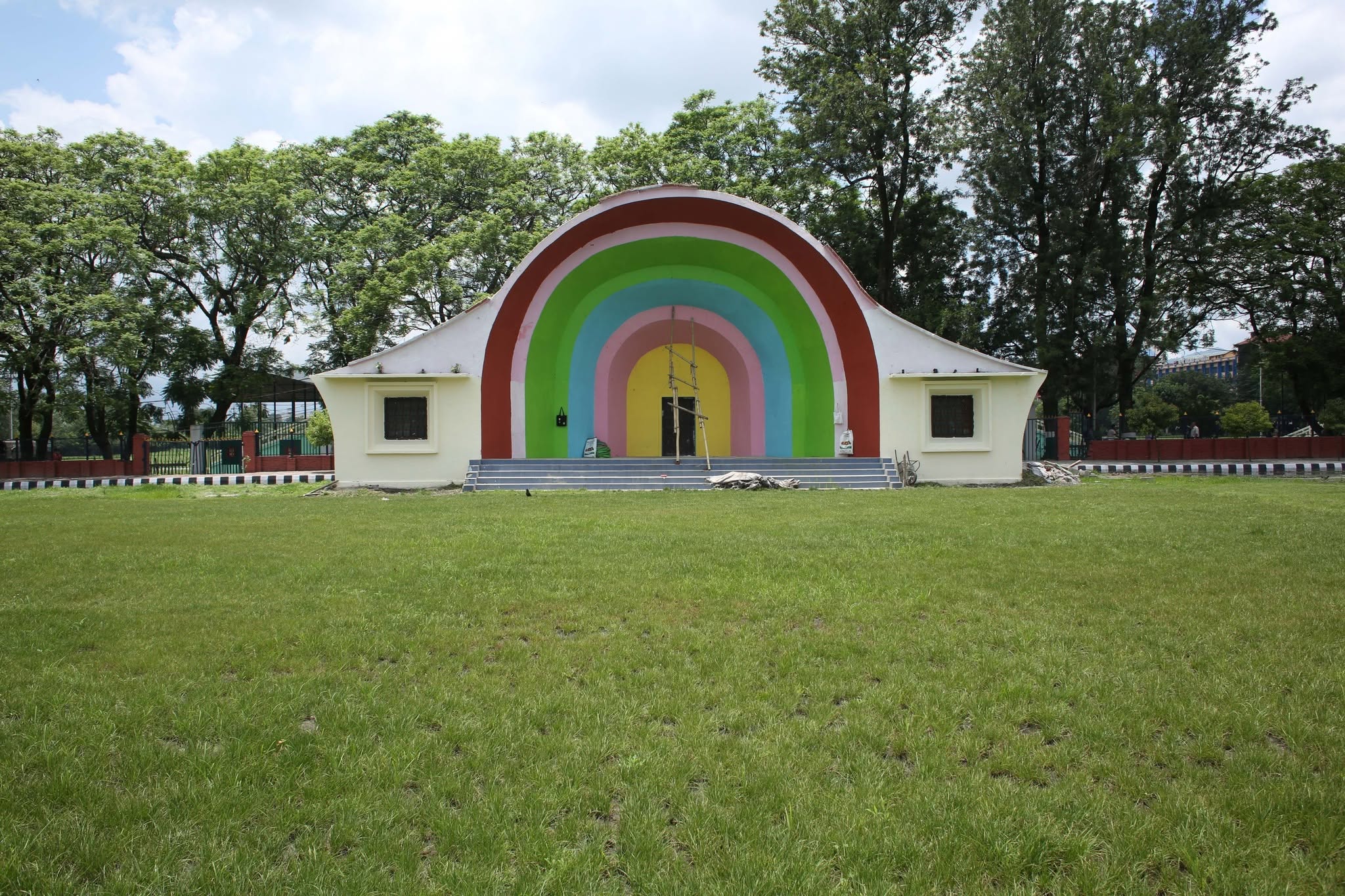
Khula Manch is only one part of the much larger historic Tundikhel. Historically, Tundikhel was a vast open area extending from Rani Pokhari to Dasharath Stadium. During the Rana regime, it served as a site for military exercises and public proclamations. Historical sources mention that Chandra Shumsher proclaimed the abolition of slavery in 1924 at Tundikhel.
Around 1956, the southern section of Tundikhel was developed into a sports stadium on the occasion of King Mahendra’s coronation. Around 1960/61, the construction of the Martyrs’ Gate and roads further divided Tundikhel, leaving what we now recognise as Tundikhel and Dasharath Stadium as separate spaces. Around 1962, the construction of Ratna Park further fragmented the historic open area.
There are somewhat differing accounts regarding the construction of Khula Manch itself. Some sources mention that an open-air theatre-like space was added to this part of Tundikhel in 1973; others state that the area began to be known as Khula Manch after an arch-style stage was constructed in 1975/76.
Either way, its identity as a major open platform for political movements became particularly strong after the 1980 referendum. After King Birendra announced the referendum that year, political activities became comparatively more open. B.P. Koirala addressed a mass gathering at Khula Manch on June 8.
The 1990 People’s Movement culminated in the restoration of multiparty democracy on April 8. The following day, a major victory rally was held at Khula Manch. The historic memory of leaders, including the commander of the People’s Movement, Ganesh Man Singh, as well as Krishna Prasad Bhattarai and Girija Prasad Koirala, addressing the public from Khula Manch and celebrating the victory is deeply associated with the place.
King Gyanendra announced the restoration of the dissolved House of Representatives on April 24, following the 2006 People’s Movement. The massive gathering held at Khula Manch on April 27 remains part of the public memory of that political transformation.
Following the peace process, the first major public gathering of the then CPN (Maoist) was also held in the Tundikhel–Khula Manch area. Myriads of regional political parties also used the venue to publicly articulate and announce their political demands.
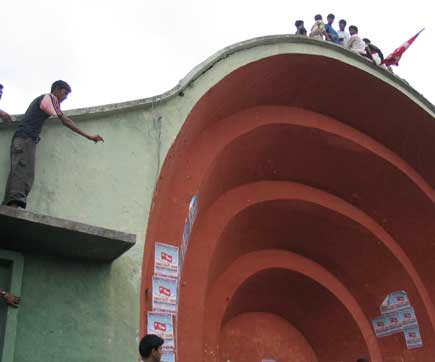
Khula Manch was not created specifically for political movements. It was conceived as an open-air theatre and a space for public and social activities. But its historical use gradually transformed the meaning and character of the space itself.
After the devastating 2015 earthquakes, the importance of Khula Manch as a shelter and emergency open space increased significantly. At the same time, however, a new chapter in the controversy surrounding its openness began. The irony was that the very open space citizens desperately needed during a disaster gradually became restricted to various governmental and commercial uses in the name of post-earthquake reconstruction.
Three major developments subsequently contributed to turning Khula Manch into an almost barren and disorganised space through reconstruction-related and temporary uses. First, Khula Manch became a storage area for construction materials required for the reconstruction of nearby Bir Hospital and Durbar High School. Second, after construction of the Kathmandu View Tower began at the old bus park, a large part of Khula Manch was used as a temporary bus park. Third, along with the bus park, various small commercial sheds and other structures popped up in the area.
On February 1, 2017, the then CPN (Maoist), led by Netra Bikram Chand, had inaugurated its eighth general convention at one corner of Khula Manch. After that, major political programmes at Khula Manch largely disappeared.
Then in 2019, a group consisting of members of civil society, academics, politicians, heritage activists, environmentalists and local residents launched the Occupy Tundikhel campaign. Its principal objectives included stopping the encroachment of Tundikhel, restoring public access, protecting Kathmandu’s public open spaces, preserving Tundikhel for future generations, and ensuring that open spaces remain available during disasters. People from political, academic and civil society backgrounds expressed solidarity with the campaign.
In the 2022 local elections, Balendra Shah was elected Mayor of Kathmandu Metropolitan City. Many activists expected that Khula Manch would finally be reopened. After all, Shah had presented himself as a mayor willing to take strong action against the misuse of public property, encroachment and unauthorised structures. Yet, contrary to those expectations, a proposal to construct an underground parking facility at Khula Manch became one of the major controversies of the early part of his tenure.
The metropolis’ budget and policy programme for fiscal year 2022-23 included a plan to conduct a feasibility study for underground parking, with reverse boring, on land described as being ‘adjacent to Khula Manch’. Later, the 10th meeting of the Municipal Council decided to proceed with a DPR for a triple-basement underground parking facility and groundwater recharge pits in the Khula Manch area.
This raised a major question: Why was the budget originally framed as underground parking on land adjacent to Khula Manch, but the later decision referred to building the parking facility at Khula Manch itself?
Activists involved in the Occupy Tundikhel campaign began opposing the underground parking proposal. Campaigners cited figures suggesting that Tundikhel’s public open space had declined from around 52 percent in 1967 to 33 percent in 1990, 25 percent in 2000 and approximately 14 percent in 2017. A significant section of the Newa civilisation activists associated with Occupy Tundikhel also described Khula Manch/Tundikhel not merely as an empty piece of land, but as a public heritage space deeply connected to Kathmandu’s historical and cultural identity.
Following strong opposition from the indigenous Newa community and various activists, the Shah-led metropolis eventually stepped back from the underground parking plan.
In a complete U-turn, Shah, on February 15, 2024, through social media, shared his vision of Khula Manch as a multi-purpose public open space—a place for morning walks, yoga and meditation in the morning, children’s recreation and socialising during the day, as well as demonstrations, protests and creative activities.
However, later on, he exposed a gap between his words and his actions. Victims of the predatory lending were prevented from entering Khula Manch. The metropolis argued that allowing them to remain there for a prolonged period could effectively result in the occupation of Khula Manch, while also saying that it supported the victims’ demands and suggesting alternative locations for their protest.
This raised an important democratic question: If Khula Manch is genuinely open to everyone, should it also remain open to protesters? Or can the metropolis restrict access in the name of management and public order?
Later that year, the metropolis, still under the mayoralty of Shah, decided to proceed with reopening Khula Manch to the general public. But the decision did not translate into practice.
Nearly three years after the decision, Kathmandu Metropolitan City, now under the leadership of Sunita Dangol, formally reopened Khula Manch to the general public on April 16 this year.
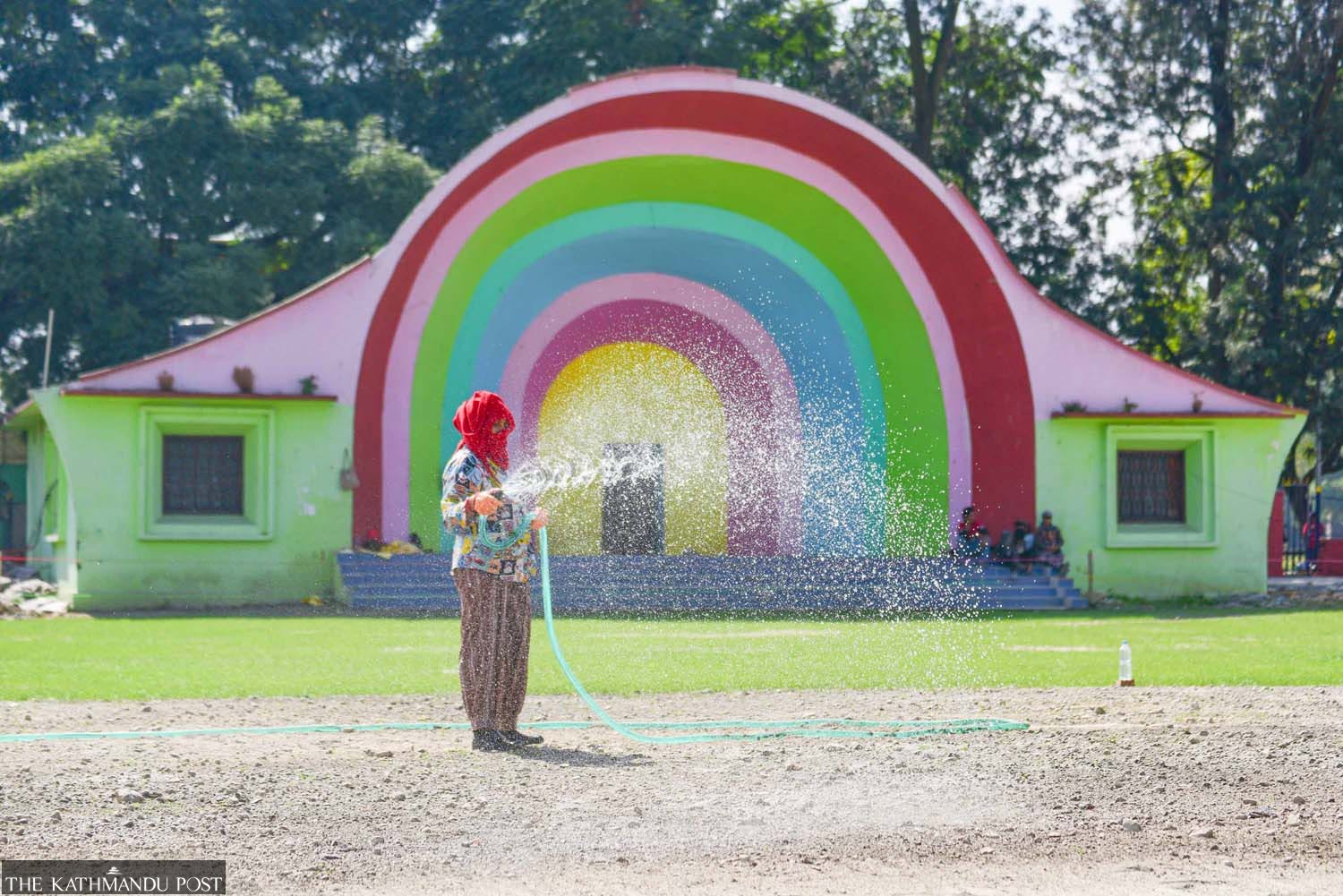
The metropolis has since developed Khula Manch as a public ground. Grass has been planted, pedestrian paths have been constructed around it, and arrangements have been made for the public to walk, exercise, rest and engage in recreational activities.
So, who can claim that they reopened Khula Manch?
Does Prime Minister Balendra Shah really have the moral authority to say, “Thankfully, Khula Manch has been made good enough for the new party to hold a programme and criticise us!”, as though he himself created the place?
Some have praised him for using bulldozers to remove piles of gravel, stones and concrete from Khula Manch, levelling the ground, planting grass and even repainting its walls. And it is undeniable that the Shah-led metropolis administration has played an important role in the most recent phase of restoring Khula Manch.
But presenting that contribution as though Balendra Shah created the entire history of Khula Manch, or founded it as a democratic political space, simply does not correspond with the historical record. The political character of Khula Manch was shaped decades before Shah.
Finally, in the Prime Minister’s own style, let me add a few things that seem to have been left out:
“Thank goodness the Occupy Tundikhel movement happened during Mayor Balendra Shah’s tenure, so that Prime Minister Balendra Shah now has the opportunity to claim that he made Khula Manch good.”
Majid Ansari
Ansari is a youth activist.




Most Read from Columns


Editor's Picks

What to know about the US trial over Mamta Kafle’s disappearance
NPL returns with bigger ambitions and global recognition
What’s new in the Nepal Premier League’s third season?
After Nepal’s recent disaster, it wants to test whether COP31 can deliver climate justice

Why does an hour long flight to Dhangadhi cost more than a flight to New Delhi?
E-PAPER | October 25, 2026

×