Gagan Thapa can make the case. Can he make the change?
For nearly two decades, the Nepali Congress president has been one of Nepal’s most effective political speakers. As he prepares to lead the party, his greatest strength becomes his biggest test. Dipesh Darshandhari/TKP
Gagan Thapa did what he does best. He delivered a good speech.
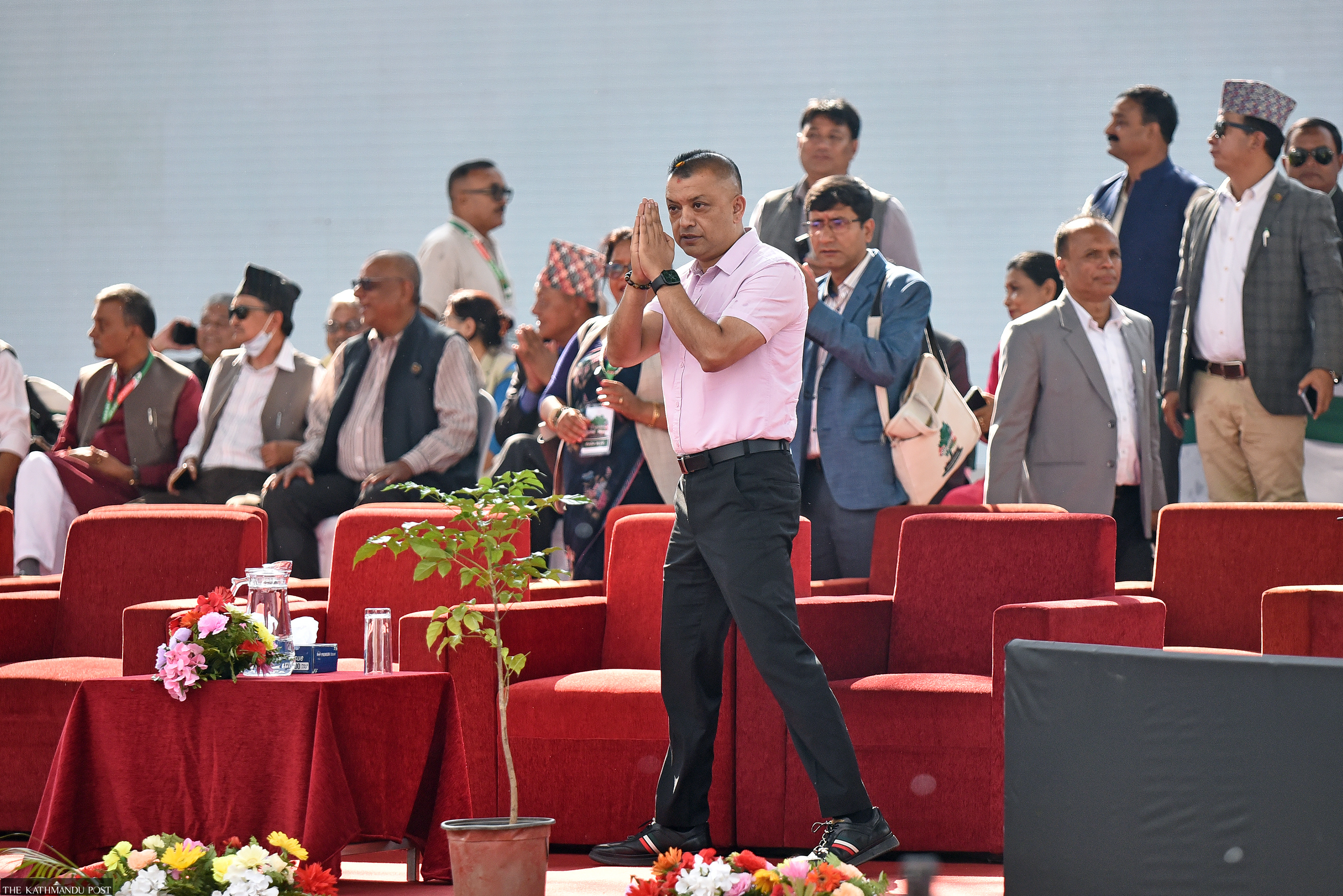
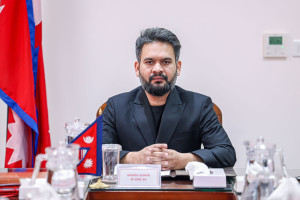
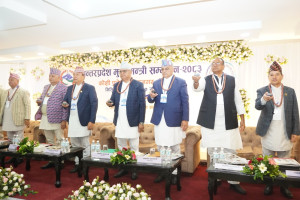
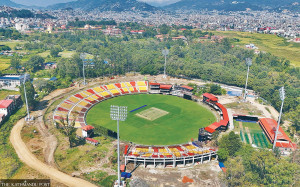
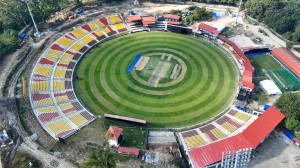
Addressing the 15th General Convention of the Nepali Congress on Sunday, Thapa began with a metaphor. He used Khula Manch, the open ground where the convention is being held, to make a point about the state of Nepal’s politics — and to take a shot at Prime Minister Balendra Shah.
“The message that the Nepali Congress wants to take and convey by organising its convention at Khula Manch is that open spaces are needed in many places in Nepal — and first of all, we need one in Parliament,” he said. “Parliament is not open. It is closed. The prime minister must be present in the Parliament that elected him. Until he appears there with respect for Parliament, the people and the political system, Parliament cannot be considered open.”
It was a direct jab at Shah, who has made little effort to attend parliamentary proceedings during his six-month tenure, drawing criticism from several quarters.
But Thapa was doing more than taking a potshot. He used Khula Manch as the organising metaphor for his speech. The open ground, he said, is part of Nepal’s political memory.
“B.P. Koirala had spoken there in 1979, Ganesh Man Singh had spoken here in 1990,” he said. “This site has witnessed some of the country’s most consequential political moments.”
But history, Thapa argued, should not merely be celebrated.
“History does not give us power. History gives us lessons,” he said. The lesson, he argued, was that the Congress survived because, at different points in history, it answered the most important question of its time: freedom from the Rana regime in 1951, an end to the Panchayat system in 1990, an end to violence in 2006, and a constitution in 2015.
Then came the question that mattered most for the party at this moment.
“What is today’s question?” he asked. “Congress cannot sustain itself with the answers from yesterday. It must answer today’s question.”
And that required Congress to leave its own rooms and listen to people outside them — particularly young people who did not experience the historical struggles that the party continues to invoke.
Gagan Thapa did what he does best again. He made a strong case for his party by criticising it — and himself, not directly, but as part of the political mechanism he was criticising. This has been one of the more effective features of his political rhetoric. He did not pretend Congress had done everything right. He made the admission part of the argument for Congress’s renewal.
“Citizens had legitimate aspirations,” he said. “We failed them.”
He described an increasingly entrenched political culture in which leaders repeatedly squabbled, made and broke alliances and realigned around the same coveted prize: the prime minister’s chair. It had become, in his words, a kind of “musical chairs.”
“The public saw politicians running — but could not see what they were running for beyond power,” he said. “That failure helped produce the political disillusionment that eventually turned into something more explosive.”
Thapa refused both easy condemnation and easy glorification of last September’s youth uprising, which subsequently caused an upheaval in the Congress. He also acknowledged that the Congress itself had been a victim of the upheaval. The special convention that followed elected Thapa as party president.
“The repression on September 8 was wrong. The criminal violence on September 9 was wrong,” he said. “But neither could be used to dismiss the popular uprising itself.”
He acknowledged that it had not happened overnight.
“It was an explosion of the suffocation that had been building inside.”
The word “suffocation” was particularly striking because he had begun the speech by invoking Khula Manch as a metaphor for political openness, while also pointing to the space that itself was being suffocated by encroachment — another oblique jab at Shah. His answer to political suffocation was, fittingly, openness.
Dipesh Darshandhari/TKP
His answer was openness — an open Parliament, an open society, open dialogue between generations and communities, an open digital space, and even an open Congress where members can question their leaders without fear of losing their party membership. He then arrived at perhaps his most important argument: Congress’s crisis is not electoral.
“It is a crisis of identity. It is a crisis of purpose,” he said.
The Congress suffered its most humiliating electoral defeat in the March elections, months after the Gen Z uprising, under Thapa’s leadership. Thapa himself, after years of electoral success, tasted defeat for the first time. But he turned even that defeat into another emphatic political statement.
“We must be prepared to lose not one but five elections for the sake of our principles,” he said.
A Congress member, he argued, should not be known merely as a ward chair or district committee member.
“They should be known for what they do — a person who works for community schools, advocates for women facing violence, helps farmers or serves the community — and only then should someone add: ‘And that person is also a Congress member,’” he said. “Every Congress member should have a purpose.”
It is a powerful argument. But it also reveals the scale of the challenge Thapa is taking on.
The speech’s most consequential test is not hypothetical. Thapa has already led Congress through an election in which the party suffered a major electoral defeat.
There is nothing particularly new about Thapa speaking well. That Thapa makes great statements is almost an understatement. He has been doing it for nearly two decades. He is undoubtedly one of Nepal’s most effective political speakers. He knows how to frame an argument, find a metaphor, acknowledge his party’s — and his own — failures without abandoning the case for his party, and turn self-criticism into political strength.
So Thapa did what he does best.
But when the convention ends, Thapa is most likely to become the leader of the Congress. And that changes the question.
He has spent years telling Congress what is wrong with Congress. He has said it needs to listen better, change its political culture, answer contemporary questions, regain public trust, and give its members a purpose beyond elections.
The test now is whether he can change everything he’s said the party needs to.
Satgainya is Editor, Features & Investigations for KMG. Previously, he served as the Editor of The Kathmandu Post from February 2020 to September 2022.




 13.77°C Kathmandu