



 20.28°C Kathmandu

Sat, Oct 17, 2026
Columns
Why Nepal’s latest disaster needs a local name—not just a scientific label
We use words like ‘tsunami’ and ‘monsoon’ to honour the communities who know these disasters best. It’s time for Nepal to do the same.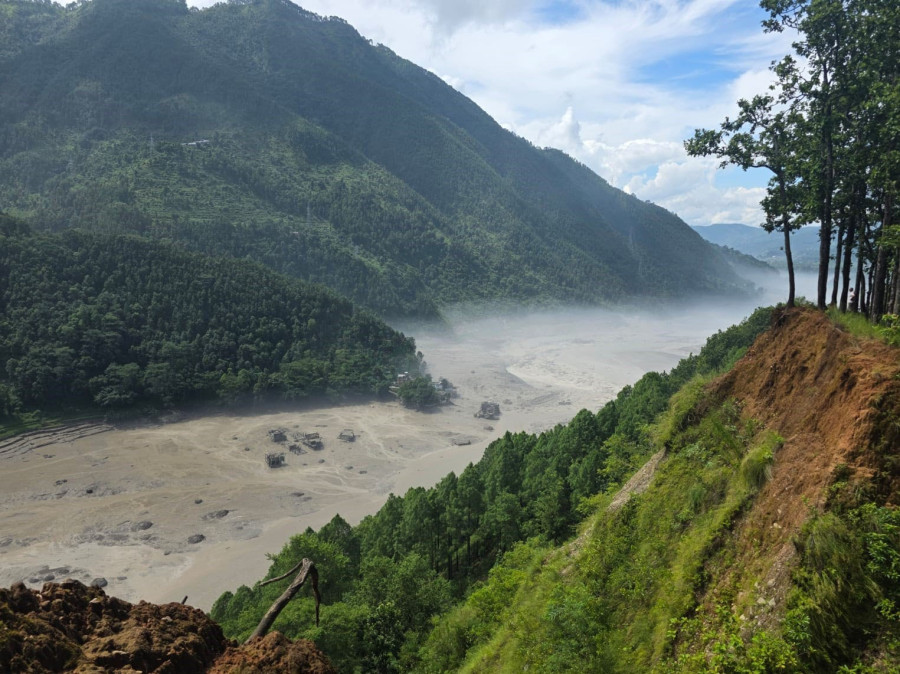
bookmark
Kathryn S March
Published at : September 27, 2026
Updated at : September 27, 2026 08:34
The Government of Nepal has shown wisdom in establishing a committee to find a proper name for the recent devastating floods in the Lende-Bhotékoshi-Trishuli corridor. This is a most welcome and necessary development. Scientists, journalists, policymakers, and ordinary people are all struggling to decide what to call this extraordinary event, and most of the proposed names are unbearably cumbersome and don’t do it justice.
To this admirable task, I want to add only one plea: Please choose a local name. For the moment, and to open to discussion, I want to propose the word gangbal, and I will explain why.
But first, I want you to understand I am opining on this particular topic. It has been my great good fortune to have worked in Nepal since 1973 and with the Tamang peoples of Nuwakot, Rasuwa and Dhading since 1975. The thoughts I present here are my own, and I encourage you to obtain many opinions as you deliberate on endorsing a new name for this terrible phenomenon.
I believe it is in Nepal’s interest to take the lead in generating a simple name for what is a distinctive cascading rock-ice mountain-failure-triggered debris-filled flash-flood of devastating speed, consistency and proportions. The very fact that it takes so many words to describe it underscores the need to give it a unique name. Giving it a Nepali name will underscore the unique vulnerability of her population to a form of disaster not entirely of her own making.
In addition, I want to suggest that you look for a name among the local people who have historically occupied the place where it originated, in remote upper Rasuwa. They are not the only people affected by this disaster, by any means, but their local environmental knowledge has much to teach us, and their extreme vulnerability and resilience deserve our respect.
There are many natural and often catastrophic events that are known by names coming from traditional local communities where such events first or frequently occurred. A famous example is tsunami, which means something like ‘harbour wave’ in Japanese. There, fishing communities were often among the hardest hit when great earthquake-generated ocean waves flooded their harbours, destroying boats, lives and livelihoods. Haboob are ferocious desert dust storms whose name comes from Arabic. Thus, too, the whole world calls seasonal heavy rains ‘monsoon’ after the term mausam in many South Asian languages, including Nepali. A lahar is a destructive lava-mud flow, from Indonesian/Javanese. And perhaps most poignant of all, we still use the Taino word for their storm/wind divinity, ‘hurricane’, although the Taino people, their communities, and their culture, which used to dominate the Caribbean, were devastated almost into extinction by Spanish colonialism.
I encourage the Nepali officials to work closely with the local people of Rasuwa, and with scholars of Tamang language and culture, to find out what they call events like the cataclysm of August 26. In my conversations and research, the word gangbal has come up several times, but others may be able to identify a local word that is better. Gangbal, however, is the most appropriate one I've found so far, with roots in local environmental understanding, as well as being mythically evocative of disasters of legendary proportions and with lessons about how to live safely near rivers capable of such violence.
A long-time friend, host, co-researcher, and colleague, Suryaman Nghyéma Karma Himdung Tamang, from the heavily impacted Ward-5 of Kishpang Rural Municipality, said that his father Lal Bir Himdung Tamang, who was an important local political leader beginning in 2017 BS, had learned the word gangbal from Tschong Gongbo Tamang from Gonggang (below Bremtang, near Gatlang and Goljong). Suryaman recalls that the word was related to the idea of a great water serpent that rode the leading edge of major flood waters, rolling down the precipitous canyons like a giant train, with a bright floodlight shining in front.
According to the founding Tamang politician in Rasuwa, Dawa Finzo, in a recent interview with Tikaram Yatri, these gangbal—the serpents and the rock-ice floods they brought with them—were so large that they could not fit under the bridges, so they washed them away. He specifically remembers one such flood in 2018 BS.
Another friend and colleague, Sete Ram Tamang, recalls his grandfather also telling him about the great gangbal who rode terrible floods down the rivers and warning him never to build houses near the rivers because of the gangbal floods.
Linguist Ajitman Tamang links the idea of gangbal to the myth about the primordial lake in the Kathmandu Valley. According to legend, when Manjushree’s mighty sword cleaved what is today Chobhar Gorge, not only did the waters rush out (in what must have been a catastrophic flood well into what today is India) but it also loosed the great ngyémbu water serpent. Even today, when Tamang people refer to the Kathmandu Valley, they call it Yembu, in honour of this great being and his watery release.
My plea is that we use this word, gangbal, or find another like it—with deep roots in mountain wisdom—through the efforts of those knowledgeable about Tamang language and culture, to name this kind of event for the whole world to know about the growing Himalayan mountain risks and to respect the Tamang community, their suffering, and their heritage, just as we use the term tsunami to refer to the catastrophic earthquake-triggered ocean waves both scientifically to identify a specific complex natural and destructive event and to honour the Japanese fishermen whose boats and lives were historically most affected.
Kathryn S March
March is a graduate professor and professor emerita of anthropology, feminist studies and public policy at Cornell University.



Most Read from Columns
Before you take credit for Khula Manch, read its history
Shah went to the UN to speak for Nepal, then left before he could make the most of it

Bhotekoshi flood wasn’t a freak event. It’s the Himalaya doing what it does
Lesson learned after the death of Ronaldo
Why passive neutrality won’t take Nepal anywhere
Editor's Picks

Dashain paints the country in festive colours
Buying a goat for Dashain? Look for the green mark

Explained: Why does an hour long flight to Dhangadhi cost more than a flight to New Delhi?
Bhotekoshi flood wasn’t a freak event. It’s the Himalaya doing what it does

How Tenzing Sherpa became Nepal’s breakout star at the Asian Games
E-PAPER | October 17, 2026

×