From 1986 citizenship photos to ancestral land records, we treat data like a smartphone problem. It’s actually about who controls your story. Post File Photo
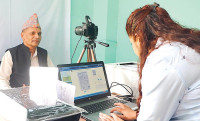
Juthe Tamang, 52, has been living under a tarpaulin in Bidur, Nuwakot, since the August flood took his house. The government has promised displaced families Rs15,000 a month in housing assistance, paid into a bank account. When he went to open one, Sanima Bank turned him down. His citizenship certificate was issued in 1986, when he was 16. The photograph on it, the bank said, does not match his face.
Thirty-six years of a life, and the document never moved.
Everyone in this story, reported in The Kathmandu Post on September 28, behaves reasonably. The bank follows a rule; officials suggest workarounds; Nepal Rastra Bank has eased verification for flood victims. What does not exist is any way for a citizen to bring a state record up to date with the person it describes. While a directive is kindness, a right would have made kindness unnecessary.
That is a data problem, and it has nothing to do with anyone’s phone. Bills on information technology, forensic laboratories and heritage will be waiting when the House reconvenes. Yet the word ‘data’ makes most people hand the subject to specialists and look away. Here are six myths worth giving up before discussions on the bills resume.
Myth 1: Data is something on my phone
Data is any fact kept so it outlives the moment that produced it: a citizenship certificate, a land record, a hospital file, a river-gauge reading, a family’s vamshavali, or the forest plants an amchi names for her novice, written down nowhere. Most of the data that governs a Nepali life was never digital. Juthe Tamang’s 1986 photograph is data, and it is why he has no bank account.
Myth 2: Data belongs to technical people
The phrase ‘data science’ was coined in 1974; the first master’s degree in it opened in the United States in 2007. Nepal’s land-revenue archive holds documents from before 1769. The records are older than the name of the profession.
The specialisations—data science, geospatial technology, now artificial intelligence—are real. But a cadastral surveyor who measures your farming land does not come to own it. How a record is stored and analysed is a technical question. Who may hold it, what the holder owes you, who may see it and who decides are civic questions, and no schooling or diploma is required to ask them.
Myth 3: Data sharing means satellites
The Prime Minister has proposed satellite data sharing with India and China. But the view from space was the part that already worked in August: the scientists who explained the collapse relied largely on free archives.
The earliest notice came from the ground. When the slope let go at 08:37 am, seismometers registered a tremor equal to a magnitude 5.5 earthquake; the debris reached the border seven minutes later. A seismic network China helped Nepal build was handed over in 2019. But detecting a signal and being charged to warn on it are different things, and Nepal’s flood warnings wait for water to reach a gauge. This time the gauges were swept away first. The sharing that failed was closer to home: between Singha Durbar departments, and between a hospital morgue and a family looking for a body.
Myth 4: Public data is free
You buy it. The meteorological department sells its records on a price list last revised in 2009. The Survey Department sells contour lines at Rs240 a sheet, and the whole country at Rs300,000. The Department of Mines and Geology lists five of its six regional maps as out of stock: maps that exist and cannot be bought. A Nepali student gets a seventy-five per cent discount, and still pays. Meanwhile, research paid for with public money often ends up on a private laptop or abroad, with little left in a Nepali archive. Nepal sells what it holds, and does not hold what was made about it.
Myth 5: If the state holds a record about me, I can see it and correct it
Your hospital must keep your records, but no law says for how long, or that you may come back and see them, or have them corrected. Under the National Identity Card and Registration Act, your registered details can be corrected once, for life. Whether you will ever see who has looked at your record is for the authorities to decide. Nor does the record loosen at death: most of the flood’s missing still cannot be registered as dead, so an orphaned child cannot yet be recorded as one.
Myth 6: Get the data, and the decision follows
This one cuts both ways. “We need more data first” can become a way of never deciding. And people decide well with data no department counts: a village that has farmed one slope for two centuries remembers where the water came in its grandparents’ time.
A hazard map can tell you where a debris flow may reach. It cannot tell you whether a village should move uphill, away from its fields, or downstream, away from its temple. So when you hear “decision-ready information”, listen carefully. When someone hands you an answer rather than the records behind it, the value judgements have already been made, and made invisible.
This is the difference between relief and reconstruction. Relief is logistics, and needs speed. Reconstruction decides where a settlement will stand for fifty years or more, on whose land, with what livelihood, and it needs the records, and the standing of the people who will live there.
Minding what is ours to mind
None of this asks a person to have a mobile phone or to have finished high school. Three questions are enough. When a legislative bill is described as being about information technology, ask whether it also decides what you may know about yourself. When a new portal is announced, ask what it will hold, on what terms, and who already holds the same thing. When a decision is presented as what the data shows, ask who chose, and what else they could have chosen. The same questions serve an institution, or a country: before speaking of a data gap, ask what is already held, and in whose hands.
A law on how data is owned, exchanged and protected, as the government committed to in its AI policy of August 2025, deserves to move quickly, and to be argued over in full, across every part of society, not only among IT or data specialists.
Juthe Tamang does not need a platform. The assistance exists; the bank is willing. What is absent is one rule: that a record about a person must be capable of being corrected by that person. Data never decides anything. Somebody chooses. The only question is whether you get to see them do it.




 15.17°C Kathmandu