Two days after the death of Ronaldo, the famed elephant, I travelled to Chitwan with fellow activists working for elephant conservation. We wanted to understand what his death might tell us about the conditions in which humans and elephants are expected to coexist.
We spoke with representatives of Chitwan National Park (CNP), the Nepali Army and the Nepal Electricity Authority (NEA) in Bharatpur. The Park representatives spoke about elephants, monitoring and conservation. The Army people spoke about protecting the park while keeping personnel alive and connected in remote posts. Whereas NEA officials explained what electricity infrastructure can and cannot practically provide.
We realised Ronaldo’s death should not be limited to a search for a convenient institution to blame. The focus must be shifted to exploring and examining the system that allowed the needs of wildlife, conservation, security and infrastructure to meet at a fatal point.
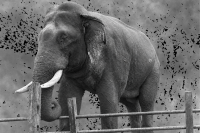
Ronaldo, father to 38 calves at the elephant breeding centre, was found dead on September 19 near Bishazari Lake in the buffer zone of CNP. The cause of death was suspected to be electrocution since he was found with electric wires inside his mouth. It was reportedly an insulated electricity line supplying a security post, strung approximately 17 feet above the ground.
But reducing the tusker’s identity to a ‘celebrity elephant’ risks diminishing the significance of his death. First, he was a wild Asian elephant, and second, he was among the species classified as Endangered on the IUCN Red List and protected under Schedule 1 of Nepal’s National Parks and Wildlife Conservation Act. The Elephant Conservation Action Plan (ECAP) identifies habitat loss and fragmentation, destruction of traditional ranges and corridors, human-elephant conflict, and infrastructure development without adequate consideration of wildlife safety as major challenges facing elephant conservation. Its stated goal is to maintain viable elephant populations while balancing conservation and development needs. That balance is exactly what Ronaldo’s death forces the system to confront.
Animal rights is an important perspective that needs more scrutiny in Nepal’s context, yet the animal rights perspective needs not disregard human safety. CNP hosts 39 security posts, of which eight lack electricity connections, and 17 have no telephone connectivity. Electricity at a post supports communication, medical needs and lighting. Wildlife management becomes particularly difficult when animals and people are simultaneously at risk. 35 Nepali Army personnel have lost their lives during the course of protected-area duties.
“We are all on the same page, only the actors are different, but the goal is the same,” an Army official told us.
Our discussion with an NEA representative moved the conversation from responsibility towards meaningful possible solutions. The representative explained that armoured underground cable can be an alternative since it is physically protected in ways that make cutting or biting it difficult. Underground installation, however, comes at a high cost. According to the representative’s estimate, such installation can be around 67 times more expensive than ordinary cables.
NEA records show that the Chanauli-Madi 33 kV feeder already incorporates an underground cable. UNESCO’s description of Chitwan’s management challenges has also specifically referred to the underground electricity transmission line serving people in the Madi Valley.
Technology, however, will not solve the problem alone. It needs budget and maintenance. A CNP representative explained that budget allocations overlook maintenance. The Army representative raised similar concerns about another alternative, solar power. Though solar may appear to be an obvious alternative, the maintenance requires continuous funding.
The Army representative repeatedly returned to another solution—education. Awareness sessions have already been conducted within schools for approximately 50 to 100 students. Even if only half of those attending remember what they learn, that knowledge can change behaviour during a future wildlife encounter.
Local curricula in elephant range areas could teach children and communities how elephants behave, what to do when one approaches a settlement, why wildlife corridors must remain open, why direct electrical traps are dangerous, and when human intervention in natural wildlife behaviour can itself create additional danger. Coexistence cannot be planned after an elephant enters a village.
To begin with, we must internalise that Chitwan is not an ordinary conservation landscape. It was established in 1973 as Nepal’s first national park and inscribed as a UNESCO World Heritage Site in 1984. Bishazari and associated lakes in its buffer zone are also recognised as wetlands of international importance under the Ramsar Convention.
A joint review of electrical infrastructure in elephant movement areas could identify dangerous sections before another animal encounters them. CNP, the Army, NEA, local governments, technical experts, conservation organisations and affected communities could jointly map high-risk locations and determine which require underground or armoured cable, improved insulation, relocation, alternative energy or other wildlife-safe designs.
The most dangerous locations should be addressed first. Installation funding should accompany maintenance funding. Elephant monitoring authorities should cooperate to inform infrastructure decisions. Public awareness and advocacy must become continuous rather than reactive.
Most importantly, none of this requires choosing animal rights over human rights. In fact, that is the wrong choice to present. Security personnel should not have to work without electricity, communication or medical support. Communities should not be expected simply to tolerate threats to life and property. At the same time, a protected wild elephant should not be exposed to preventable lethal infrastructure while moving through its habitat. Nepal’s Elephant Conservation Action Plan already calls for strengthening human-elephant coexistence, protecting corridors, improving monitoring and increasing coordination among stakeholders.
We often speak proudly of Nepal’s wildlife conservation achievements. Protecting an elephant cannot mean valuing it only when it remains inside the forest, attracts tourists or contributes to a breeding programme. In a landscape increasingly crossed by roads, electricity, settlements and other human infrastructure, protection must also mean anticipating where an elephant and that infrastructure have the possibility to meet.
In Suray Prasad Sharma Dhungel v. Godavari Marble, the court gave a profound decision stating that, “Elements such as air, water, forests, and biodiversity, which are intrinsically linked to the identity and existence of nature, are not only meant for a single generation. Their degradation must not be permitted under any pretext. No one has the right, even in the name of development, to destroy the fundamental character or integrity of nature and its components.”
Accordingly, Ronaldo is an irreparable loss to our nation. We need to understand that coexistence is the only way out. If the electricity cable seems to be a problem, alternatives must be discussed. There should be no blame game, but only a way forward for a safer habitat for wild animals.
Ronaldo survived for decades in Chitwan. Chitwan National Park was his home. Just mourning for some days and forgetting about Ronaldo’s death is not enough. Immediate action is necessary; we do not want another similar story for another wild animal. His death must not be limited to a tragic story, but it should be the new beginning of discussion for a balanced approach to conservation. That would be the most meaningful way to remember Ronaldo.




 15.17°C Kathmandu