How Paleti’s intimate gatherings have been documenting and sustaining modern Nepali music
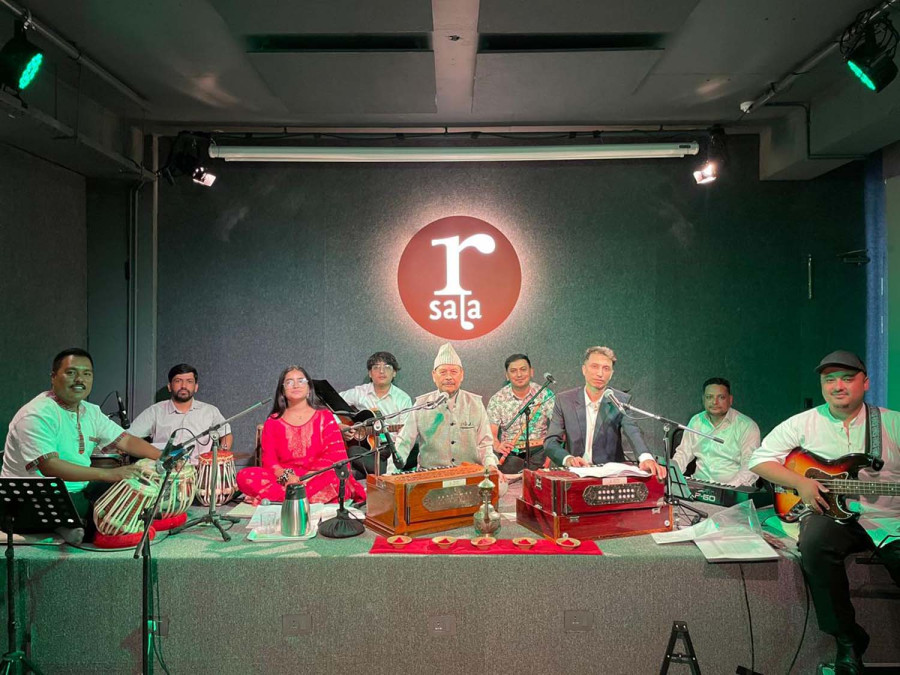
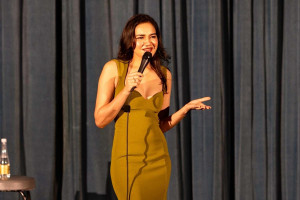
Paleti’s intimate gatherings honour forgotten voices, revive classics and connect generations through songs and poetry. Paleti is known to feature vocal artists along with lyricists and composers on the same stage. Courtesy of Sarad Giri
Seema Luitel, 52, from Kathmandu, has been attending Paleti almost every month since 2008. Previously, when she worked in the development sector, she recalls waiting until the end of the month to attend this micro-session happening at Nepalaya’s R-sala. Paleti was, and still is, more than just a musical event for her.
“Sitting there is deeply meditative,” she says. “It feels like a therapy session.”
Luitel remembers acquiring a membership to the event and getting the CDs for free. This had revived her childhood enthusiasm for modern Nepali music. “Paleti is also a medium for me to remain connected to my childhood through the memories of Aadhunik music,” she adds.
Being within the orbit of these micro-sessions is to be entirely and vigilantly immersed in the art of music and poetry. Artists sit in proximity to the audience, making their presence central to the shared experience in the charming, intimate space of Nepalaya’s R-Sala. Rhythms ripple across the room, emotions overflow, and art is celebrated deeply and meaningfully.
In 2005, composer, music director and currently the coordinator of Paleti, Aavaas initiated the idea of performing music in a space where the artist sits in a comfortable, culturally prominent position known as Paleti (a cross-legged sitting position). Previously known as ‘Paleti Kasera Aavaas Lai Sunau’, the series has significantly broadened its reach over time. Gradually, the title evolved as ‘Paleti’, and so did the number of featured artists. “I did it alone for a year,” says Aavaas. “Now it has become something we carry together.”
Paleti has brought over 50 senior artists from Nepal and Darjeeling, India, on the ‘R’-Sala stage, including Kunti Moktan, Phatteman, Premdhoj Pradhan and Amber Gurung, among others.
“Modern Nepali music was considered something of a low profile at the time,” shares Aavaas. “Through this small event, a space was created where this music could be heard and valued.”
In most musical spaces, the spotlight almost entirely falls upon the singer. Paleti resists this hierarchy. Here, lyricists, composers, and vocalists are all introduced, acknowledged, and placed at the centre of the performance.
Music cannot be formed in singularity. It encompasses layers of creativity, such as lyricism, composition, and vocals. To Aavaas and the Paleti team, making music is an interwoven process. This belief is significantly mirrored in their practice, featuring not just the vocal artist but also the lyricist and the composer on the same stage.
Poet and lyricist Dinesh Adhikari has written over five hundred songs, collaborating with vocal artists such as Narayan Gopal, Gulam Ali, and Amber Gurung. Adhikari has been attending the Paleti sessions since its very beginning. Over the years, he believes he has witnessed Paleti contributing to the preservation, promotion, and evolution of modern Nepali music.
For him, too, music has never been a solitary act. He believes that creativity of all kinds deserves equal recognition, presenting it as an ethical and legal necessity.
“The right for all creators to get credits for thier work is guaranteed by both national and international laws,” he says. “Not mentioning lyricists and composers while streaming any music is a violation of that right.”
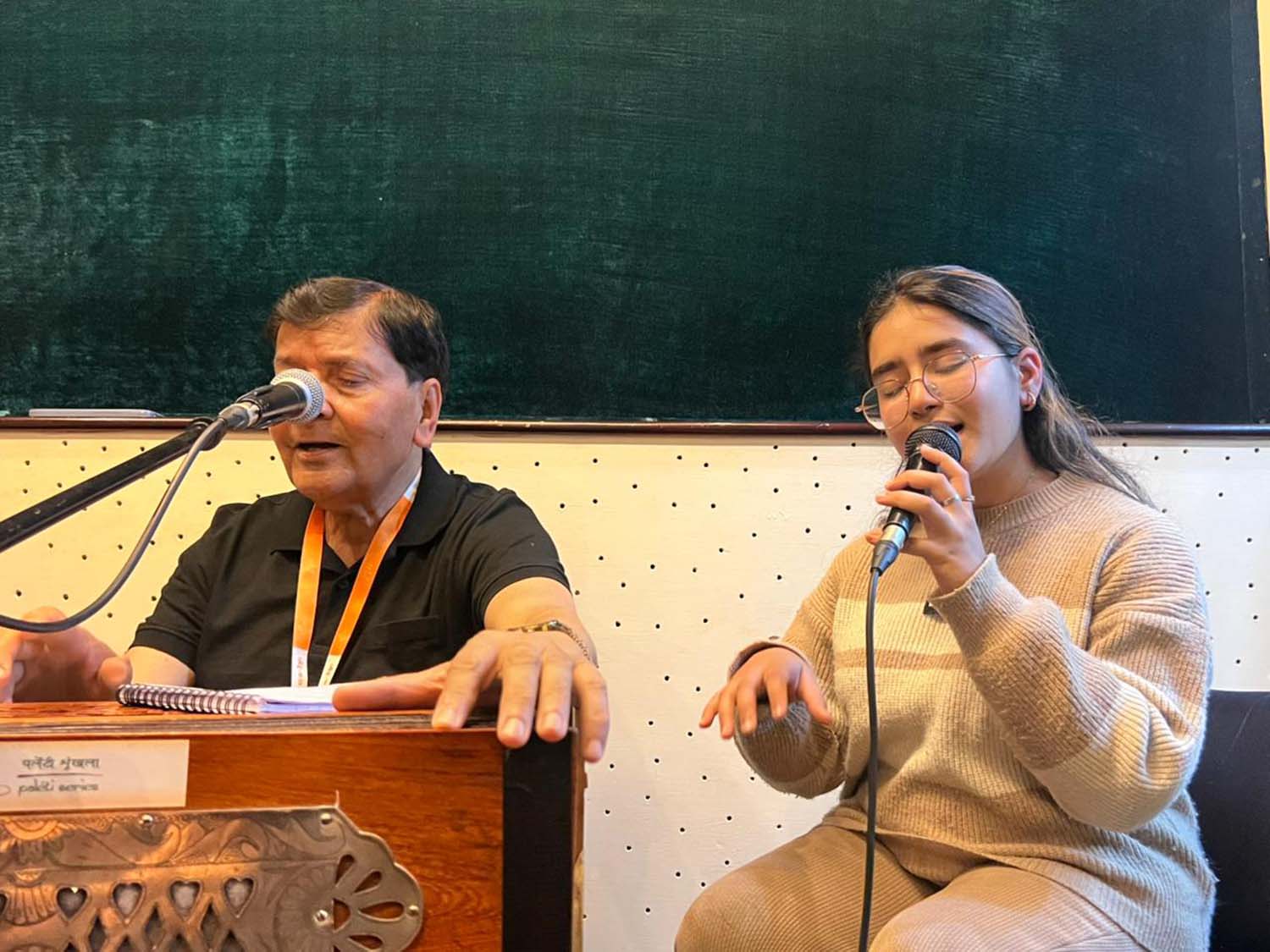
Youth participation in Paleti’s sessions is increasing.
His critique extends to mainstream media, which often overlooks these contributors. Despite repeated advocacy, he notes, proper crediting remains inconsistent. Yet, he is hopeful that it will change.
This philosophy of shared creation becomes most visible on stage. As lyricists, composers and singers came together, poet Bhushita Vasistha entered Paleti as a performer of verse. Her performances, rooted in Chanda (metrical poetry), introduced a new dimension to Paleti. In doing so, she expanded the platform’s possibilities, bringing the audience closer to literary traditions and presenting them with what she calls the ‘treasures of the Nepali language’.
Vasistha, unlike most Paleti performers, did not come from a musical background. Her entry was unexpected, yet it marked a significant change in Paleti’s trajectory.
While performing in a theatre production, she had improvised a recitation of Laxmi Prasad Devkota’s poetry. Later, through the curators of Paleti, she was encouraged to bring poetry to its stage.
Due to her lack of formal training, she initially hesitated. But what convinced her was a simple yet radical idea that art is not defined by technical perfection but by its ability to move people.
“Gradually, I felt responsible to deliver as it was a labour of love,” she says.
Among the younger voices performing at Paleti, 19-year-old singer Abhigya Ghimire describes her participation in a living archive of Nepali music.
Ghimire has collaborated with several veteran artists for their old and unreleased songs in Paleti. For her, older Nepali songs carry a different emotional weight. “Performing the old songs feels like paying a tribute,” she says. “Many of these artists are no longer with us, but through music, we get to remember and honour them.”
Her participation in this micro-event also marks a growing connection between younger generations and Nepal’s musical heritage. It allows them to revisit classic compositions and reinterpret them as a contemporary occurrence.
Beyond performance, Paleti’s long-term significance lies in preserving these moments, presenting visual archives of the music and its artists. There are some musicians whose songs are known but faces unseen, and others who are hidden but deeply talented. “Radio archives were the only medium for us to identify our artists,” says Aavaas. “We brought them to the stage. For many, it was their first live appearance and the only visual archive.”
According to Nepalaya’s Kiran Krishna Shrestha, visual documentation has been central to the project from the very beginning. “In Nepal, archiving has not been done very systematically,” he explains. “So one of our main priorities has always been to document everything we do.”
Over the past two decades, Paleti has worked with dozens of artists, many of whom are no longer with us. For some, these recordings now stand as their only visual archive. Initially, they were released as CDs, with more than two dozen volumes produced. Today, the archive lives primarily online, making it accessible to audiences both within Nepal and abroad. These videos are not driven by virality or scale. Instead, it grows organically, reaching a more selective but deeply engaged audience. “It is not about making something viral,” says Shrestha. “It is about preserving and sharing.”
The meditative setting of Paleti becomes a space where live music and rhythms are received consciously, and with deep appreciation.
“A song is not just entertainment,” says Aavaas. “It is also literature. It is poetry.”




 19.27°C Kathmandu