



 21.42°C Kathmandu
Mon, Oct 12, 2026
Culture & Lifestyle
How Lekbesy is reimagining lapsi
A Nepali startup is turning the traditional hog plum into chocolate truffles and snacks, aiming to take a familiar local taste to international markets.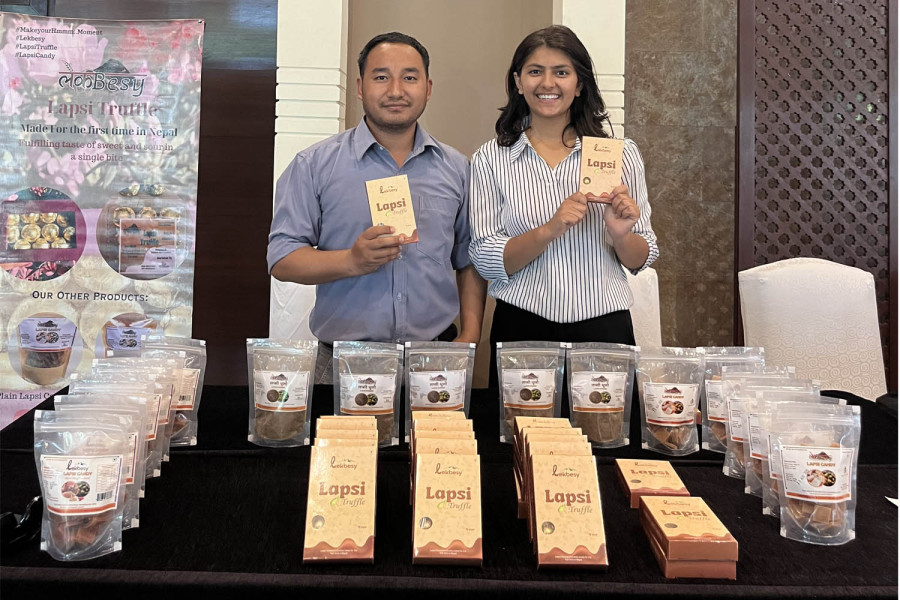
bookmark![]()
Lapsi Truffle ![]()
Lapsi Choco Bites ![]()
![]()
Skanda Swar
Published at : May 1, 2026
Updated at : May 1, 2026 07:30
Kathmandu
There is a fruit that almost every Nepali child has grown up with, tart, chewy, and unmistakably familiar. Lapsi, the Nepali hog plum, has long been a staple of snacking culture across the country—its sharp sourness transformed into candies, pickles, and chatpate street bites.
But for all its cultural significance, lapsi had never truly crossed borders. It had never sat on a shelf in a boutique chocolate shop in Europe or been gifted in a premium box to someone in North America who had never heard of Nepal’s hills and forests. That is, until Lekbesy came along.
Founded by Dikshya Paudel and her partner, Vivek Rana, Lekbesy is the brand name of the parent company, Namuna Agro Products, a food-processing startup that aims to turn native fruits and vegetables from Nepal into internationally recognised products while preserving their identity.
The name itself is a statement of intent.
In Nepali, Lek besi loosely translates as ‘spanning from the mountains to the Terai, from Nepal’s highest altitudes to its southern plains.’
“We wanted a word that could describe all of Nepal,” Paudel explains.
.jpeg)
Before there was Lekbesy, there was a problem Paudel could not ignore. As an education fellow with Teach For Nepal in Sindhupalchowk, she saw how difficult life was for many women in the district—struggling with gender-based violence, economic vulnerability and a steady drift of young people migrating overseas for work.
An idea began to form: provide opportunities for women to work in their own villages, using the resources in their backyards. “I thought that maybe we could create something where we can provide employment to women in the village,” she says.
Together with Vivek Rana, she co-founded Kosis Enterprises, a social enterprise that promotes gender equality and economic independence through grassroots entrepreneurship. The enterprise ran skills training programmes for women and youth and partnered with international organisations, including the Global Peace Foundation Nepal, to run lapsi candy-making programmes as small-business incubators, with participants receiving technical, financial, and food safety training, and some receiving micro-grant loans to start their own ventures.
But the results were mixed. Production was hard. Beneficiaries struggled to sustain businesses independently. “The beneficiaries could not create a sustainable business on their own,” Paudel says. “Production was hard and challenging. So then we decided we had to make a model business ourselves.” That business became Lekbesy.
With Kosis Enterprises as the foundation, Paudel and Rana turned their attention to the product. They wanted something that could represent Nepal and could be maintained by women and youth.
They chose lapsi.
One day, they were sitting together, throwing around ideas about which direction to take, when the question came up: what if they combined lapsi with chocolate to make a truffle? “It came as a stupid idea,” Paudel recalls, laughing. “What if people don’t like it? Chocolate is sweet, and lapsi is sour. We weren’t sure.”
But they tried it anyway. They made samples, gathered feedback, adjusted the recipe, and handed them out again. “Eventually, we landed on a product that everyone liked,” she says. The result was the Lapsi Truffle, a hand-crafted confection that wraps the tangy, dried pulp of lapsi inside a smooth chocolate shell.
The reasoning behind the combination was clear to Paudel from the start. “Lapsi has always been a huge snack in Nepal, but it hadn’t been branded internationally,” she says. “Our traditional products are more linked to Nepali taste buds. To make lapsi global, we had to pair it with something everyone worldwide loves. That’s when we found chocolate.” Hand-rolled and coated in imported chocolate, each truffle contains a centre of processed lapsi pulp combined with sugar and dried into a chewy, flavourful core.
.jpeg)
The truffle has a companion in Lapsi Choco Bites, a newer, more snackable variation of the same concept. Bite-sized and designed for impulse snacking and easy portability, the Choco Bites represent Lekbesy’s evolution from a single signature product into a small but considered product range.
Then there is the lapsi candy, the brand’s more traditional offering, available in plain and spicy hing. This is the product that speaks most directly to Nepali taste buds and the diaspora abroad, tangy, fruity, and familiar in the way only a childhood snack can be.
Every one of these products begins not at the production table but at the farm. Lapsi sourcing, Paudel is quick to point out, is the single most important step in the entire process. “If the lapsi is good quality, then the product is good,” she says.
Lekbesy sources directly from farmers in Kavre, Paudel’s home district, and Sindhupalchowk. It has also established community centres for lapsi processing and runs plantation programmes to support and expand its cultivation.
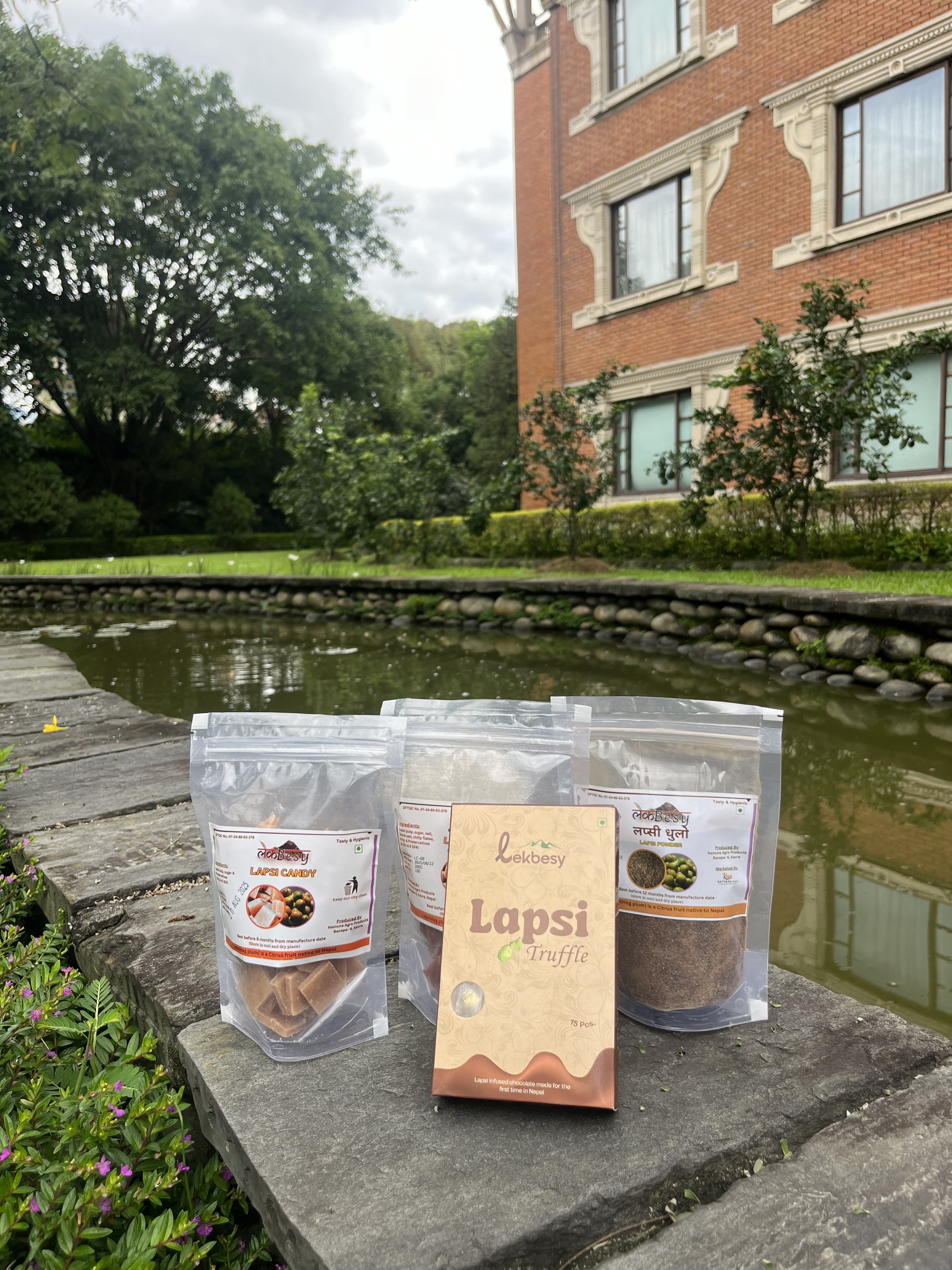
The brand’s commercial growth is tied deliberately to the livelihoods of the farming communities that supply it. The chocolate is imported, as cacao is not grown commercially in Nepal, but everything else, the lapsi, the sugar and everything else, comes from within the country. Every batch of finished product is personally monitored by the founders. “We work on a small scale, so every day we test on our own.”
Running the operation, however, is far from simple. Paudel identifies three persistent challenges: technology, human resources, and working capital. On technology, the problem is fundamental; no machinery has been designed specifically for lapsi processing. “Lapsi-specific technology hasn’t been developed,” she explains. “Whatever machines we use for processing are actually made for other purposes—we are making use of them somehow. So it’s hard, and most of our work is labour-intensive.” The human resource challenge compounds this. Training workers to produce truffles to a consistent standard takes time, and retaining skilled workers is harder still in a labour market where many young Nepalis leave for work abroad.
Working capital rounds out the difficulty, with suppliers sometimes putting payments on hold. Managing cash flow while meeting production demand is a tightrope walk that is particularly acute for a small, ingredient-dependent operation. “Even for the Nepali market, production isn’t enough,” Dikshya admits. “Since everything is handmade, we are slowly expanding.”
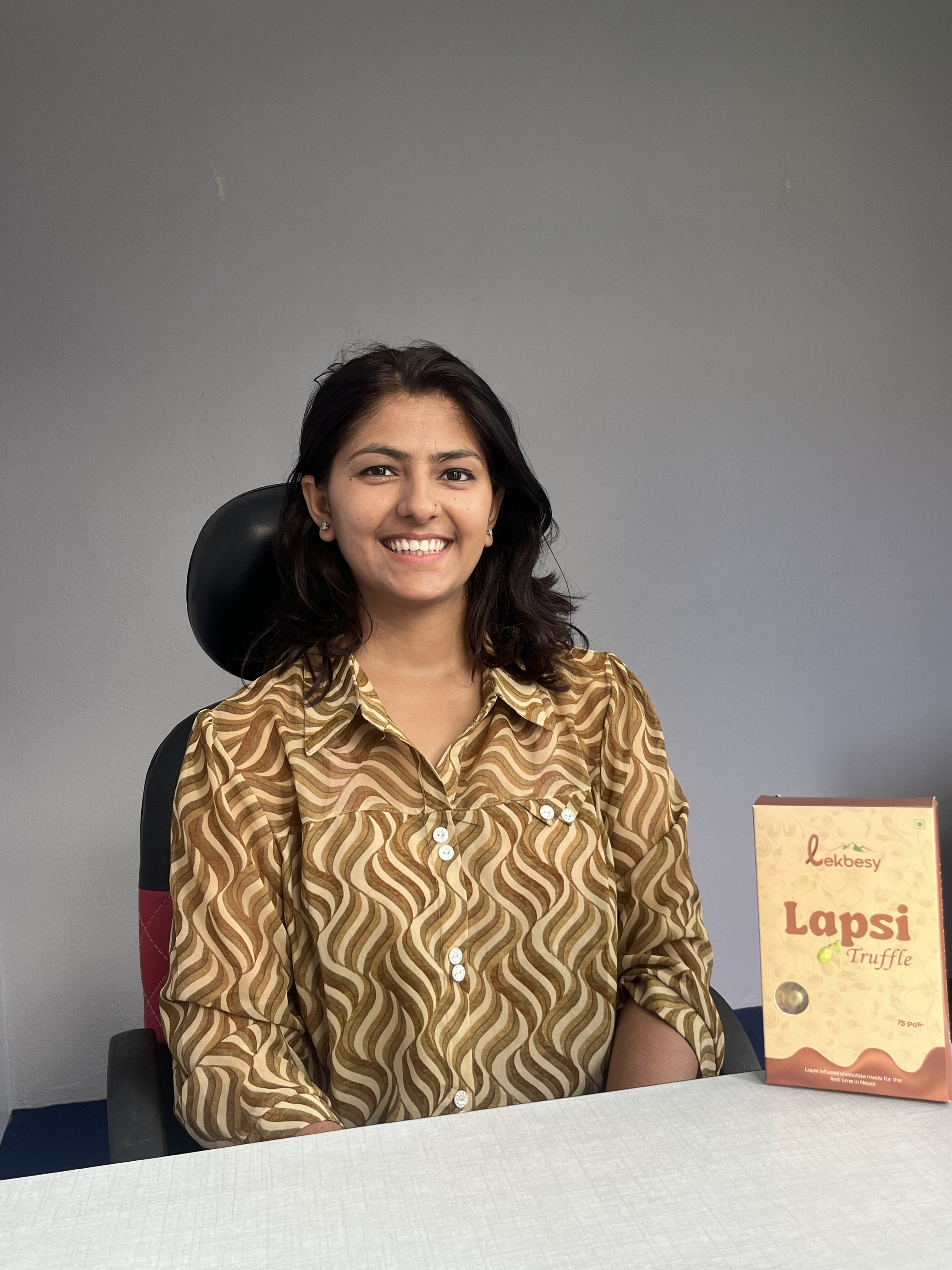
The market response has given her plenty of optimism. Dikshya says almost all of the international taste-testers have responded positively to the truffles, with many asking directly when they can order from their own countries. “Every time we sample it to people from other countries, they want us to export it to their country—which is a really good sign,” she says.
“The trial period is over. Now we are at a stage of growth.” TikTok videos from the brand’s account show the product reaching taste testers as far away as the United States. Without a single paid marketing campaign to date, Lekbesy has grown entirely through word of mouth and a deliberate strategy of capturing and sharing authentic reactions—from ordinary customers to well-known public figures who have voluntarily tried and endorsed the product.
“Whoever we make try our products, we record their reaction,” Paudel says. “From normal people to influencers, we get reviews from everyone.”
The near future is focused rather than scattered. Rather than rushing into new product categories, Paudel and Rana have decided to spend the next few years deepening their commitment to lapsi—improving quality, scaling production responsibly, and pushing harder into international distribution. One particularly ambitious goal is developing chocolate production within Nepal itself. “We have been looking into the production of chocolate so that we don’t need to import anymore,” Paudel says.
New lapsi combinations are also in development, responding to feedback from Nepali customers who want a product that leans more into the fruit’s signature sour punch rather than the sweeter, chocolate-forward balance of the current truffles. “For a few years, our major focus will be on making these products with more quality, and going on a global stage more,” she says. “Rather than working on newer products, we want to focus on promoting lapsi. The focus will be there.”





Most Read from Culture & Lifestyle

It’s a bird … it’s a plane … it’s the Indian ambassador’s farewell tweets

‘Tenzing’ puts the Sherpa at the centre of the Everest story
How should Nepal navigate a world in reorder? Rajib Upadhya on geopolitics and foreign policy

How Anup Poudel took Nepali cinema to Cannes

A Nepali photographer rediscovers Calcutta after decades
Editor's Picks

Constitutional Bench caught in seniority, ‘pick and choose’ dispute

A Dom boy’s long road to becoming a doctor

From blankets to handmade dolls, two foreign women bring comfort to flood survivors

News Analysis: When institutional defence exposes institutional fault lines
It’s a bird … it’s a plane … it’s the Indian ambassador’s farewell tweets
E-PAPER | October 12, 2026

×