The Rastriya Swatantra Party (RSP), which emerged as Nepal’s largest political force by securing nearly two-thirds of the parliamentary seats it contested in the March 5 elections, has for the first time formally articulated its political philosophy and ideological direction.
Through its first general convention, scheduled to be held in Chitwan from June 21 to 23, the party is set to officially endorse a fully democratic republican system and commit itself to the rule of law. The move marks the first explicit declaration of the party’s stance on Nepal’s system of governance, an issue that had not previously been addressed in its statute.
According to a statute amendment report prepared by a committee led by joint general secretary and lawmaker Bipin Acharya, the RSP has now clearly defined its political philosophy and ideological outlook. The committee, which also includes party leaders Ganesh Parajuli, Chanda Karki, Prakash Chandra Pariyar and Sushant Vaidik, has proposed a new section titled “Ideological Foundation and Guiding Principles” in Part 3 of the proposed statute.
Clause 6 of the statute proposes the party’s political philosophy and ideological vision. It states that the party stands for “a fully democratic republican system of governance based on pluralism, with full guarantees of individual freedom and fundamental rights, and accountable good governance founded on the rule of law”.
The party has also committed itself to pursuing constitutional socialism. The proposed amendment states: “A liberal economy and a competitive social market system with social justice, while remaining committed to equitable development.” It further adds that the party seeks to achieve “the principal goals of socialism through peaceful means and govern the state based on national policies and programmes under constitutional socialism”.
Acharya said they have tried to clarify the party’s ideological and theoretical direction.
“The party’s political and ideological vision is advanced democracy and good governance. We are working on the foundational pillars for running the party, how to move forward, and what matters are important for the party,” Acharya said. “We are also working on the party’s objectives and programmes. We will clearly define in the statute the ideological basis of the party and what guides it.”
On religious and cultural issues, the party has proposed promoting “Sanatan civilisation and cultural coexistence”, defined as coexistence and mutual respect based on Nepal’s history, Sanatan (eternal) civilisation, and religious and cultural diversity.
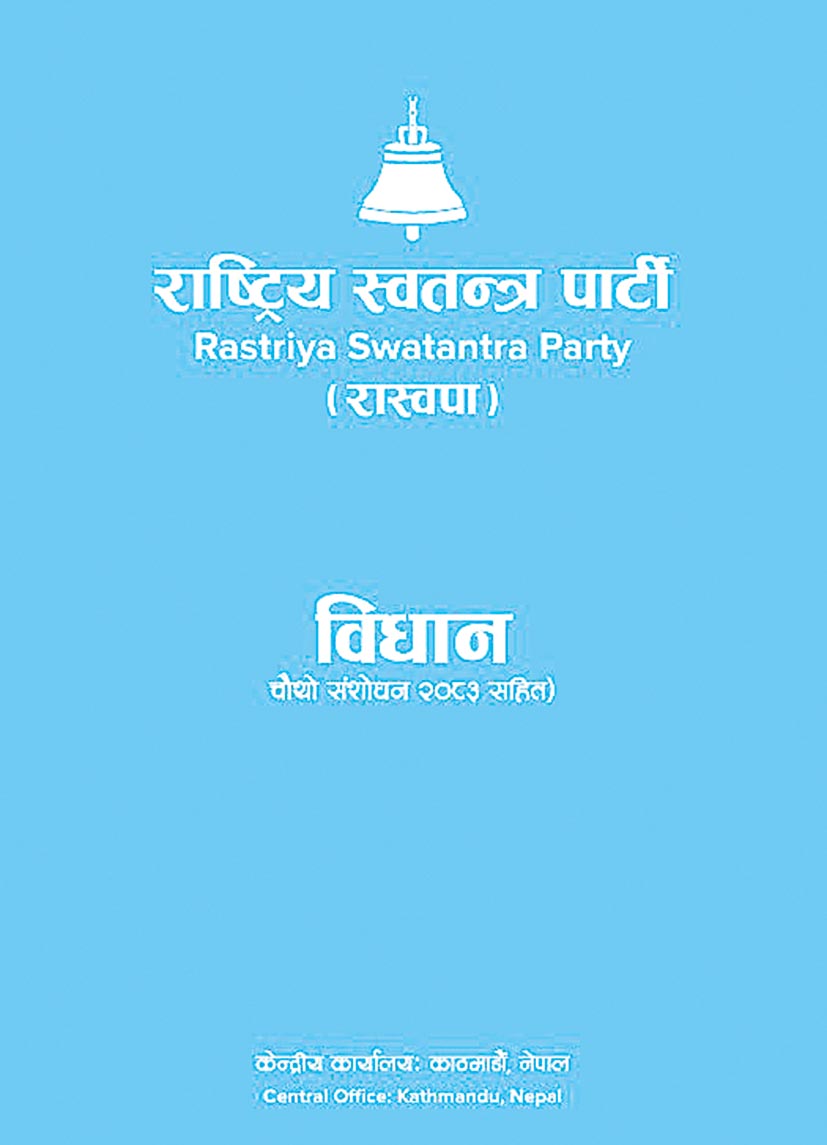
This will be the fourth amendment to the RSP statute. Earlier versions referred to a democratic state but did not mention the word “republic”.
Even after incorporating the third amendment made in 2024 to the party’s 2022 statute, the party’s principles and ideals were defined as: “Rule of law, a liberal economy with social justice, equality and inclusive representation, a fully democratic state system based on pluralism, good governance, transparency and a welfare state.”
The party has consistently maintained direct participatory democracy, proportional and inclusive democracy, individual freedom and human rights as its core principles.
Parajuli said that, according to the proposal passed by the Central Committee and the parliamentary party plenum held in Jaleshwar, Mahottari, in November 2023, the party statute now provides for a fully democratic republic based on pluralism.
“Matters endorsed by the historic Jaleshwar meeting have been incorporated into the statute this time. We had already written the party’s ideology at that time and had clearly stated that the party embraces constitutional socialism,” Parajuli said.
Professor and political analyst Krishna Pokharel said that by explicitly accepting the constitution in its statute, the RSP has responded to the political and ideological questions raised about it.
“The RSP has said that its policy is what is written in the constitution itself. It has endorsed the constitutional provision of a federal democratic republican system based on pluralism,” Pokharel said.
“This may also have been included in the statute to show full commitment to implementing the constitution. This has dispelled doubts that the RSP does not accept the constitution or wants to bring back the monarchy.”
Member of the statute amendment committee and chief whip Pariyar said the party has adopted constitutionalism, leaving no room for ambiguity.
“The party has embraced constitutionalism and included in the statute that it will move forward on a centrist path. Along with this, we have already accepted federalism. The party will move forward on restructuring, strengthening, and making federalism more economical and result-oriented,” Pariyar said.
Professor Pokharel said that the RSP cannot step back from the federal system. He noted that while the party had shown some scepticism towards provincial structures when it first entered the 2022 elections, it has now become clearer in its stance on federalism from the 2025 elections.
“When the RSP was formed, it was not very positive about federalism. It did not even field candidates in the provinces at that time,” Pokharel said. “But after realising that opposing federalism would lead to a boycott from Madhesi, Indigenous, and Janajati communities, it has now developed a more positive stance.”
The RSP has also stated in the document that it will adopt a non-aligned, independent, and balanced foreign policy.
“Considering Asia’s emerging geopolitical importance, with Nepal’s sovereignty, territorial integrity, and national interest as paramount,” the statute states, “it will expand diplomatic relations with neighbouring friendly countries and the international community based on sovereign equality and the principles of Panchsheel.”
As part of its internal reforms, the RSP has proposed a complete prohibition on dynastic politics and nepotism within the organisation.
The proposed statute states that no more than one member from the same family shall be appointed or elected to any party body at the same level. It also bars family members of office-bearers from being recommended for party or state positions.
The statute clearly defines “family” to include close relations such as spouse, parents, children, siblings, grandparents, in-laws, and their spouses.
The RSP has also proposed institutionalising digital and participatory democracy within the party, including the use of digital voting or surveys for key policy decisions and the protection of members’ personal data.
The statute amendment committee has proposed expanding the central committee from 129 to 136 members.
According to the proposal, the structure will include one chairperson, 99 elected members, 29 nominated members, and seven ex-officio provincial chairpersons.
Rabi Lamichhane is almost certain to secure another term as party chair.
Prime Minister Balendra Shah is recognised as the party’s senior leader, although the proposed statute does not formally include this position. The party’s official website, however, lists him as a senior leader and places him second in hierarchy.
Parajuli said the secretariat will decide whether to include the “senior leader” provision in the statute or address it differently.
“The secretariat meeting will decide whether to include the provision of a senior leader in the statute or how to address it,” Parajuli said.
The amendment also proposes 16 office-bearers, including chairperson, vice-chairpersons, general secretaries, joint general secretaries, spokesperson, deputy spokespersons, treasurer and deputy treasurer.
Under the proposal, most office-bearers will be elected through the general convention, while some will be appointed by the chairperson, with quotas for women and marginalised groups.




 22.15°C Kathmandu