After back and forth, President is set to sign Constitutional Council Ordinance
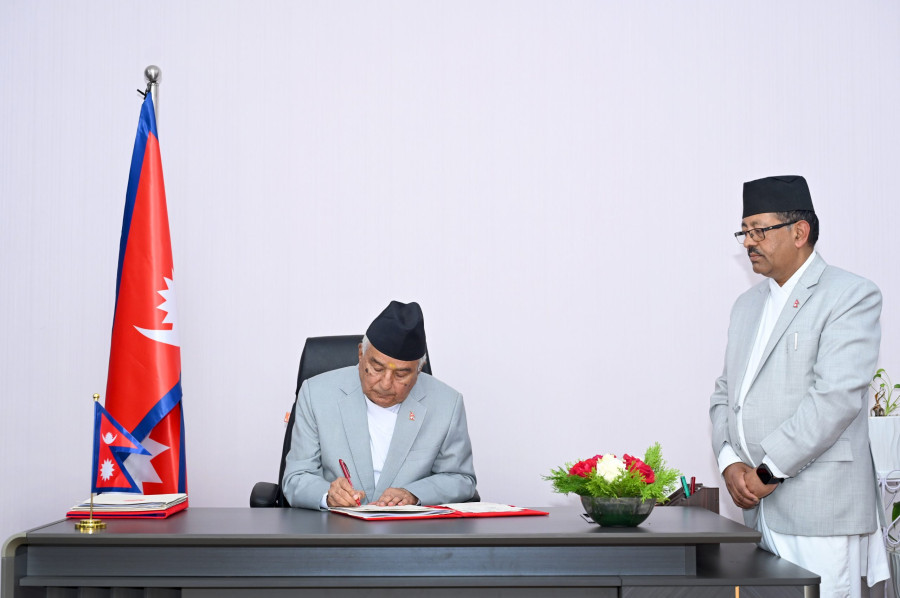
The President earlier insisted on a four-member majority in Constitutional Council, but government refused to revise the ordinance and sent it back unchanged. File photo: Office of President
After sitting on it for a week, President Ramchandra Paudel returned the ordinance on the Constitutional Council (Functions, Duties, Powers and Procedures) to the government for review on Sunday. The Balendra Shah administration refused to reconsider it and sent it back to Paudel for authentication.
A Cabinet meeting held on Monday decided to resend the ordinance in its existing form. Now, the Shital Niwas is unwilling to hold it further and act as recommended, said an official, speaking on condition of anonymity, as he is not allowed to speak to the media.
Paudel’s aides say that, as the provisions he had reservations about in the bill to amend the Constitutional Council Act have been carried over into this ordinance as well, he had expressed similar concerns as in the past.
“The President has always wished that the constitutional spirit is reflected in any bill or ordinance. He has maintained the same position both in the past and in this ordinance as well,” said Baburam Kunwar, the President’s legal advisor and a senior advocate.
The six-member council, chaired by the prime minister, comprises the Speaker, the chief justice, the chairperson of the National Assembly, the deputy Speaker, and the leader of the opposition. Under this structure, the President has a clear position as to how the ‘majority’ should be determined. He has been maintaining that at least four (the majority mark) out of the six members should be required for decision-making. While returning the ordinance for reconsideration on Sunday, the President recalled the position he had taken earlier.
In the past, Paudel had returned a bill to revise the Act, endorsed by both Houses of the federal parliament, with the same reservations.
At that time, the proposed provisions were even more controversial. The bill allowed only the chairperson and one member of the council to take the decision when only three members were present in the meeting.
The bill had envisioned four situations in which meetings and decisions could be held. It stated that when the chairperson and five members are in office, decisions could be taken by at least four, including the chairperson and at least three members. When the chairperson and four members are in office, at least three, including the chairperson and at least two members, could make the decision, and when the chairperson and three members are in office, at least three, including the chairperson and two members. When the chairperson and two members are in office, at least two, including the chairperson and one member, were proposed to make a decision.
Stating that such provisions would weaken the very essence of the majority, the President had returned the bill with a five-point message. Later, the government led by Sushila Karki was also prevented from issuing an ordinance with the same provisions.
This time, the ordinance recommended by the government led by Balendra Shah includes more progressive provisions than the previous bill. However, the concern that decisions should be based on the majority of all members has still not been addressed.
“Returning it once for reconsideration was meant to avoid any perception of double standards by an institution like the President. Having returned a bill with similar provisions in the past, it would not have sent the right message if the ordinance had been issued immediately after the recommendation,” said another official at the President’s Office.
“Once the government resends it, whether or not it addresses the concerns, it should be issued in line with the spirit of the Constitution, and the President is in that mindset.”
The ordinance proposed by the government states that a meeting can be held if at least four members are present, and decisions can be taken by a majority of those present. This means that if four members are present, even three can make a decision, which does not amount to a majority of the total members.
Under the existing law, a meeting can be held if the chairperson and at least four members are present, meaning a quorum of five. It also mandates that the first meeting must make decisions unanimously. Only if consensus is not reached can decisions be taken by majority in a second meeting, and such majority must be “of the total number of members (six).”
Senior advocate Chandra Kanta Gyawali says that even if the government resends the ordinance in the same form for the second time, the constitution does not allow the President to block it.
The constitution does not clearly provide what should be done if the government resends an ordinance exactly as returned by the President. Article 114 of the Constitution provides that the President may issue an ordinance on the recommendation of the Council of Ministers when the federal parliament is not in session. Such an ordinance must be presented in both Houses once Parliament convenes, and if not approved by both Houses, it becomes inactive. It can also be repealed by the President at any time, and if neither repealed nor inactive, it automatically lapses after 60 days of the commencement of both Houses.
However, Article 113(3) provides that, except for finance bills, the President may return a bill once with a message if reconsideration is deemed necessary. There is no obligation for Parliament to amend the returned bill. If Parliament resends it with or without addressing the concerns, Article 113(4) requires the President to authenticate it within 15 days.
Senior advocate Gyawali says the same spirit applies to ordinances as well. “The President can examine whether it is in line with the constitution and law and return it once with a message for reconsideration,” he said. “The executive may choose not to reconsider it. But once it is recommended again, the President is bound to approve it. A constitutional President does not have the authority to hold or return it again; the entire credit, blame and accountability of the ordinance lies with the government.”
Meanwhile, sources close to the prime minister argue that the amendment by ordinance was necessary to ensure that appointments to constitutional bodies are not obstructed even amid opposition from opposition parties. In the Constitutional Council, three members are inclined towards the opposition: the leader of the main opposition Nepali Congress parliamentary party, Bhishma Raj Angdembe; the National Assembly Chairperson, Narayan Dahal, elected from the Nepali Communist Party; and the Deputy Speaker, Ruby Kumari Thakur, elected from the Shram Sanskriti Party.
“A provision allowing three members to take decisions had to be made to ensure that recommendations by the council are not stalled under any circumstances,” said a minister in Shah’s cabinet.




 21.12°C Kathmandu