Former President Bhandari eyes active political role as dissidents seek to reorganise UML
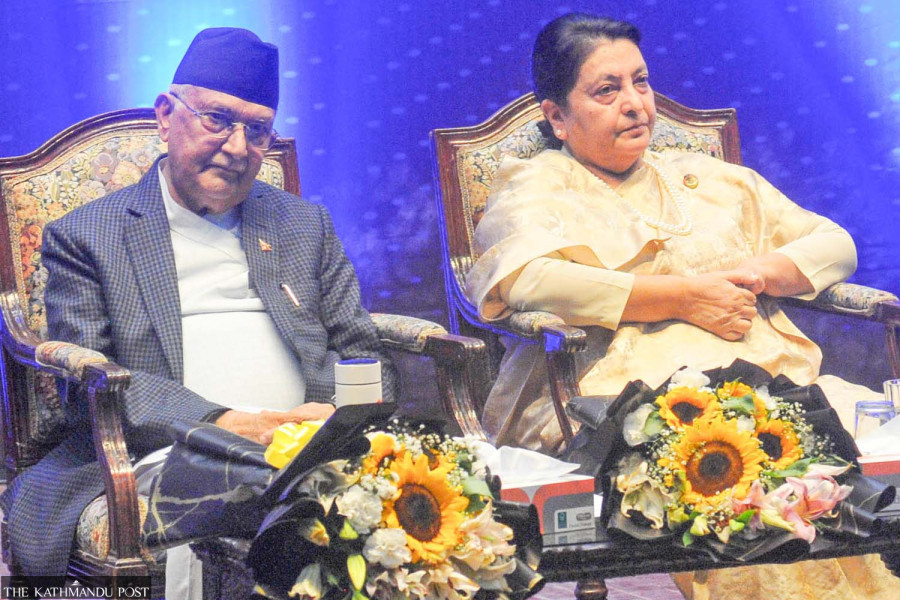
Last year, Bhandari could not muster enough strength to beat Oli, who was sitting prime minister. Oli’s wings have been clipped now.Oli and Bhandari at an event commemorating the late Madan Bhandari in June 2025. Post file photo
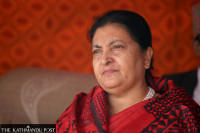
Even days before the September 8–9 Gen Z revolt that toppled his government, prime minister and CPN-UML chairman KP Sharma Oli was reportedly trying to block the return of former President Bidya Devi Bhandari to the party.
Seven months down the line, Bhandari, a former UML vice-chairperson, has renewed her bid to return to the party leadership. By now, Oli has been significantly weakened. Oli not only lost the recent parliamentary election and his party shrunk to a distant third force in the House of Representatives, but the four-time prime minister has just been released from judicial custody after interrogation for his role in suppressing the youth rebellion.
As many in the UML rank and file demand a special convention to revive the party, Bhandari has restarted political engagements.
She is in continuous meetings with various UML leaders, said Krishna Bahadur Rai, a leader considered close to Bhandari, “but I’m not able to categorically reveal those names.”
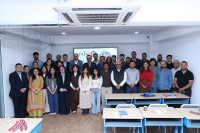
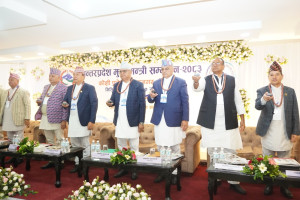
On Friday, Bhandari invited a group of editors from various media outlets for an interaction at the Madan Bhandari Foundation's office in New Baneshwar, Kathmandu. The event comes amid growing voices within the UML for a special convention. Even as the leaders close to Bhandari, a UML vice-chair until she assumed the role of President in 2015, say her meetings and interactions should not be interpreted as a renewed political engagement, they are indicative of her intent not to remain silent in the face of growing trouble for the UML.
Her close aides say that, as a member of the party in which she has invested her “sweat and blood”, it is unnatural to expect her to remain silent amid such political turmoil.
“I believe she won’t hesitate if there are circumstances to lead the party, but this is my personal opinion. I have had no discussion with her in this direction,” Rai said.
But Raj Kumar Rai, the personal secretary of former president Bhandari, said that her interactions are about the latest political developments following the March 5 election and have nothing to do with the internal politics of the UML.
When Bhandari tried to return to active politics earlier, the UML’s central bodies did not accept it.
At the party’s second national statute convention (September 5–7), leaders supporting Oli focused on amending the party statute to block Bhandari’s return. They removed the two-term limit and the 70-year age cap, clearing the path for Oli’s third term as party chair. In doing so, the party, which was also leading the government, failed to anticipate the Gen Z movement and its possible consequences. Bhandari also lost momentum after the Gen Z movement in September.
After finding herself unable to engage directly in active politics, Bhandari sought to exert influence through the party’s 11th general convention, held last November. She reportedly backed the candidacy of then-UML senior vice-chairman Ishwar Pokharel against Oli for the party chair.
Pokharel formed a panel against Oli but the convention representatives did not support him. Out of the party’s 19-member Secretariat, only two figures aligned with his panel secured victories: Gokarna Bista was elected a vice-chair, and Yogesh Bhattarai a deputy general secretary. Pokharel himself lost to Oli by a significant margin.
During the election held on March 5, the UML secured victories in only seven of the 165 first-past-the-post seats. With an additional 18 seats out of the 110 in proportional representation category, the party’s total stands at 25.
In light of the party’s diminished public support, some within the party have demanded a special general convention for organisational restructuring. Bhandari’s political engagement has renewed interest among observers.
Analysts say that Nepal’s communist movement has reached one of the weakest points in its history. At a time when voices are growing louder for a fundamental restructuring of the communist movement, they argue that the re-entry of former president Bhandari into active politics alone is unlikely to create the environment needed for such renewal.
“If the UML is to restructure its politics, it must move beyond the second generation of leadership towards a third generation,” said Keshav Dahal, a political analyst. “Bhandari is not the right figure to lead the party.”
Deputy General Secretary Bhattarai confirmed that the proposal for a special general convention has been put forward by some of the party’s younger members. There is still much work to be done within the party before such a step is considered, he said. The party statute provides for a special general convention only if 50 percent of the general convention delegates sign a petition for it.
“However, there has been no discussion about bringing the former president into the party leadership, whether through a special general convention or the party’s restructuring,” Bhattarai said. He sees slim chances of a special convention.
The UML Central Committee had previously concluded that a former head of state returning to active party politics would not set a positive precedent in national politics.
Bhandari has long been interested in becoming actively involved in party politics again, but this was possible due to resistance by party chair Oli, says Krishna Pokharel, a professor of political science. Oli did not allow her to take an active role as he appeared to fear that her presence in the party could pose a challenge to him.
“Now Oli’s position within the party has become comparatively weaker, Bhandari might once again attempt to re-enter politics,” Pokharel said.
Bhandari’s renewed political engagement could further weaken the communist movement rather than strengthen it, at a time when it is already struggling to redefine itself, according to analyst Dahal.
Politics in the coming years, he argues, will need to move away from personality-driven leadership and instead operate on a more collective and institutional basis. The outcome of the March 5 election, shaped in large part by the momentum of the September Gen-Z movement, exposed the difficulties faced by traditional political parties.
For analysts, the election results were a direct reflection of the failure of the personality-centric political culture that older parties long tried to maintain. The election has effectively ushered Nepal into a new political environment, one in which a younger generation has already begun to establish itself in positions of leadership.
In such circumstances, there is limited confidence that a party or a political movement can regain momentum simply by returning to leadership figures whose political trajectories have already been thoroughly tested.
Gajendra Thapaliya, chair of the intellectual council of the UML, who is one of the leading figures in the signature campaign for the special convention, also claimed that the campaign is not oriented towards any leaders, nor is it intended to establish anyone in the party's leadership.
“Our campaign is for the overall restructuring of the party to match the current needs of the time,” Thapaliya said.




 22.68°C Kathmandu