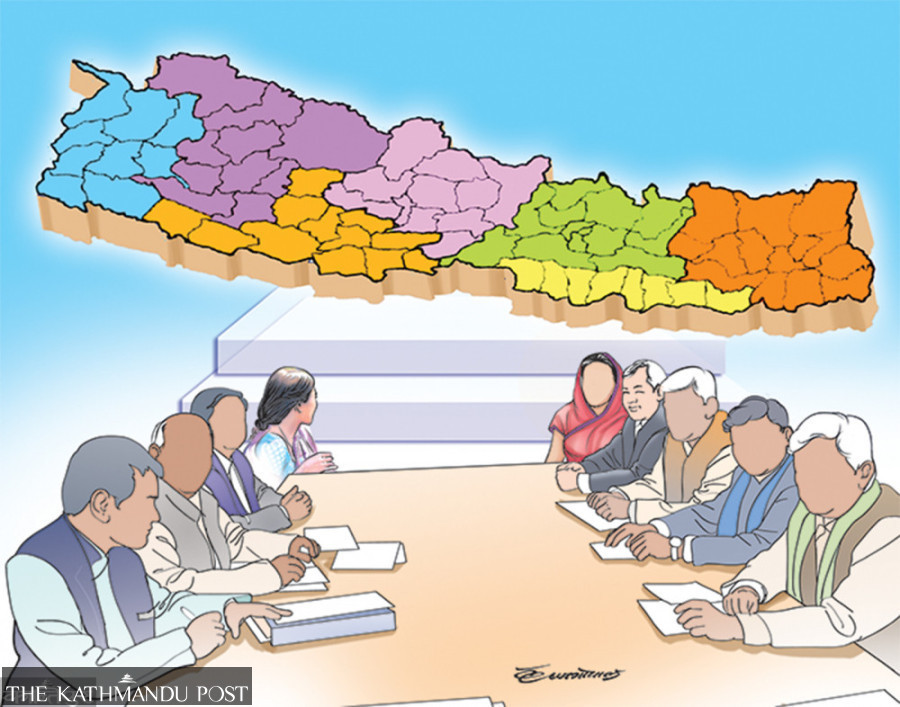
In one of the first verdicts issued to resolve the long-pending row over jurisdictions between different tiers of government, the Supreme Court has ruled that the federal government must uphold the principle that Nepal’s federalism is based on cooperation, coexistence, and coordination before enacting any federal laws.
Passing a verdict in a writ petition by the Madhesh Province against the federal parliament, the top court reminded Kathmandu that its interference in the executive authority of the provinces would be unconstitutional.
A Cabinet meeting of Madhesh on March 8, 2019, had decided to bring the Sagargath Forest Development Project, covering 13,132 hectares of land in Sarlahi, Mahottari, and Rautahat districts, under the provincial government. The provincial executive claimed that it had informed the federal government about its decision.
However, then KP Sharma Oli government, on June 6 of the same year, decided to merge the Sagarnath Forest Project with the Timber Corporation Nepal. The decision was taken after the enactment of the Forest Act 2019. Claiming that several provisions in the Act contradicted the constitutional spirit and that the federal government had interfered in provincial jurisdiction, the provincial ministry of industry, tourism, forests and environment, on August 1, 2019, filed a case against the federal government at the Supreme Court.
The provincial government said the federal government had no authority to decide on the forest project which came under its jurisdiction. This was the first writ petition any provincial government had lodged against the federal government. The top court still has eight other petitions related to a jurisdiction dispute between the federal and provincial governments to decide.
The Constitutional Bench of the court, on August 30, 2019, issued an interlocutory order against the federal government, asking it not to implement the decision. Again, on December 11 that year, it issued an interim order, continuing the earlier order. However, it took around seven years to reach the verdict, which found that the federal government had interfered with the provincial government’s jurisdiction.
With this verdict, the authority to handle forest-related matters will now rest with the Divisional Forest Officer deployed under the executive structure of the provincial government, instead of a Divisional Forest Officer assigned by the federal government.
In its ruling, the Supreme Court provided a detailed interpretation that the distribution of forest-related powers among the federal, provincial, and local levels is not “competitive” but based on a framework of “cooperative federalism.”
It stated that the Constitution of Nepal envisions a constitutional structure in which the federal government plays a policy-making role in forest matters, the province assumes a managerial role, and local governments and communities are entrusted with conservation and participatory roles.
Annulling several provisions in the 2019 Act, Chief Justice Prakash Man Singh Raut-led five-member Constitutional Bench has directed the federal parliament to formulate the National Forest Policy in accordance with the spirit of the constitutional provisions set out in Article 232, based on the principles of cooperation, participation, and coordination.
“After the policy is issued, amend the Forest Act in line with the essence of the federal structure, the executive powers of the provinces, and inter-tier relations,” reads the full text of the verdict released on Thursday.
The court further observed that the provision listed in Schedule 6 of the constitution should be understood as an “exclusive but not absolute provision.” This means that while the province has primary authority over the subject, that authority must be exercised in coordination with the overall constitutional framework, the federal policy-making domain, and the arrangements governing concurrent powers.
“If, in the name of implementing federal law, the day-to-day administration, management, and decision-making over national forests within a province are placed entirely under federal control, the provisions of Schedule 6 (which lists out the absolute authority of provinces) risk becoming a mere formality and rendered ineffective in practice,” reads the verdict.
The verdict states that the Constitution neither places forest-related matters entirely under federal control nor grants the province an absolute monopoly. Rather, it clearly intends to situate them within a multi-level, coordinated, and functional federal structure, where policy, standards, management, and conservation roles at different levels are distinct yet complementary.
Binod Ghimire covers parliamentary affairs and human rights for The Kathmandu Post. Since joining the Post in 2010, he has reported primarily on social issues, focusing on education and transitional justice.




 20.85°C Kathmandu