Free internet, dollar cards, paid internships: UML offers goodies to youths
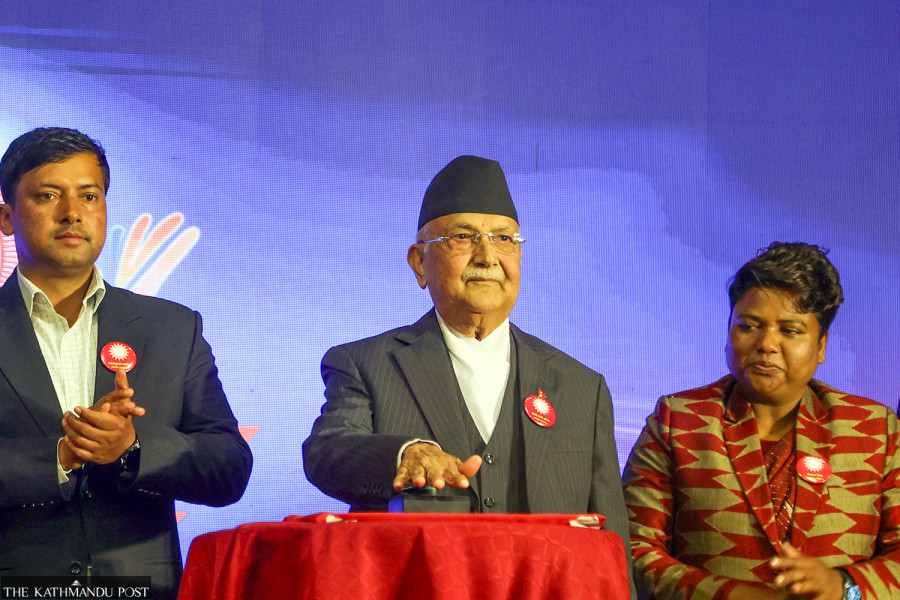
The party, guided by communist ideology, envisions a welfare state in its manifesto.The document makes a clear effort to appeal to young voters, with promises focused on jobs, innovation, and opportunity. Suryams Upreti/TKP
The CPN-UML has named its election manifesto ‘pratibaddhata patra’, meaning commitment paper, emphasising what it calls are firm promises backed by responsibility.
In the early days following the Gen Z uprising, the UML openly questioned the legitimacy of the government led by former chief justice Sushila Karki, arguing that it was unconstitutional, and casting doubt over any election it might conduct. The party also appeared largely unsympathetic to the young protesters, often taking a hard line against their demands.
Yet in its newly unveiled manifesto, the tone has noticeably shifted. The document makes a clear effort to appeal to young voters, with promises focused on jobs, innovation, and opportunity. The contrast is striking—from scepticism towards the movement to actively courting the generation that drove the party out of government.
Targeting voters aged between 18 and 28, the UML has rolled out an array of youth-focused pledges. These include providing 10 GB of free mobile data each month for a year, issuing dollar cards worth up to $10,000 to young people and entrepreneurs, offering interest-free student loans of up to Rs2 million, and introducing paid internship schemes.
Published under the campaign theme “UML builds”, the party’s manifesto also promises swift action if it forms the next government. It says the first Cabinet meeting under a UML-led administration would immediately launch 11 priority initiatives, forming part of what it describes as 25 pillars of prosperity aimed at driving economic transformation.
Presenting itself as the driving force of national development, the UML claims credit for major achievements, including the end of load-shedding, and the construction of the Gautam Buddha International Airport and the Pokhara International Airport. It also highlights the expansion of the health insurance scheme to 65 districts as a key accomplishment under its leadership.
However, the manifesto is notably silent on some uncomfortable realities. Despite being completed some time ago, both international airports have struggled to operate at capacity. Likewise, the health insurance programme has faced funding shortages, with several hospitals reportedly on the verge of suspending services due to a lack of government reimbursement. These challenges find no mention in the party’s otherwise confident account of its record.
The UML, guided by communist ideology, envisions a welfare state in its manifesto. The party says it aims to grow the national economy by 7 to 9 percent annually. However, the document itself offers little on what economic foundations would sustain such ambitious targets.
That explanation came later. Speaking at an interaction following the manifesto’s launch, Yubaraj Khatiwada—a former finance minister and member of the committee that drafted the document—elaborated on the party’s thinking. He argued that by widening the tax base and redistributing revenue collected from the public more equitably, the state could finance the welfare programmes the party has pledged to pursue.
Nepal’s economy has two principal engines for growth, Yubaraj Khatiwada said. “The country can achieve the ambitious growth rate envisioned by the party primarily through the exploitation of mining sectors and by expanding energy exports.”
In the 2022 general election, the UML had unveiled a manifesto built around bullet-point pledges, outlining what it called 20 foundations for national development. It also issued “20 guarantees” that it promised to deliver within five years.
Those commitments included providing 50 units of free electricity, supplying 10,000 litres of free water, creating 500,000 jobs, raising the minimum monthly wage to Rs25,000, ensuring irrigation for farmlands, and promoting the slogan “Youth at home, not in the Gulf”—a call to create opportunities within Nepal rather than forcing young people to seek work abroad.
However, the party was unable to deliver on those promises. Critics argue that none of the headline commitments were implemented the way they had been announced.
Yet Pushparaj Kandel, a member of the party’s manifesto drafting committee, maintains that efforts were underway to implement the plans. “The party was forced out of government before it could bring its programmes to fruition,” he said.
The party in the manifesto has maintained that it will raise Nepal’s economic size to Rs10 trillion within five years, the same pledge that was made in its earlier manifesto released prior to the 2022 election.




 15.26°C Kathmandu