



 12.97°C Kathmandu
Sun, Oct 11, 2026
Politics
Nepali Congress unveils its election manifesto in Janakpur
A 10-point synopsis of the party’s poll manifesto, made public in the capital of Madhesh Province, focuses on good governance, economic growth and citizens’ dignity.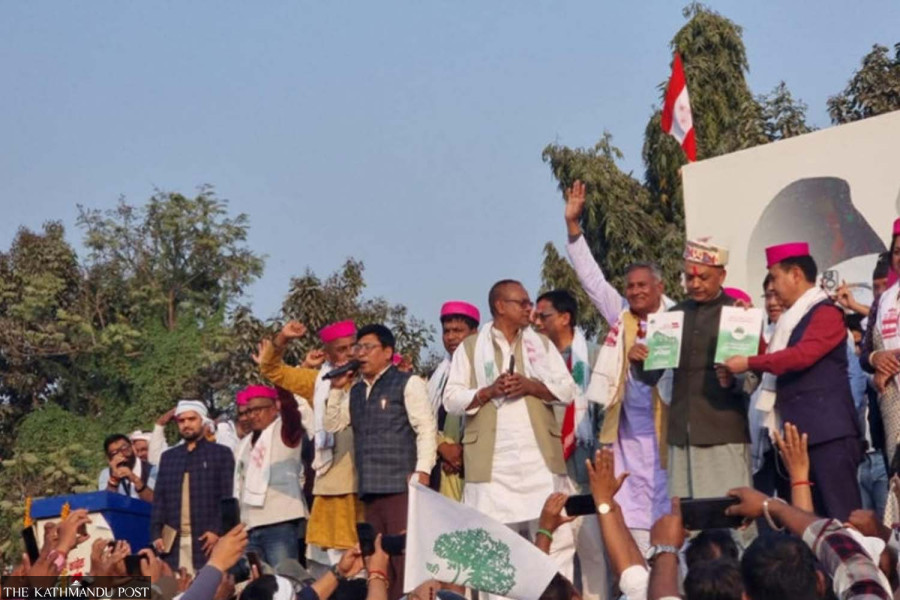
bookmark
Post Report
Published at : February 19, 2026
Updated at : February 19, 2026 06:42
The Nepali Congress on Wednesday unveiled its election manifesto called “Pratigya Patra” (a commitment charter), presenting a 10-point plan focused on good governance, economic growth and citizens’ dignity.
Party president Gagan Thapa said the document is both a policy roadmap and an appeal to voters in Madhesh Province, a region considered crucial in the March 5 polls.
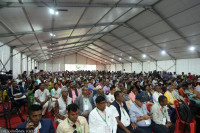
The Pratigya Patra, with the slogan ‘Prosperous Nepal, Dignified Nepalis' was made public at an event in Janakpur. The theme of the paper sounds similar to the slogan championed by the CPN-UML for some time as ‘Prosperous Nepal, Happy Nepali’.
The document outlines the goals the party intends to achieve over the next five years. With its message of “transformed Congress, transformed nation,” the party has pledged to build a governance system that places citizens at the centre.
According to the charter, the party’s idea of Nepal prioritises the dignity and self-respect of every individual. It commits to ending all forms of discrimination based on caste, religion, gender, and region, and to building a society where every citizen can live with pride and confidence.
The party has also promised to strictly enforce the rule of law, end privilege based on political power and access, and ensure that public services are free of irregularities and bureaucratic hurdles.
As part of its governance reform agenda, the party has committed to controlling corruption and eliminating delays in service delivery, with a long-term aim of enabling citizens to access services from home by improving the government’s delivery mechanism.
On the economic front, the charter emphasises strengthening of the private sector, encouraging wealth creation, and building an investment-friendly climate. It also highlights the importance of creating jobs within Nepal so that young people can see their future at home rather than seeking opportunities abroad.
Agriculture is presented as a dignified and modern profession in the party’s plan, with commitments to improving the use of technology, market access, and productivity—aiming to build a farmer-centred economy capable of feeding the population and promoting Nepal internationally. Tourism, energy development, and infrastructure expansion are identified as key drivers of national prosperity.
The party has also pledged to expand the state’s responsibility in education and healthcare. It promises a system in which no one becomes poor by paying for expensive medical treatment, and the introduction of a reliable, high-quality health insurance programme. In education, the vision emphasises accessible, high-quality learning that does not impose a financial burden on parents while producing competitive human resources.
The document also underscores the importance of embracing modernity while taking pride in Nepal’s indigenous languages, culture, and heritage. It commits to maintaining national dignity in international forums through a balanced foreign policy.
With 32 first-past-the-post seats at stake and nearly 20 percent of the country’s total population residing in Madhesh, the province carries significant electoral weight. The proportional representation votes from Madhesh alone could substantially boost a party’s total number of seats in Parliament. As a result, almost all major parties have turned their focus on the province in the run-up to the election.
For the Congress, the emphasis on Madhesh appears particularly pronounced. Party president Thapa is himself contesting the House of Representatives election from Sarlahi-4, underscoring the importance the party attaches to the province.
The decision to unveil the party’s manifesto in Janakpur—despite earlier indications that it would be released at the party’s central office in Lalitpur—further signals that the province is being viewed as a crucial electoral base in the March 5 polls.
Addressing the gathering, Thapa sought to connect emotionally with voters, saying he had come to Madhesh not as an outsider, but as a ‘son of Madhesh’. In an effort to appeal to the local electorate, he said that although Madheshi blood might not run through his veins, “the dream of Madhesh lives in my heart”.
“I will not pretend that Madheshi blood flows in my veins,” Thapa said. “But in my heart lives the dream of Durganand Jha.”
Durganand Jha is remembered as a figure associated with Nepal’s democratic movement. In 1962, when King Mahendra visited the Janaki temple in Janakpur, Jha tried to assassinate him by throwing a bomb—an incident often cited in discussions on resistance against the Panchayat regime.
Thapa’s reference to Jha was widely seen as an attempt to invoke the history of political struggle and democratic aspirations linked to Madhesh ahead of the election.
Although the party chose to unveil its manifesto under a new name, several senior leaders were notably absent from the event.
However, Bimalendra Nidhi and Mahendra Yadav, two prominent figures who had previously rejected the party’s second special general convention held in January, were present at the Janakpur rally.
Both leaders are contesting the election from Dhanusha constituencies 3 and 4. Addressing the gathering, Nidhi and Yadav urged voters to hand the party a majority, calling for a government to be formed under Thapa's leadership, who was elected party president by the special general convention.
Addressing the rally, Nidhi urged people of Madhesh to vote for the Congress in order to safeguard federalism.
Addressing the party’s Pratiyaga Sabha, Nidhi warned that federalism is under threat. “This is not an ordinary election,” he said. “The constitution is at risk, democracy is at risk, and federalism is at risk. To protect these achievements, the Congress must win.”
The Congress has also announced that it will hold an open question-and-answer session to discuss the issues outlined in its election manifesto.
To provide further clarity and engage directly with the public on its election pledges, the party is organising an interaction titled ‘Our Pledges, Your Questions’ on Thursday in Kathmandu.
Thapa will respond to queries on the manifesto and the party’s broader vision. The party will unveil the full Pratiyga Patra, an elaboration of its vision-10 statement, on Thursday.

Most Read from Politics
Home Minister Sudan Gurung to visit India next week
Nepal’s climate diplomacy faces a test of delivery
Uproar in Nepal parliament over former chief justice’s unexplained detention
From the Himalayas to the islands, Nepal calls for a united climate response
Gagan Thapa wins Congress presidency with 94 percent of the vote
Editor's Picks

Constitutional Bench caught in seniority, ‘pick and choose’ dispute

A Dom boy’s long road to becoming a doctor

From blankets to handmade dolls, two foreign women bring comfort to flood survivors

News Analysis: When institutional defence exposes institutional fault lines

It’s a bird … it’s a plane … it’s the Indian ambassador’s farewell tweets
E-PAPER | October 11, 2026

×