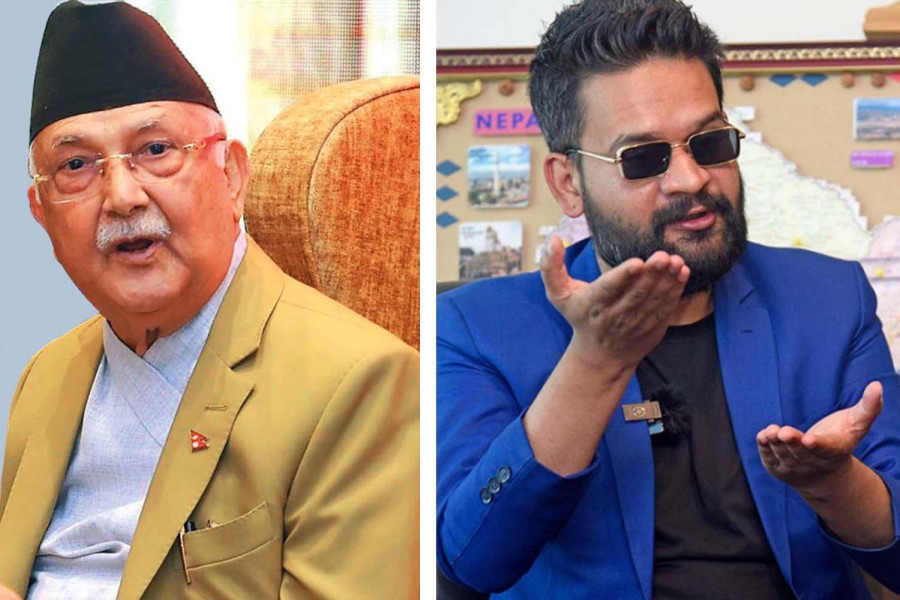
The CPN-UML has issued a 35-point appeal urging voters in Jhapa-5 to re-elect party chair KP Sharma Oli, as he faces tight competition from Balendra Shah, the Rastriya Swantantra Party senior leader.
The UML’s Jhapa-5 constituency committee on Saturday issued the appeal outlining the reasons Oli “needs to get elected”. It has claimed that the country needs Oli to safeguard the country’s sovereignty, strengthen democracy and end “blatant foreign interference”.
“The climate of fear the country has faced must come to an end, and peace and security must prevail. Oli must be elected to make this happen,” the appeal states. “We urge voters to support Oli to complete the development projects initiated in Jhapa-5 and to restore the rights taken away from the people.”
The document also argues that Oli’s leadership is necessary to revive the sluggish economy, energise the agricultural sector and move the country towards food self-sufficiency.
While the UML leadership says the appeal is the party chair’s commitment to his constituency, others take it as testimony that Oli is having a hard time securing his seat from Shah, the former Kathmandu mayor who is also the RSP’s prime ministerial face.
The September youth uprising and growing generational discontent are shaping an increasingly competitive race between Oli and Balen Shah, turning the constituency into one of the most closely watched battlegrounds of the election.
Yatis Ojha, a Gen-Z representative from Jhapa and a legal professional, argues that the UML's appeal suggests Oli is struggling to secure enough votes to win the election this time.
He said that even committed party supporters are considering voting for the UML under the proportional representation system while changing their choice in the first-past-the-post contest.
“We have found weak grounds to believe that UML chair Oli will secure sufficient votes this time. This commitment will have a sparse impact on the ground,” Ojha said. “Voters are particularly unhappy with him for his government’s role in suppressing the Gen Z movement. Even dedicated party cadres appear willing to support the party in the proportional system but are thinking of switching their vote in the direct election this time.”
UML leaders, who have long tried to vilify the Gen Z movement, say their party has never shied away from acknowledging the concerns voiced by the young protesters. “Our party only opposes arson and destruction from September 9, not the larger demands of the movement,” Min Bahadur Shahi, coordinator of the party’s election publicity committee, said in a press meeting.
As many as 19 people were killed on the first day of the movement on September 8. The following day, as people took to the streets to protest what they described as state repression, a further 58 people were killed in separate incidents, taking the death toll to 77.
The UML’s effort to whitewash Oli’s image does not seem to be bearing fruit. Santosh Dulal, a political activist based in Jhapa-5, says the appeal issued in support of Oli is unlikely to attract voters.
Dulal argues that voters can judge how a leader governs within five years, and that Oli—who has been elected repeatedly from Jhapa for almost the past 35 years—has not provided a compelling reason for voters to elect him again this time.
Even as he acknowledges that Jhapa saw infrastructure development during Oli’s tenure as prime minister, Dulal alleges that investment has also been made in some unnecessary projects in the district.
“It is unfortunate that while unnecessary infrastructure has been developed in Jhapa, many other parts of the country have yet to see meaningful development,” Dulal said. “For the sake of balanced national development, voters in Jhapa-5 appear to be thinking of changing their choice this time.”
However, not everyone in Jhapa believes Ojha and Dulal. Some local intellectuals note that while the ground has shifted, it’s not easy for Shah to beat Oli. They argue that Shah lacks the organisational base across the district while Oli’s network has expanded down to the grassroots.
Ram Bhandari, who teaches at Damak Multiple Campus, says that although some young people appear to be against Oli, it would be inaccurate to claim that the overall environment is firmly against him.
“It appears difficult for Oli to overcome Shah on social media,” Bhandari said. “But the reality on the ground is different.”




 23.1°C Kathmandu