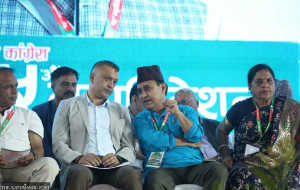
The Nepali Congress has ramped up poll preparations by endorsing an election mobilisation directive while other major political parties say the Election Commission’s code itself is sufficient. Yet others suggest they will introduce similar internal guidelines for the March 5 vote.
A virtual meeting of the Congress Central Working Committee on Sunday approved the election mobilisation directive, which instructs leaders and members to work from their assigned areas.
Clause 21 of the directive calls for a campaign commitment titled “My 21 days for the March 5 general election”, under which party members are expected to be actively engaged in canvassing for votes from February 13 to March 5, under the principle, ‘Serve where you are assigned.”
The directive also states that representatives deployed to the federal, provincial, district, and House or Representatives constituency levels must return to their respective districts, constituencies, municipalities, and wards after completing their assigned responsibilities and remain focused on local campaigning.
Except for those formally assigned duties elsewhere, all party office bearers and members across organisational levels have been instructed to concentrate their efforts within their own areas.
“An active member of one ward should not move to another ward; instead, they should work in their own ward with the slogan ‘Our ward, our victory,’” the directive reads. “Members of the party’s sister and well-wisher organisations are also expected to fulfil responsibilities accordingly.”
A party publishing its election mobilisation directives is unprecedented, said Congress central office member Dinesh Thapa Magar. Should there be any violation of the directives by the party candidates during campaigns, the disciplinary committee will take action against them, Magar added.
But the election code or directives of any political parties seldom get implemented, said Bikal Shrestha of the National Election Observation Committee. It is not that political parties do not follow such conduct but there are a lot of cases of their breaches, Shrestha said.
“As observers, we keep monitoring the election and have found that political parties breach such codes most of the time,” Shrestha said.
The Congress, in its directives, has highlighted three main issues, stressing that the election arena is not a battleground of enmity, but a grand democratic exercise of ideas and leadership.
The Nepali Congress has adopted a policy of making fair and constructive remarks about rival parties and their candidates. The party has instructed its candidates and campaigners to refrain from hateful, provocative, or inflammatory expressions.
On the other hand, the CPN-UML says it has no intention of issuing directives separately.
“Our party candidates will follow the code of conduct [enforced by the Election Commission],” said Min Bahadur Shahi, head of the UML publicity department.
Congress Vice-president Pushpa Bhusal argues that the code of conduct set by the commission is different from the party’s campaign directives. The Election Commission’s code of conduct is mandatory for all political parties and candidates to follow.
“The party also has various campaign committees across the country, which the Election Commission’s code of conduct does not regulate. In order to monitor all party committees and cadres during the campaign, the party introduced the election mobilisation directives,” Bhusal said.
The Nepali Communist Party (NCP) has no election directives of its own for its candidates but its intra-party directive serves the purpose.
“During this election our main objective is to maintain economic transparency,” said party spokesperson Agni Prasad Sapkota.
“Economic transparency during the election is one of the benchmarks of good governance, which our party candidates should follow. Making no big promises but sticking to workable policies is our main directive.”




 14.81°C Kathmandu