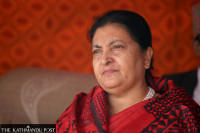
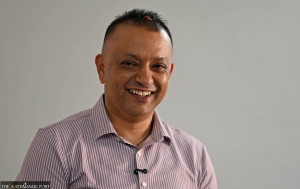
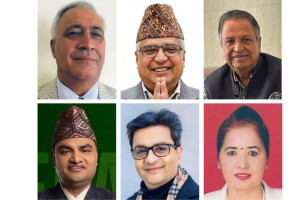
Madhav Nepal running from Rautahat for sixth parliamentary term
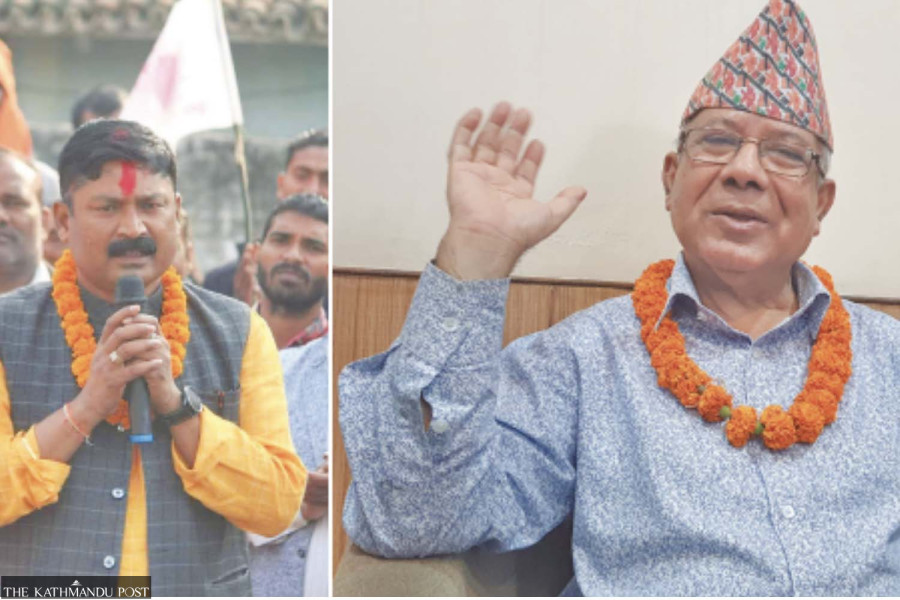
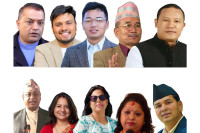
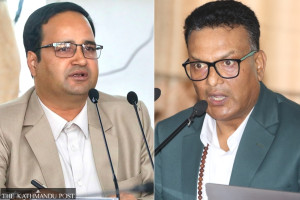
His candidacy has been a topic of local debate as voters and political activists deal with questions not just of development and governance, but of legal accountability and integrity. Candidates Ajay Kumar Gupta and Madhav Kumar Nepal Post Photos
On a sweltering June afternoon last year, a crowd of supporters gathered to greet chairman of the then CPN (Unified Socialist), Madhav Kumar Nepal, at its party office in Gaur.
The former prime minister, who has won multiple elections from his Rautahat constituency, was the chief guest. While party leaders expressed their views, his cell phone rang continuously. When Nepal finally received the call, it sent ripples through the event and beyond—a corruption case had been filed against him by the country’s anti-graft body.
Within hours, the campaign rally dispersed, and he returned to Kathmandu under a cloud of controversy that now looms over his fresh bid for the House of Representatives elections.
The Commission for Investigation of Abuse of Authority (CIAA) on June 5, 2025 had filed the corruption case at the Special Court against Nepal, accusing him of facilitating the illegal sale of land exempt of government ceilingto Patanjali Yogpeeth and Ayurveda Company Nepal during his tenure as prime minister from May 25, 2009 to February 6, 2011.
The anti-graft body has sought a prison sentence of 10 to 14 years and recovery of Rs185.85 million in damages and fines. Nepal, currently the joint coordinator of the Nepali Communist Party, was detained and released on bail.
Nepal, aged 72, is a household name in Nepali politics. He has been elected multiple times to the legislature, serving as a member of the National Assembly in early 1990s and later winning several terms in the lower house. In past elections, he won from Rautahat-1, with strong backing in this rural constituency bordering India.
Nepal contested the parliamentary elections from Rautahat-1 in 1999, 2008, 2013, and 2022. He is back in the race in Rautahat-1, facing an intensely competitive field of rivals from major national parties this time.
His candidacy has been a topic of local debate as voters and political activists wrestle with questions not just of development and governance, but of legal accountability and integrity.
This time, Nepal is facing a four-way contest against CPN-UML leader Ajay Kumar Gupta, Nepali Congress candidate Anil Kumar Jha, Janata Samajbadi Party’s Yogendra Yadav and Rastriya Swatantra Party nominee Rajesh Chaudhary. Gupta was defeated by Nepal in both the 2013 and 2022 elections.
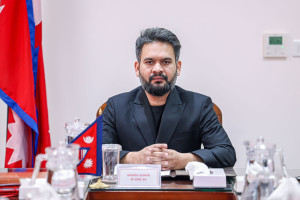
Jha, a former minister, had won the 2017 election from this constituency representing the Rastriya Janata Party. More recently, the Sadbhawana Party chair joined the Congress just a day before filing his candidacy in the same constituency.
Jha entered politics in 1990 and was elected to the Constituent Assembly through the proportional representation system in 2008. He has served twice as a minister in the federal government. Jha is confident of his electoral victory, arguing that the Congress has a strong organisational base there.
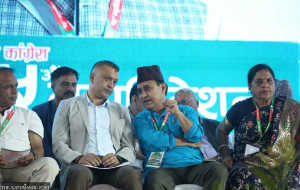
Both members of the provincial assembly and chiefs of two local units in the constituency are from the Nepali Congress, which, Jha says, bolsters his prospects. He further claims that the impact of Congress President Gagan Kumar Thapa standing in the neighbouring Sarlahi-4 constituency will also be felt in Rautahat-1.
UML candidate Gupta is in the race as one of his party’s strongest candidates. Having begun his political career with Madhesh-based parties, he served two terms as mayor of Gaur Municipality. In the 2013 election, when he ran for the Madhesi Janadhikar Forum Loktantrik, Gupta lost narrowly to Nepal of the then UML by just 338 votes.
In the 2022 election, Nepal, backed by an electoral alliance with the Nepali Congress, defeated Gupta by a margin of 6,600 votes. This time, with no alliances in place, Gupta says he is confident of victory. He has made a permanent solution to the chronic flooding in the area as his campaign plank.
Another contender, Chaudhary had contested the 2017 provincial assembly election as a congress candidate. After being denied a party ticket in 2022, he ran as an independent. This time, he is in the race representing the RSP. In the 2022 election, the RSP fared poorly in this constituency, with its candidate Suryadev Koirala securing just 163 votes and forfeiting his deposit. With four major candidates in the fray, the contest is expected to be closely fought. In 2022, Nepal won the seat with 33,522 votes, riding on an alliance with the Congress and the CPN (Maoist Centre).
Yogendra Yadav, running for the Janata Samajbadi Party Nepal, is also considered a strong candidate. A former minister, Yadav had won the provincial assembly election in 2017. In the 2022 provincial polls, he finished third with 5,729 votes. This time, he has shifted his focus from the provincial assembly to the House of Representatives. Locals say the result could tilt in his favour if he succeeds in consolidating votes in areas where his community has a numerical advantage.
However, Sheikh Pharman of Saruatha, citing past election results, said the influence of caste-based voting appears limited in the constituency. “It would be wrong to say caste has no influence here. Our Muslim community also has a significant presence. But when it comes to voting, people look at the individual rather than caste,” he said.
The decision of former prime minister Nepal to remain in the electoral race despite facing corruption charges has become a common topic of public debate. Having won previous elections riding electoral alliances, many expected Nepal to withdraw from the contest after a case was registered against him at the Special Court.
Contrary to those expectations, Nepal continued to visit his home district regularly, holding meetings with party cadres and remaining active in organisational work even as the legal process moved forward. According to his close associates, sustained pressure from party leaders and supporters persuaded him to contest the election. Nepal maintains that he has delivered substantial development to the district and has therefore sought another mandate, potentially his final.
Nepal’s electoral journey has seen both emphatic victories and notable defeats. In the first Constituent Assembly election in 2008, he contested simultaneously from Rautahat-6 (now Rautahat-4) and Kathmandu-2, losing both constituencies. In 2008, he was defeated by an independent candidate, Baban Singh, who stunned the political establishment by registering victory while remaining underground despite facing criminal cases in both Nepal and India.
Having won Rautahat-1 in 1999, Nepal chose to abandon the constituency in 2008 and instead contested from Rautahat-6, widely regarded as a UML stronghold, as well as from Kathmandu-2. He was defeated in Kathmandu-2 by Jhakku Subedi. The twin defeats, including one from a UML bastion, came as a major setback. Following the losses, Nepal was nominated by the President to the Assembly.
In the 1999 election, when he was the UML general secretary, Nepal had secured a commanding victory in Rautahat-1 with 22,868 votes, while Nepali Congress candidate Bajrakishor Singh garnered 10,757 votes. Despite that decisive win, Nepal shifted constituencies in 2008 to Rautahat-6, an area with a large hill-origin population. In the 2013 second Constituent Assembly election, he won Rautahat-6 by a narrow margin of 338 votes, securing 8,361 votes. Nepal also won from Kathmandu-2 in the same election but later vacated the seat.
In the 2017 election, following the UML-Maoist alliance, Nepal fielded Maoist Centre candidate Satyanarayan Bhagat in his constituency while he contested from Kathmandu-2 and won.
Despite the alliance, Bhagat finished third in Rautahat-1 with 12,331 votes. The seat was won by Anil Jha of the Rastriya Janata Party with 21,472 votes, while Congress candidate Krishna Prasad Yadav, now the chief minister of Madhesh Province, secured 15,874 votes.
In Rautahat-1, the organisational strength of both the then CPN (Unified Socialist) and the CPN (Maoist Centre) is considered formidable. The chiefs of three local units in the constituency are from the Nepali Communist Party, while 29 of the 41 ward chairpersons also belong to the party. This gives Nepal the confidence for victory.
Political analysts say the corruption charges are bound to shrink his space. Rautahat-based political analyst Binda Sahani says: “The political situation is volatile. In such a context, it is difficult to predict where anyone’s politics will go.”




 14.69°C Kathmandu